AQA · A-Level · History
Course version: 7042 · Version from Sept 2017
Britain, c1783–1885 – Political change and social reform, 1832-1846…
Full specification wording
1F Industrialisation and the people: Britain, c1783–1885 – Political change and social reform, 1832-1846 (A-level only): The Conservative response to change: finance, administration and the economy; the Bank Charter Act; trade and business reform
Sir Robert Peel's Conservative government (1841–1846) responded to economic instability through sweeping administrative and financial reforms designed to stimulate trade and restore confidence.
Checked against the AQA 7042 specification (opens in a new tab) on .
- Point 4 of 6
- 4 key terms
Study notes
From the checked teaching notes for this specification point.
The idea
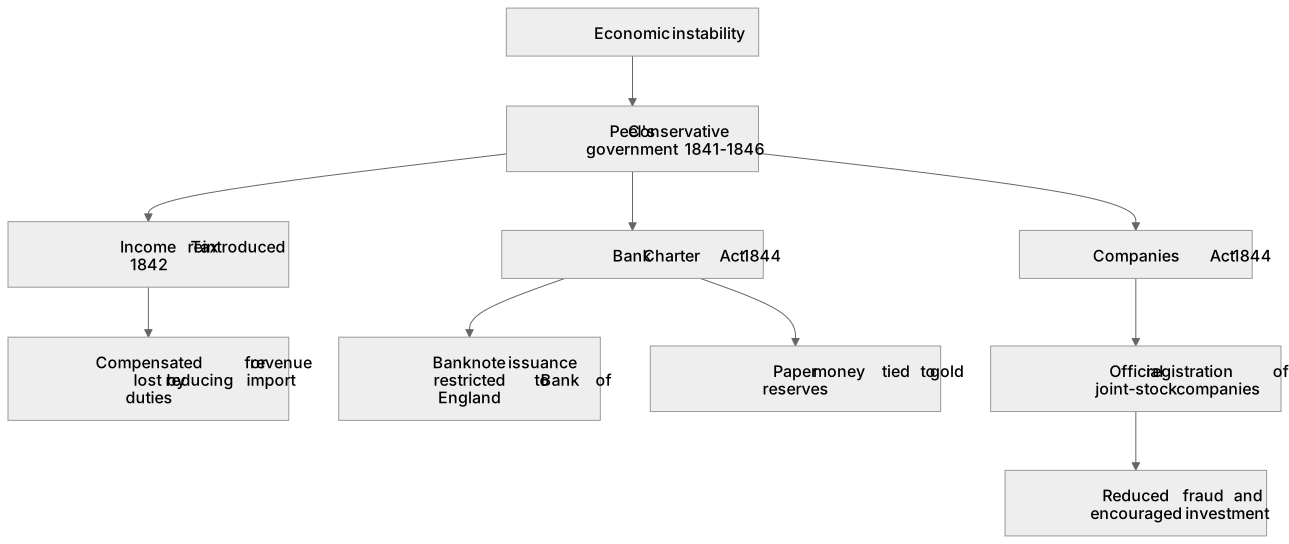
Sir Robert Peel's Conservative government (1841–1846) responded to economic instability through sweeping administrative and financial reforms designed to stimulate trade and restore confidence. To stabilise the economy, Peel reintroduced the peacetime Income Tax in 1842, which compensated for revenue lost by drastically reducing import duties on raw materials and food. The pivotal 1844 Bank Charter Act restricted the issuance of banknotes to the Bank of England, tying paper money strictly to gold reserves to prevent inflation and banking collapses. Furthermore, business reform was advanced through the 1844 Companies Act, which regulated corporate administration by requiring the official registration of joint-stock companies, thereby reducing fraud and encouraging investment.
What earns the marks
- Analyse how Peel's reintroduction of the Income Tax in 1842 facilitated broader free trade policies by offsetting the reduction in indirect taxes.
- Evaluate the significance of the 1844 Bank Charter Act in stabilising the British financial system and establishing the dominance of the Bank of England.
- Assess the impact of the 1844 Joint Stock Companies Act on business administration, specifically how mandatory registration curbed fraudulent enterprises.
- Examine the overarching Conservative strategy of using economic and administrative efficiency to address social unrest and preserve established institutions.
Common mistakes and how to put them right
Claiming the Bank Charter Act deregulated banking.
Put it right: It actually imposed strict regulations by tying the issue of banknotes to gold reserves and limiting the powers of regional banks.
Assuming Peel's financial reforms were solely about the Corn Laws.
Put it right: His budgets of 1842 and 1845 systematically dismantled hundreds of tariffs across various trades to stimulate the broader economy.
Confusing the 1844 Companies Act with later limited liability legislation.
Put it right: The 1844 Act introduced registration and administrative oversight but did not yet grant limited liability to shareholders.
Exam tips
- Link Peel's financial policies directly to his political aims; argue whether his economic reforms were intended to alleviate working-class distress and prevent revolution.
- Use the Bank Charter Act as a prime example of the Conservative government's commitment to the gold standard and financial orthodoxy.
- When evaluating the Conservative response to change, contrast their proactive economic and administrative reforms with their more cautious approach to constitutional change.
Try the lesson
The start of the 1F Industrialisation and the people: Britain, c1783–1885 – Political change and social reform, 1832-1846 (A-level only): The Conservative response to change: finance, administration and the economy; the Bank Charter Act; trade and business reform lesson, made from checked teaching notes for this specification point.
Have a go first
What was the primary purpose of the Bank Charter Act introduced by Sir Robert Peel's Conservative government in 1844?
Listen
Sir Robert Peel's Conservative government (1841–1846) responded to economic instability through sweeping administrative and financial reforms designed to stimulate trade and restore confidence. To stabilise the economy, Peel reintroduced the peacetime Income Tax in 1842, which compensated for revenue lost by drastically reducing import duties on raw materials and food. The pivotal 1844 Bank Charter Act restricted the issuance of banknotes to the Bank of England, tying paper money strictly to gold reserves to prevent inflation and banking collapses. Furthermore, business reform was advanced through the 1844 Companies Act, which regulated corporate administration by requiring the official registration of joint-stock companies, thereby reducing fraud and encouraging investment. A strong answer earns marks for these points. Analyse how Peel's reintroduction of the Income Tax in 1842 facilitated broader free trade policies by offsetting the reduction in indirect taxes. Evaluate the significance of the 1844 Bank Charter Act in stabilising the British financial system and establishing the dominance of the Bank of England. Assess the impact of the 1844 Joint Stock Companies Act on business administration, specifically how mandatory registration curbed fraudulent enterprises. Examine the overarching Conservative strategy of using economic and administrative efficiency to address social unrest and preserve established institutions. Exam tip: Link Peel's financial policies directly to his political aims; argue whether his economic reforms were intended to alleviate working-class distress and prevent revolution.
See it
Put the events in order
Put these events in the order they happened, earliest first.
- 1. Peel reintroduced the peacetime Income Tax
- 2. Peel's budget dismantled hundreds of tariffs across trades
- 3. Bank Charter Act restricted banknote issuance to the Bank of England
Key words
Say what each word means before you turn the card.
Free trade
Try answering aloud or in your head before turning the card.
Administrative reform
Try answering aloud or in your head before turning the card.
Conservative statecraft
Try answering aloud or in your head before turning the card.
Bank Charter Act
Try answering aloud or in your head before turning the card.
See every definition
- Free trade
- Policies that reduce import duties on raw materials and food, which Peel's reintroduced Income Tax compensated for in lost revenue.
- Administrative reform
- Sweeping changes designed to stimulate trade and restore confidence, advanced through the 1844 Companies Act regulating corporate administration.
- Conservative statecraft
- A strategy of using economic and administrative efficiency to address social unrest and preserve established institutions.
- Bank Charter Act
- The pivotal 1844 measure that restricted the issuance of banknotes to the Bank of England, tying paper money strictly to gold reserves.
Label the diagram
Some boxes have lost their names. Pick the right name for each number.
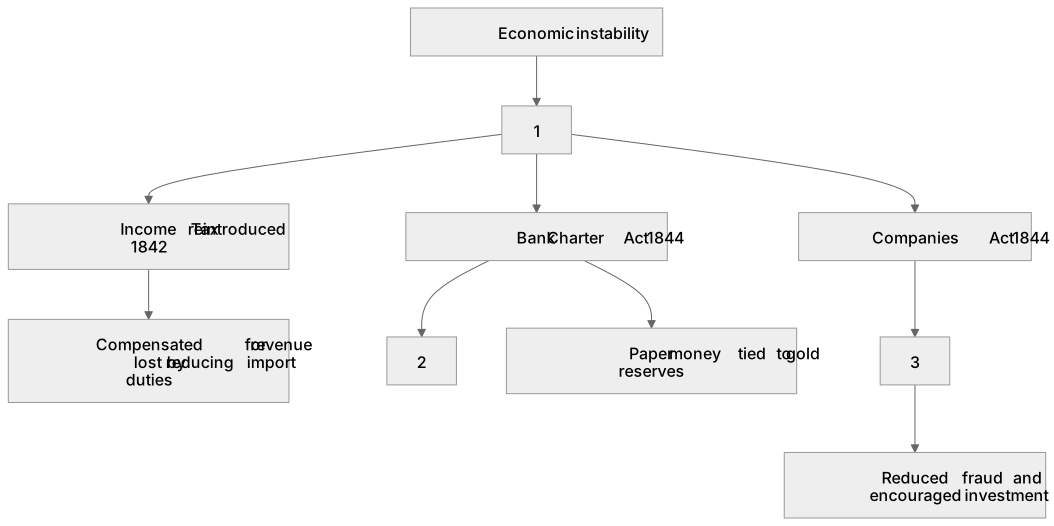
1Box 1
2Box 2
3Box 3
There is more to this lesson
The full lesson goes on to check your understanding and help you earn the marks. Create a free account to carry on, with your progress saved.
A week of Premium from your first lesson · Then the free plan continues · No card, no charge
Test your understanding of 1F Industrialisation and the people: Britain, c1783–1885 – Political change and social reform, 1832-1846 (A-level only): The Conservative response to change: finance, administration and the economy; the Bank Charter Act; trade and business reform
Active recall beats re-reading. Take an instant quiz now to test what you’ve learned and lock it into long-term memory.
A week of Premium from your first lesson · Then the free plan continues · No card, no charge