AQA · A-Level · History
Course version: 7042 · Version from Sept 2017
Britain, c1783–1885 – Political change and social reform, 1832-1846…
Full specification wording
1F Industrialisation and the people: Britain, c1783–1885 – Political change and social reform, 1832-1846 (A-level only): Pressure for change: Chartism; Irish radicalism; the Anti-Poor Law League; the Anti-Corn Law League; social reform campaigners including Shaftesbury and Chadwick
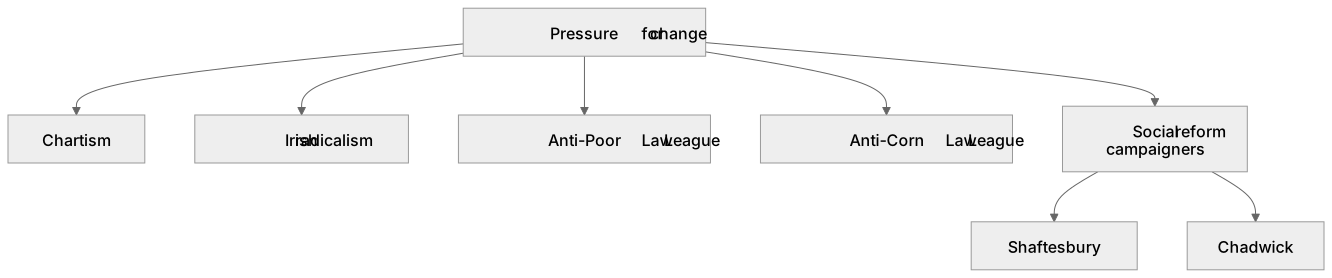
During the 1830s and 1840s, Britain faced intense pressure for change from diverse extra-parliamentary movements.
Checked against the AQA 7042 specification (opens in a new tab) on .
- Point 3 of 6
- 4 key terms
Study notes
From the checked teaching notes for this specification point.
The idea
During the 1830s and 1840s, Britain faced intense pressure for change from diverse extra-parliamentary movements. Chartism demanded democratic political reform through its Six Points, while Irish radicalism, led by Daniel O'Connell, campaigned to repeal the Act of Union. The Anti-Poor Law League fiercely opposed the harsh 1834 workhouse system, particularly in the industrial North. Conversely, the middle-class Anti-Corn Law League successfully utilised modern campaigning methods to achieve free trade in 1846. Individual social reform campaigners also drove change: Lord Shaftesbury championed factory and mining legislation to protect child workers, whilst Edwin Chadwick's pioneering reports exposed public health crises, leading to the 1848 Public Health Act.
What earns the marks
- Evaluate the differing methods and success rates of middle-class movements, such as the Anti-Corn Law League, versus working-class movements like Chartism.
- Assess the impact of Daniel O'Connell's Repeal Association on British politics and the government's response to Irish radicalism.
- Analyse the motivations behind the Anti-Poor Law League and why it struggled to maintain momentum compared to other contemporary movements.
- Examine the specific contributions of Lord Shaftesbury to factory reform, such as the Ten Hours Act, and Edwin Chadwick to sanitary reform.
Common mistakes and how to put them right
Confusing the aims of the Anti-Poor Law League with the Anti-Corn Law League.
Put it right: The former opposed the 1834 workhouse system, while the latter sought free trade by repealing grain tariffs.
Assuming Chartism was a complete failure.
Put it right: While it failed to achieve its Six Points immediately, it heavily influenced subsequent political reforms and working-class consciousness.
Treating social reformers as a unified group.
Put it right: Shaftesbury was an evangelical Tory aristocrat motivated by religion, whereas Chadwick was a utilitarian focused on administrative efficiency.
Exam tips
- Compare the organisational structures of the Anti-Corn Law League and Chartism to explain their differing levels of immediate success.
- Use specific examples of Chadwick's utilitarian approach, such as his 1842 Sanitary Report, to illustrate the shift towards government intervention in public health.
- When discussing Irish radicalism, explicitly link O'Connell's campaigns to the broader context of British political instability during this period.
Try the lesson
The start of the 1F Industrialisation and the people: Britain, c1783–1885 – Political change and social reform, 1832-1846 (A-level only): Pressure for change: Chartism; Irish radicalism; the Anti-Poor Law League; the Anti-Corn Law League; social reform campaigners including Shaftesbury and Chadwick lesson, made from checked teaching notes for this specification point.
Have a go first
Which area of social reform was the primary focus of Edwin Chadwick's campaigning during the 1830s and 1840s?
Listen
During the 1830s and 1840s, Britain faced intense pressure for change from diverse extra-parliamentary movements. Chartism demanded democratic political reform through its Six Points, while Irish radicalism, led by Daniel O'Connell, campaigned to repeal the Act of Union. The Anti-Poor Law League fiercely opposed the harsh 1834 workhouse system, particularly in the industrial North. Conversely, the middle-class Anti-Corn Law League successfully utilised modern campaigning methods to achieve free trade in 1846. Individual social reform campaigners also drove change: Lord Shaftesbury championed factory and mining legislation to protect child workers, whilst Edwin Chadwick's pioneering reports exposed public health crises, leading to the 1848 Public Health Act. A strong answer earns marks for these points. Evaluate the differing methods and success rates of middle-class movements, such as the Anti-Corn Law League, versus working-class movements like Chartism. Assess the impact of Daniel O'Connell's Repeal Association on British politics and the government's response to Irish radicalism. Analyse the motivations behind the Anti-Poor Law League and why it struggled to maintain momentum compared to other contemporary movements. Examine the specific contributions of Lord Shaftesbury to factory reform, such as the Ten Hours Act, and Edwin Chadwick to sanitary reform. Exam tip: Compare the organisational structures of the Anti-Corn Law League and Chartism to explain their differing levels of immediate success.
See it
Key words
Say what each word means before you turn the card.
Extra-parliamentary opposition
Try answering aloud or in your head before turning the card.
Chartism
Try answering aloud or in your head before turning the card.
Social reform campaigners
Try answering aloud or in your head before turning the card.
Anti-Poor Law League
Try answering aloud or in your head before turning the card.
See every definition
- Extra-parliamentary opposition
- Pressure for change from diverse movements outside Parliament, such as Chartism, Irish radicalism, the Anti-Poor Law League and the Anti-Corn Law League.
- Chartism
- A movement that demanded democratic political reform through its Six Points.
- Social reform campaigners
- Individual campaigners such as Shaftesbury and Chadwick who drove change, championing factory and mining legislation and exposing public health crises.
- Anti-Poor Law League
- A movement that fiercely opposed the harsh 1834 workhouse system, particularly in the industrial North.
Label the diagram
Some boxes have lost their names. Pick the right name for each number.
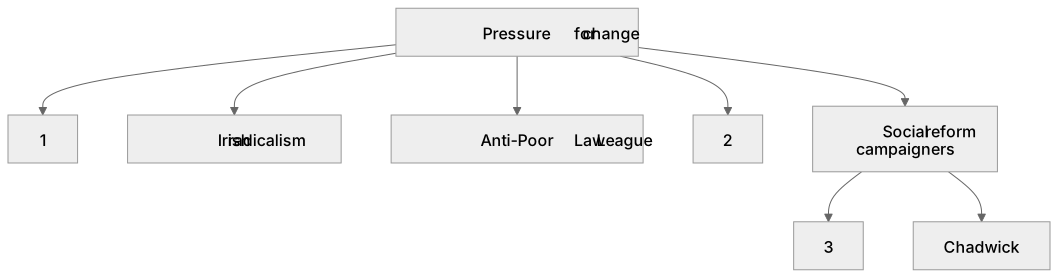
1Box 1
2Box 2
3Box 3
There is more to this lesson
The full lesson goes on to check your understanding and help you earn the marks. Create a free account to carry on, with your progress saved.
A week of Premium from your first lesson · Then the free plan continues · No card, no charge
Test your understanding of 1F Industrialisation and the people: Britain, c1783–1885 – Political change and social reform, 1832-1846 (A-level only): Pressure for change: Chartism; Irish radicalism; the Anti-Poor Law League; the Anti-Corn Law League; social reform campaigners including Shaftesbury and Chadwick
Active recall beats re-reading. Take an instant quiz now to test what you’ve learned and lock it into long-term memory.
A week of Premium from your first lesson · Then the free plan continues · No card, no charge