AQA · A-Level · History
Course version: 7042 · Version from Sept 2017
Britain, c1783–1885 – Pressure for change, c1783–1812: Economic…
Full specification wording
1F Industrialisation and the people: Britain, c1783–1885 – Pressure for change, c1783–1812: Economic developments: industrialisation; the growth of cotton and other industries; changes in power; the condition of agriculture
Between 1783 and 1812, Britain experienced rapid economic developments driven by early industrialisation.
Checked against the AQA 7042 specification (opens in a new tab) on .
- Point 3 of 6
Study notes
From the checked teaching notes for this specification point.
The idea
Between 1783 and 1812, Britain experienced rapid economic developments driven by early industrialisation. The growth of the cotton industry was central, transitioning from a domestic system to factory-based production, exemplified by Arkwright's water frame and Crompton's spinning mule. Other industries, such as coal and iron, expanded simultaneously to meet new manufacturing demands. Crucial to this was the change in power sources; reliance on water and wind shifted towards steam power following Watt's rotary steam engine, allowing factories to relocate away from rivers. Meanwhile, the condition of agriculture transformed through enclosure and improved crop rotations, increasing yields to feed the growing urban workforce despite wartime disruptions.
What earns the marks
- Explain the transition from the domestic system to factory production in the cotton industry.
- Assess the impact of technological innovations, such as the rotary steam engine, on the location and scale of manufacturing.
- Analyse the symbiotic growth of other industries, particularly coal mining and iron smelting, in supporting industrialisation.
- Evaluate the condition of agriculture, noting how enclosure and new farming techniques increased productivity to sustain urban populations.
Common mistakes and how to put them right
Assuming steam power completely replaced water power by 1812.
Put it right by noting that water remained the dominant power source for many mills well into the nineteenth century.
Treating the agricultural and industrial revolutions as separate events.
Put it right by explaining they were deeply interconnected, with agricultural surpluses enabling urban industrial growth.
Overstating the decline of agriculture.
Put it right by recognising that agriculture remained the largest employer and experienced significant growth and modernisation during this period.
Exam tips
- Use specific technological innovations, like Watt's steam engine or Cort's puddling process, to illustrate the shift in power and industrial growth.
- Link the growth of the cotton industry directly to the expansion of other sectors, such as the demand for coal and iron.
- When discussing agriculture, evaluate how the Napoleonic Wars artificially inflated grain prices, affecting the overall condition of the sector.
Try the lesson
The start of the 1F Industrialisation and the people: Britain, c1783–1885 – Pressure for change, c1783–1812: Economic developments: industrialisation; the growth of cotton and other industries; changes in power; the condition of agriculture lesson, made from checked teaching notes for this specification point.
Have a go first
Which significant development in power generation most facilitated the expansion of the factory system away from fast-flowing rivers during the late eighteenth century?
Listen
Between 1783 and 1812, Britain experienced rapid economic developments driven by early industrialisation. The growth of the cotton industry was central, transitioning from a domestic system to factory-based production, exemplified by Arkwright's water frame and Crompton's spinning mule. Other industries, such as coal and iron, expanded simultaneously to meet new manufacturing demands. Crucial to this was the change in power sources; reliance on water and wind shifted towards steam power following Watt's rotary steam engine, allowing factories to relocate away from rivers. Meanwhile, the condition of agriculture transformed through enclosure and improved crop rotations, increasing yields to feed the growing urban workforce despite wartime disruptions. A strong answer earns marks for these points. Explain the transition from the domestic system to factory production in the cotton industry. Assess the impact of technological innovations, such as the rotary steam engine, on the location and scale of manufacturing. Analyse the symbiotic growth of other industries, particularly coal mining and iron smelting, in supporting industrialisation. Evaluate the condition of agriculture, noting how enclosure and new farming techniques increased productivity to sustain urban populations. A common slip: Assuming steam power completely replaced water power by 1812. Instead, noting that water remained the dominant power source for many mills well into the nineteenth century. Exam tip: Use specific technological innovations, like Watt's steam engine or Cort's puddling process, to illustrate the shift in power and industrial growth.
See it
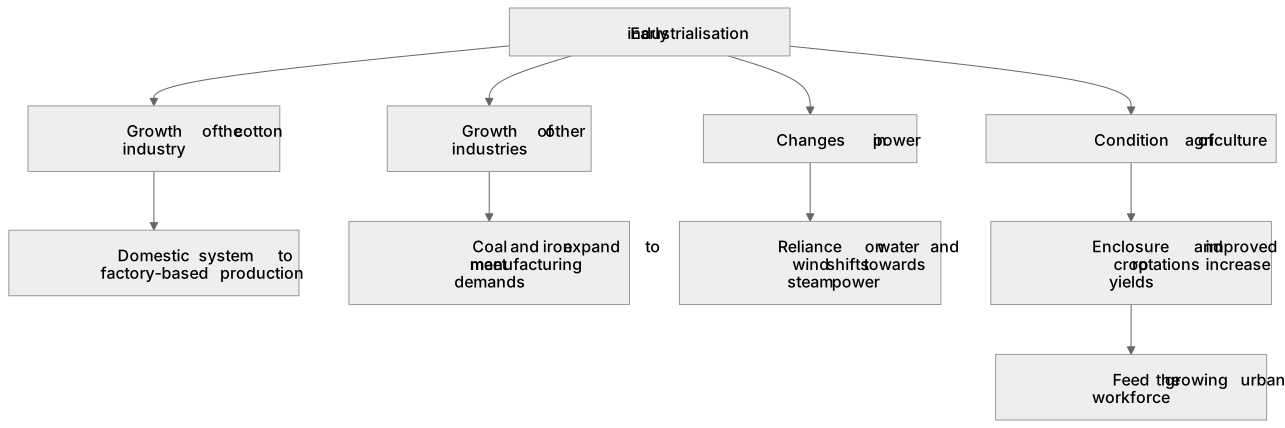
Label the diagram
Some boxes have lost their names. Pick the right name for each number.
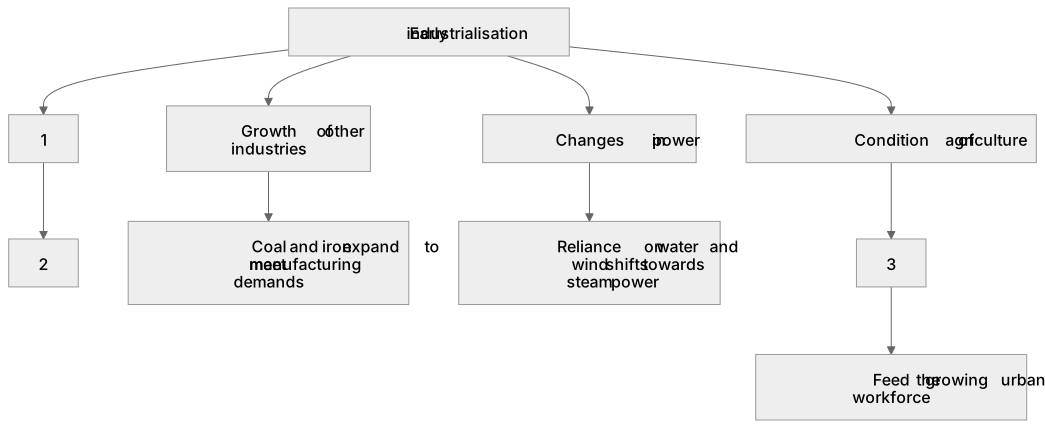
1Box 1
2Box 2
3Box 3
There is more to this lesson
The full lesson goes on to check your understanding and help you earn the marks. Create a free account to carry on, with your progress saved.
A week of Premium from your first lesson · Then the free plan continues · No card, no charge
Test your understanding of 1F Industrialisation and the people: Britain, c1783–1885 – Pressure for change, c1783–1812: Economic developments: industrialisation; the growth of cotton and other industries; changes in power; the condition of agriculture
Active recall beats re-reading. Take an instant quiz now to test what you’ve learned and lock it into long-term memory.
A week of Premium from your first lesson · Then the free plan continues · No card, no charge