AQA · A-Level · History
Course version: 7042 · Version from Sept 2017
Britain, c1783–1885 – Pressure for change, c1783–1812: Government: Pitt…
Full specification wording
1F Industrialisation and the people: Britain, c1783–1885 – Pressure for change, c1783–1812: Government: Pitt the Younger as Prime Minister and his successors; Pitt's relationship with the King; the 1784 election; reform of finance, administration and trade
William Pitt the Younger became Prime Minister in 1783, initiating a period of significant governmental reform.
Checked against the AQA 7042 specification (opens in a new tab) on .
- Point 2 of 6
- 4 key terms
Study notes
From the checked teaching notes for this specification point.
The idea
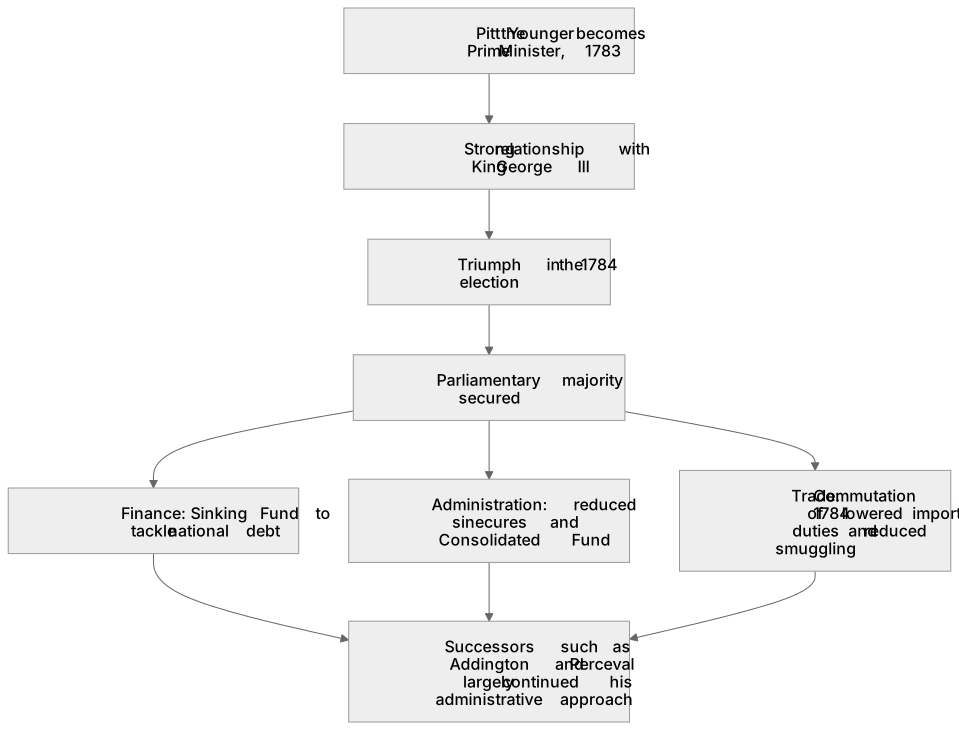
William Pitt the Younger became Prime Minister in 1783, initiating a period of significant governmental reform. His initial survival depended heavily on his strong relationship with King George III, who despised the Fox-North coalition. This royal backing was crucial for Pitt's triumph in the 1784 election, which secured his parliamentary majority. In office, Pitt implemented vital reforms: he tackled national debt through the Sinking Fund (finance), reduced sinecures and established the Consolidated Fund to streamline government efficiency (administration), and reduced smuggling by lowering import duties via the Commutation Act of 1784 (trade). His successors, such as Addington and Perceval, largely continued his administrative approach.
What earns the marks
- Assess the importance of George III's support in Pitt the Younger's appointment and his survival of the 'mince-pie administration'.
- Explain the significance of the 1784 election in consolidating Pitt's power and breaking the Whig dominance.
- Evaluate Pitt's financial reforms, particularly the introduction of the Sinking Fund to manage the national debt.
- Analyse Pitt's administrative and trade reforms, such as the abolition of sinecures and the Commutation Act, in modernising government.
- Discuss the continuity and challenges faced by Pitt's successors, including Addington, Grenville, and Perceval.
Common mistakes and how to put them right
Claiming Pitt won the 1784 election solely through popular support.
Put it right by emphasising the decisive role of royal patronage and the King's influence in the Lords and pocket boroughs.
Stating that Pitt completely abolished sinecures immediately.
Put it right by explaining he allowed them to lapse upon the death of the holder to avoid compensating them.
Confusing Pitt's peacetime reforms with his wartime policies.
Put it right by distinguishing his financial and administrative successes from 1783 to 1793 from the later repressive measures during the French Wars.
Exam tips
- Use the Commutation Act of 1784 as a prime example of how Pitt successfully linked trade reform with increasing government revenue by reducing smuggling.
- When evaluating Pitt's success, explicitly weigh the importance of his own financial acumen against the advantage of having the King's unwavering support.
- Briefly mention how Pitt's successors struggled to match his authority, often relying on his administrative framework to manage the ongoing war effort.
Try the lesson
The start of the 1F Industrialisation and the people: Britain, c1783–1885 – Pressure for change, c1783–1812: Government: Pitt the Younger as Prime Minister and his successors; Pitt's relationship with the King; the 1784 election; reform of finance, administration and trade lesson, made from checked teaching notes for this specification point.
Have a go first
What was the primary significance of the 1784 general election for William Pitt the Younger?
Listen
William Pitt the Younger became Prime Minister in 1783, initiating a period of significant governmental reform. His initial survival depended heavily on his strong relationship with King George III, who despised the Fox-North coalition. This royal backing was crucial for Pitt's triumph in the 1784 election, which secured his parliamentary majority. In office, Pitt implemented vital reforms: he tackled national debt through the Sinking Fund (finance), reduced sinecures and established the Consolidated Fund to streamline government efficiency (administration), and reduced smuggling by lowering import duties via the Commutation Act of 1784 (trade). His successors, such as Addington and Perceval, largely continued his administrative approach. A strong answer earns marks for these points. Assess the importance of George III's support in Pitt the Younger's appointment and his survival of the 'mince-pie administration'. Explain the significance of the 1784 election in consolidating Pitt's power and breaking the Whig dominance. Evaluate Pitt's financial reforms, particularly the introduction of the Sinking Fund to manage the national debt. Analyse Pitt's administrative and trade reforms, such as the abolition of sinecures and the Commutation Act, in modernising government. A common slip: Claiming Pitt won the 1784 election solely through popular support. Instead, emphasising the decisive role of royal patronage and the King's influence in the Lords and pocket boroughs. Exam tip: Use the Commutation Act of 1784 as a prime example of how Pitt successfully linked trade reform with increasing government revenue by reducing smuggling.
See it
Key words
Say what each word means before you turn the card.
Royal prerogative and prime ministerial power
Try answering aloud or in your head before turning the card.
Financial and administrative modernisation
Try answering aloud or in your head before turning the card.
Electoral politics and patronage
Try answering aloud or in your head before turning the card.
Free trade and mercantilism
Try answering aloud or in your head before turning the card.
See every definition
- Royal prerogative and prime ministerial power
- Pitt's initial survival depended heavily on his strong relationship with King George III, whose royal backing was crucial for his triumph in the 1784 election.
- Financial and administrative modernisation
- Pitt tackled national debt through the Sinking Fund, reduced sinecures and established the Consolidated Fund to streamline government efficiency.
- Electoral politics and patronage
- The 1784 election secured Pitt's parliamentary majority, with royal patronage and the King's influence decisive rather than popular support alone.
- Free trade and mercantilism
- Pitt reduced smuggling by lowering import duties via the Commutation Act of 1784, linking trade reform with increasing government revenue.
Label the diagram
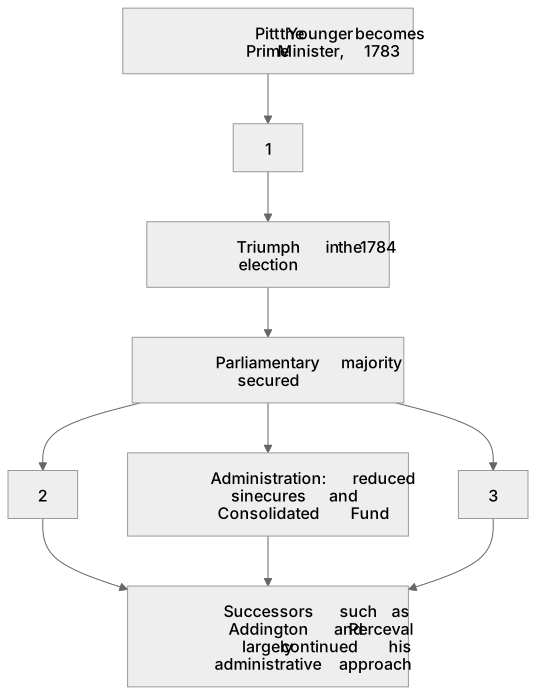
Some boxes have lost their names. Pick the right name for each number.
1Box 1
2Box 2
3Box 3
There is more to this lesson
The full lesson goes on to check your understanding and help you earn the marks. Create a free account to carry on, with your progress saved.
A week of Premium from your first lesson · Then the free plan continues · No card, no charge
Test your understanding of 1F Industrialisation and the people: Britain, c1783–1885 – Pressure for change, c1783–1812: Government: Pitt the Younger as Prime Minister and his successors; Pitt's relationship with the King; the 1784 election; reform of finance, administration and trade
Active recall beats re-reading. Take an instant quiz now to test what you’ve learned and lock it into long-term memory.
A week of Premium from your first lesson · Then the free plan continues · No card, no charge