AQA · A-Level · History
Course version: 7042 · Version from Sept 2017
Britain, c1783–1885 – Pressure for change, c1783–1812: Pressures on…
Full specification wording
1F Industrialisation and the people: Britain, c1783–1885 – Pressure for change, c1783–1812: Pressures on government: the political, economic and social impact of war; the condition of Britain by 1812
The French Revolutionary and Napoleonic Wars exerted unprecedented pressures on the British government.
Checked against the AQA 7042 specification (opens in a new tab) on .
- Point 6 of 6
Study notes
From the checked teaching notes for this specification point.
The idea
The French Revolutionary and Napoleonic Wars exerted unprecedented pressures on the British government. Politically, the conflict necessitated state expansion, including the 1799 introduction of income tax to fund campaigns, alongside the suppression of dissent. Economically, the war caused severe disruption, exacerbated by Napoleon's Continental System and the retaliatory Orders in Council, which restricted trade and triggered industrial slumps. Socially, poor harvests, rising food prices, and technological displacement led to immense hardship, sparking Luddite protests. By 1812, Britain's condition was highly volatile, characterised by economic distress, widespread social unrest, and a strained government following Spencer Perceval's assassination.
What earns the marks
- Analyse the political impact of the wars, including the introduction of new taxation methods like the income tax and the expansion of government powers.
- Evaluate the economic consequences of the Continental System and the Orders in Council on British trade and industry.
- Assess the social impact of the conflict, focusing on inflation, poor harvests, and the resulting decline in living standards for the working classes.
- Synthesise the political, economic, and social factors to evaluate the overall volatile condition of Britain by 1812, including the emergence of Luddism.
Common mistakes and how to put them right
Attributing all economic distress solely to the war.
Put it right by acknowledging the compounding effects of poor harvests and ongoing industrialisation.
Ignoring the political innovations forced by the war.
Put it right by detailing Pitt's financial measures, such as the 1799 income tax, as key political impacts.
Describing the condition of Britain in 1812 as purely revolutionary.
Put it right by explaining that while social unrest like Luddism was high, the state remained robust enough to prevent revolution.
Exam tips
- Use the Orders in Council as a specific example of how economic warfare impacted domestic industry and provoked social unrest.
- When assessing the condition of Britain by 1812, integrate the assassination of Spencer Perceval to highlight the atmosphere of political instability.
- Distinguish clearly between the social impacts of the war, such as inflation, and the social impacts of industrialisation, while noting how they overlapped.
Try the lesson
The start of the 1F Industrialisation and the people: Britain, c1783–1885 – Pressure for change, c1783–1812: Pressures on government: the political, economic and social impact of war; the condition of Britain by 1812 lesson, made from checked teaching notes for this specification point.
Have a go first
Which policy, implemented by the British government from 1807 to counter Napoleon's Continental System, caused severe economic disruption and unemployment in British manufacturing districts?
Listen
The French Revolutionary and Napoleonic Wars exerted unprecedented pressures on the British government. Politically, the conflict necessitated state expansion, including the 1799 introduction of income tax to fund campaigns, alongside the suppression of dissent. Economically, the war caused severe disruption, exacerbated by Napoleon's Continental System and the retaliatory Orders in Council, which restricted trade and triggered industrial slumps. Socially, poor harvests, rising food prices, and technological displacement led to immense hardship, sparking Luddite protests. By 1812, Britain's condition was highly volatile, characterised by economic distress, widespread social unrest, and a strained government following Spencer Perceval's assassination. A strong answer earns marks for these points. Analyse the political impact of the wars, including the introduction of new taxation methods like the income tax and the expansion of government powers. Evaluate the economic consequences of the Continental System and the Orders in Council on British trade and industry. Assess the social impact of the conflict, focusing on inflation, poor harvests, and the resulting decline in living standards for the working classes. Synthesise the political, economic, and social factors to evaluate the overall volatile condition of Britain by 1812, including the emergence of Luddism. A common slip: Attributing all economic distress solely to the war. Instead, acknowledging the compounding effects of poor harvests and ongoing industrialisation. Exam tip: Use the Orders in Council as a specific example of how economic warfare impacted domestic industry and provoked social unrest.
See it
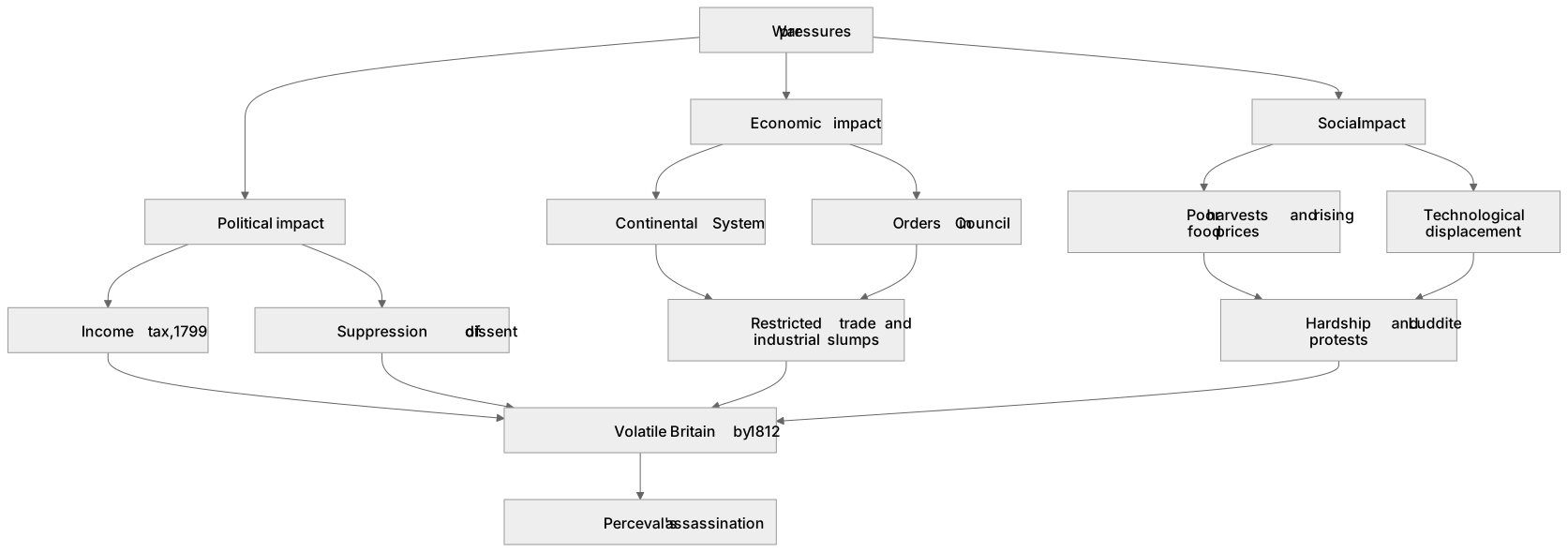
Label the diagram
Some boxes have lost their names. Pick the right name for each number.
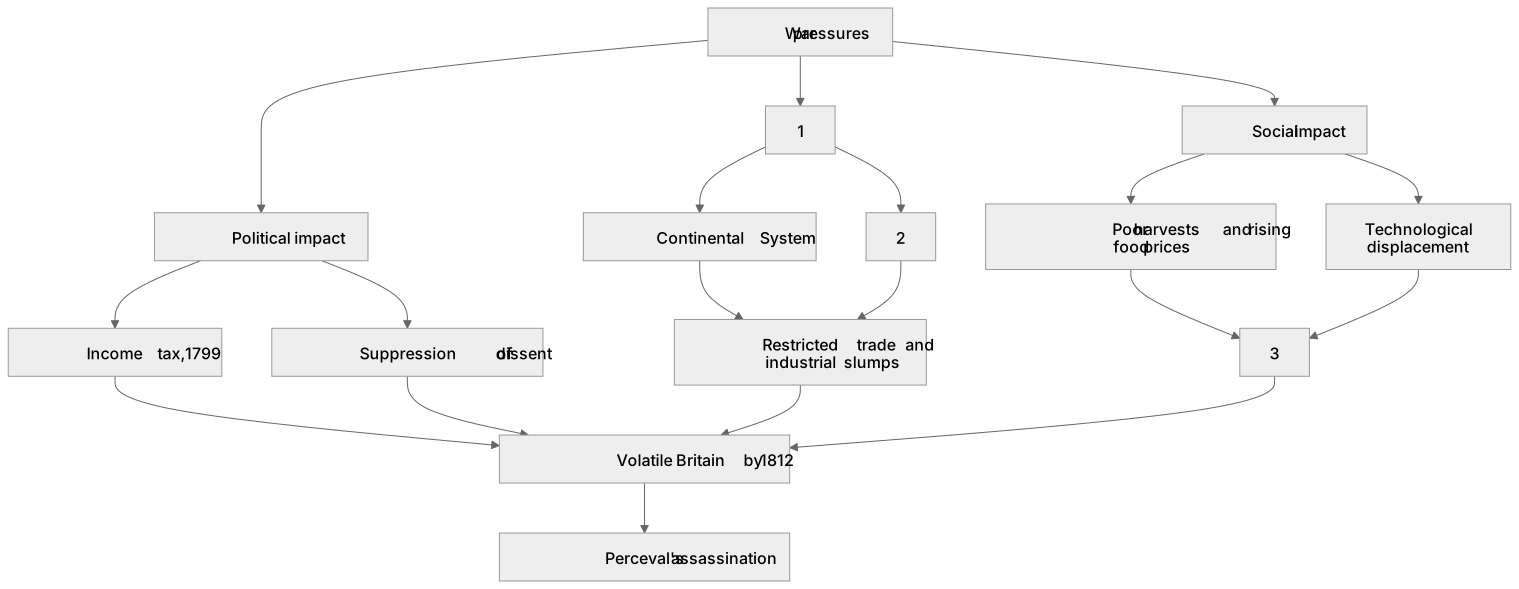
1Box 1
2Box 2
3Box 3
There is more to this lesson
The full lesson goes on to check your understanding and help you earn the marks. Create a free account to carry on, with your progress saved.
A week of Premium from your first lesson · Then the free plan continues · No card, no charge
Test your understanding of 1F Industrialisation and the people: Britain, c1783–1885 – Pressure for change, c1783–1812: Pressures on government: the political, economic and social impact of war; the condition of Britain by 1812
Active recall beats re-reading. Take an instant quiz now to test what you’ve learned and lock it into long-term memory.
A week of Premium from your first lesson · Then the free plan continues · No card, no charge