AQA · A-Level · History
Course version: 7042 · Version from Sept 2017
Britain, c1783–1885 – Pressure for change, c1783–1812: Pressures on…
Full specification wording
1F Industrialisation and the people: Britain, c1783–1885 – Pressure for change, c1783–1812: Pressures on government: the political influence of the French Revolution; Irish rebellion and union; radicalism and opposition; party splits; demands for parliamentary reform
The period 1783–1812 saw immense pressure on the British government.
Checked against the AQA 7042 specification (opens in a new tab) on .
- Point 5 of 6
- 2 key terms
Study notes
From the checked teaching notes for this specification point.
The idea
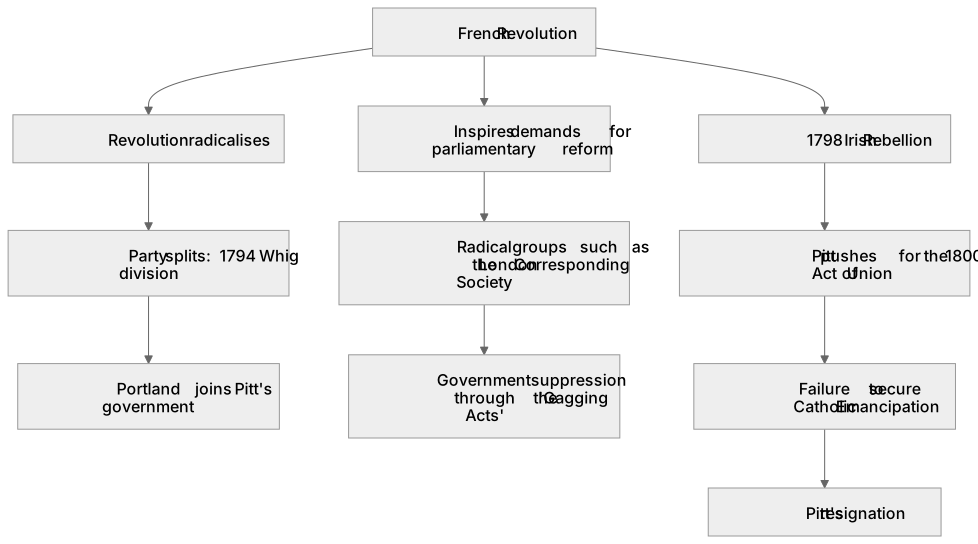
The period 1783–1812 saw immense pressure on the British government. The French Revolution initially inspired demands for parliamentary reform, leading to the formation of radical groups like the London Corresponding Society. However, as the Revolution radicalised, it caused severe party splits, notably the 1794 division of the Whigs when Portland joined Pitt's government. Radicalism and opposition faced harsh government suppression through the 'Gagging Acts'. Concurrently, the 1798 Irish Rebellion, fuelled by revolutionary ideals and Catholic grievances, forced Pitt to push for the 1800 Act of Union to secure Britain's western flank, though his failure to secure Catholic Emancipation led to his resignation.
What earns the marks
- Assess the impact of the French Revolution on both popular radicalism and conservative reaction in Britain.
- Evaluate the significance of the 1798 Irish Rebellion in precipitating the 1800 Act of Union and Pitt's subsequent resignation over Catholic Emancipation.
- Analyse the methods and aims of radical opposition groups, such as the London Corresponding Society, in their demands for parliamentary reform.
- Explain the causes and consequences of party splits, specifically the fragmentation of the Whig party in 1794 in response to revolutionary fears.
Common mistakes and how to put them right
Confusing the timeline of the French Revolution's impact.
Put it right by distinguishing between the initial positive reception from 1789 to 1792 and the conservative backlash during the Terror from 1793 onwards.
Treating the 1800 Act of Union as a standalone event.
Put it right: Explicitly linking it to the security threat exposed by the 1798 Irish Rebellion and French invasion attempts.
Assuming all Whigs supported the French Revolution.
Put it right by noting that while Fox maintained support, Burke's condemnation led to a major party split with Portland's faction joining Pitt.
Exam tips
- Link domestic radicalism directly to the ideological influence of the French Revolution to demonstrate synoptic understanding.
- When discussing party splits, use the specific example of the Fox-Portland divide to illustrate the fracturing of the Whig opposition.
- Evaluate the effectiveness of Pitt's repressive legislation, such as the 'Two Acts', when assessing the failure of demands for parliamentary reform.
Try the lesson
The start of the 1F Industrialisation and the people: Britain, c1783–1885 – Pressure for change, c1783–1812: Pressures on government: the political influence of the French Revolution; Irish rebellion and union; radicalism and opposition; party splits; demands for parliamentary reform lesson, made from checked teaching notes for this specification point.
Have a go first
How did the French Revolution primarily affect the Whig party in Britain during the 1790s?
Listen
The period 1783–1812 saw immense pressure on the British government. The French Revolution initially inspired demands for parliamentary reform, leading to the formation of radical groups like the London Corresponding Society. However, as the Revolution radicalised, it caused severe party splits, notably the 1794 division of the Whigs when Portland joined Pitt's government. Radicalism and opposition faced harsh government suppression through the 'Gagging Acts'. Concurrently, the 1798 Irish Rebellion, fuelled by revolutionary ideals and Catholic grievances, forced Pitt to push for the 1800 Act of Union to secure Britain's western flank, though his failure to secure Catholic Emancipation led to his resignation. A strong answer earns marks for these points. Assess the impact of the French Revolution on both popular radicalism and conservative reaction in Britain. Evaluate the significance of the 1798 Irish Rebellion in precipitating the 1800 Act of Union and Pitt's subsequent resignation over Catholic Emancipation. Analyse the methods and aims of radical opposition groups, such as the London Corresponding Society, in their demands for parliamentary reform. Explain the causes and consequences of party splits, specifically the fragmentation of the Whig party in 1794 in response to revolutionary fears. A common slip: Confusing the timeline of the French Revolution's impact. Instead, distinguishing between the initial positive reception from 1789 to 1792 and the conservative backlash during the Terror from 1793 onwards. Exam tip: Link domestic radicalism directly to the ideological influence of the French Revolution to demonstrate synoptic understanding.
See it
Put the events in order
Put these events in the order they happened, earliest first.
- 1. The Whig party split as Portland joined Pitt's government
- 2. Act of Union passed to secure Britain's western flank
- 3. Irish Rebellion forced Pitt to push for union
Key words
Say what each word means before you turn the card.
Radicalism
Try answering aloud or in your head before turning the card.
Repression
Try answering aloud or in your head before turning the card.
See every definition
- Radicalism
- Demands for parliamentary reform, initially inspired by the French Revolution and expressed through radical groups like the London Corresponding Society.
- Repression
- Harsh government suppression of radicalism and opposition through the 'Gagging Acts'.
Label the diagram
Some boxes have lost their names. Pick the right name for each number.
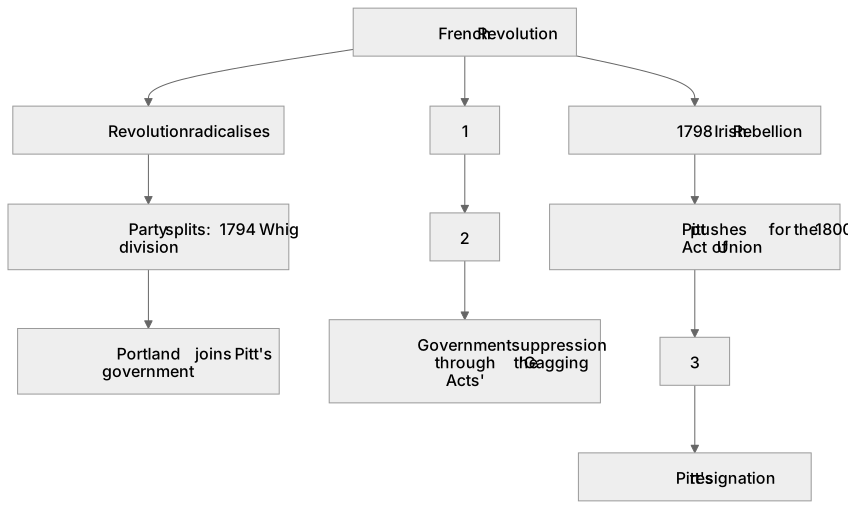
1Box 1
2Box 2
3Box 3
There is more to this lesson
The full lesson goes on to check your understanding and help you earn the marks. Create a free account to carry on, with your progress saved.
A week of Premium from your first lesson · Then the free plan continues · No card, no charge
Test your understanding of 1F Industrialisation and the people: Britain, c1783–1885 – Pressure for change, c1783–1812: Pressures on government: the political influence of the French Revolution; Irish rebellion and union; radicalism and opposition; party splits; demands for parliamentary reform
Active recall beats re-reading. Take an instant quiz now to test what you’ve learned and lock it into long-term memory.
A week of Premium from your first lesson · Then the free plan continues · No card, no charge