AQA · A-Level · History
Course version: 7042 · Version from Sept 2017
Britain, c1783–1885 – through the following key questions:: How and with…
Full specification wording
1F Industrialisation and the people: Britain, c1783–1885 – through the following key questions:: How and with what results did society and social policy develop?
Between 1783 and 1885, Britain experienced profound demographic shifts driven by rapid population growth and urbanisation.
Checked against the AQA 7042 specification (opens in a new tab) on .
- Point 4 of 6
Study notes
From the checked teaching notes for this specification point.
The idea
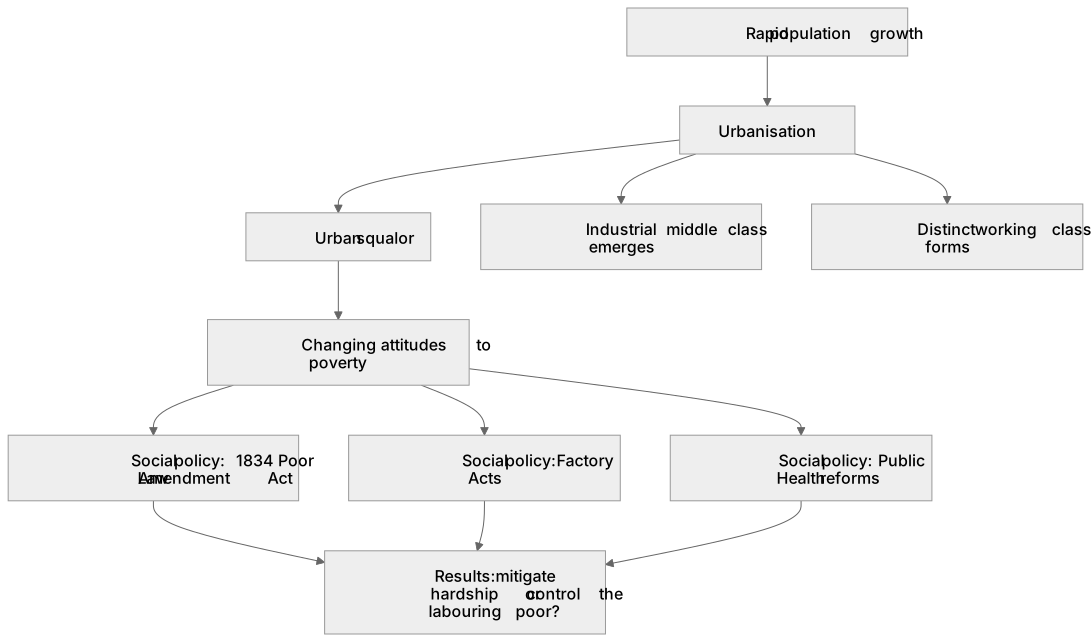
Between 1783 and 1885, Britain experienced profound demographic shifts driven by rapid population growth and urbanisation. You must explore how society developed, focusing on the emergence of a powerful industrial middle class and a distinct working class. Furthermore, evaluate how social policy evolved in response to urban squalor and changing attitudes to poverty, analysing key legislation like the 1834 Poor Law Amendment Act, Factory Acts, and Public Health reforms. Finally, assess the results of these changes: determine whether social policies successfully mitigated the harsh realities of industrial life, or if they primarily served to control the labouring poor and enforce strict laissez-faire ideological principles.
What earns the marks
- Analyse the demographic changes, specifically rapid population growth and the shift from rural to urban living.
- Evaluate the changing class structure, including the rising political and economic influence of the middle classes and the formation of working-class identity.
- Assess the motivations behind key social policies, such as the 1834 Poor Law Amendment Act, the Factory Acts, and the 1870 Education Act.
- Evaluate the results and effectiveness of social reforms in improving living and working conditions for the urban poor.
Common mistakes and how to put them right
Viewing social reform purely as a humanitarian effort.
Put it right: Analyse the utilitarian, economic, and social control motives behind policies like the New Poor Law.
Assuming the working class was a single, unified group.
Put it right: Differentiate between the experiences of skilled artisans, factory workers, and the unskilled labouring poor.
Overstating the immediate impact of early social legislation.
Put it right: Recognise that early Factory and Public Health Acts often lacked effective enforcement mechanisms or inspectorates.
Exam tips
- Always link social developments to their economic causes, demonstrating how industrialisation necessitated new approaches to public health and poverty.
- Use specific examples of legislation, including dates and key terms, to support arguments about the trajectory of social policy.
- Debate the extent to which government intervention in social issues challenged the prevailing ideology of laissez-faire.
Try the lesson
The start of the 1F Industrialisation and the people: Britain, c1783–1885 – through the following key questions:: How and with what results did society and social policy develop? lesson, made from checked teaching notes for this specification point.
Have a go first
What was the primary objective of the Poor Law Amendment Act of 1834?
Listen
Between 1783 and 1885, Britain experienced profound demographic shifts driven by rapid population growth and urbanisation. You must explore how society developed, focusing on the emergence of a powerful industrial middle class and a distinct working class. Furthermore, evaluate how social policy evolved in response to urban squalor and changing attitudes to poverty, analysing key legislation like the 1834 Poor Law Amendment Act, Factory Acts, and Public Health reforms. Finally, assess the results of these changes: determine whether social policies successfully mitigated the harsh realities of industrial life, or if they primarily served to control the labouring poor and enforce strict laissez-faire ideological principles. A strong answer earns marks for these points. Analyse the demographic changes, specifically rapid population growth and the shift from rural to urban living. Evaluate the changing class structure, including the rising political and economic influence of the middle classes and the formation of working-class identity. Assess the motivations behind key social policies, such as the 1834 Poor Law Amendment Act, the Factory Acts, and the 1870 Education Act. Evaluate the results and effectiveness of social reforms in improving living and working conditions for the urban poor. A common slip: Viewing social reform purely as a humanitarian effort. Instead, analyse the utilitarian, economic, and social control motives behind policies like the New Poor Law. Exam tip: Always link social developments to their economic causes, demonstrating how industrialisation necessitated new approaches to public health and poverty.
See it
Label the diagram
Some boxes have lost their names. Pick the right name for each number.
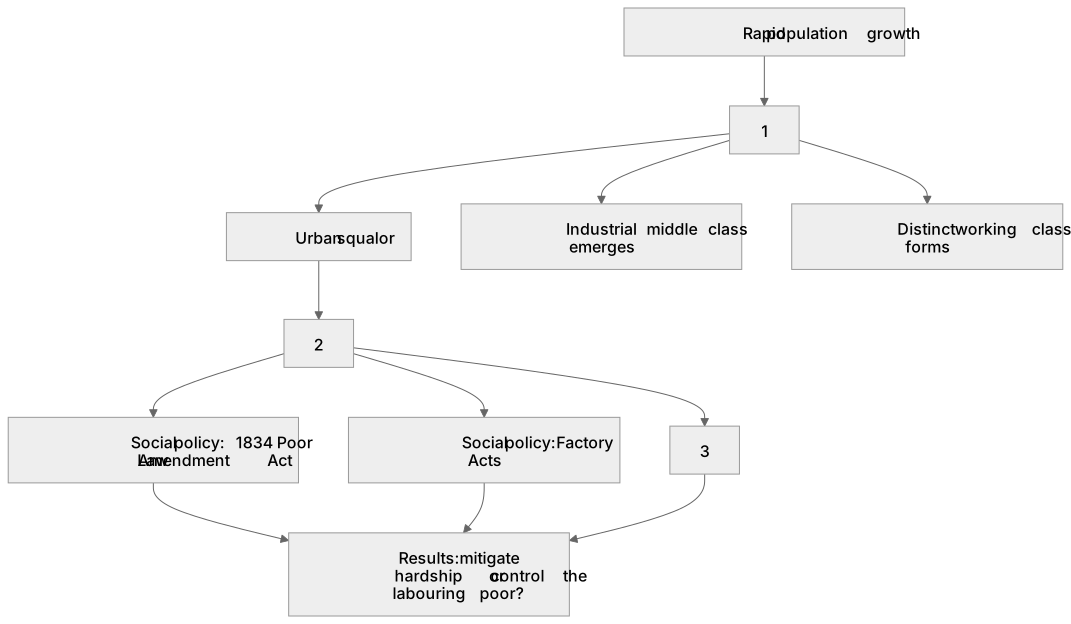
1Box 1
2Box 2
3Box 3
There is more to this lesson
The full lesson goes on to check your understanding and help you earn the marks. Create a free account to carry on, with your progress saved.
A week of Premium from your first lesson · Then the free plan continues · No card, no charge
Test your understanding of 1F Industrialisation and the people: Britain, c1783–1885 – through the following key questions:: How and with what results did society and social policy develop?
Active recall beats re-reading. Take an instant quiz now to test what you’ve learned and lock it into long-term memory.
A week of Premium from your first lesson · Then the free plan continues · No card, no charge