AQA · A-Level · History
Course version: 7042 · Version from Sept 2017
Britain, c1783–1885 – through the following key questions:: How and with…
Full specification wording
1F Industrialisation and the people: Britain, c1783–1885 – through the following key questions:: How and with what results did the economy develop and change?
Between 1783 and 1885, Britain transformed from a predominantly agrarian society into the world's first industrial superpower.
Checked against the AQA 7042 specification (opens in a new tab) on .
- Point 3 of 6
- 4 key terms
Study notes
From the checked teaching notes for this specification point.
The idea
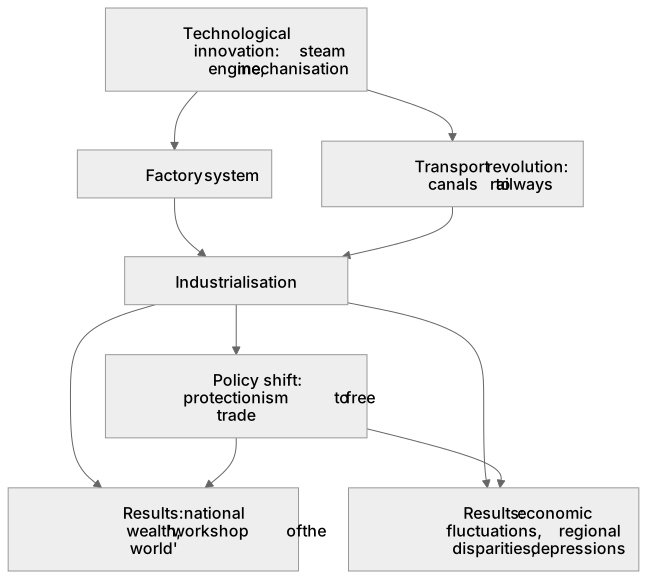
Between 1783 and 1885, Britain transformed from a predominantly agrarian society into the world's first industrial superpower. You must understand how this economy developed, driven by technological innovations like the steam engine, the factory system, and a revolution in transport from canals to railways. This period also saw a shift in economic policy from protectionism to free trade, championed by figures like Peel and Gladstone. Crucially, you must evaluate the results of these changes. While industrialisation generated unprecedented national wealth and established Britain as the 'workshop of the world', it also caused severe economic fluctuations, regional disparities, and periodic depressions that challenged economic stability.
What earns the marks
- Identify key technological drivers of economic change, such as steam power and mechanisation in the textile and iron industries.
- Explain the transition in transport infrastructure, evaluating the economic impact of the railway boom on domestic and international trade.
- Analyse the shift in government economic policy from mercantilism and the Corn Laws towards laissez-faire and free trade.
- Assess the results of economic development, including the creation of new industrial wealth, urbanisation, and the cyclical nature of economic booms and slumps.
Common mistakes and how to put them right
Treating the industrial revolution as a single, sudden event.
Put it right: Recognise it as a phased process of continuous development and regional variation.
Focusing solely on industrial growth while ignoring agriculture.
Put it right: Evaluate how agricultural improvements and the concept of 'high farming' also contributed to economic change.
Assuming free trade was universally beneficial.
Put it right: Acknowledge that while it boosted overall trade, it exposed certain domestic sectors to foreign competition and economic depressions.
Exam tips
- Use specific statistical evidence, such as coal output or railway mileage, to substantiate claims about the scale of economic growth.
- When discussing the 'results' of economic change, ensure you balance positive indicators of national wealth against the negative impacts of trade depressions.
- Link economic developments directly to political changes, showing how the demands of the new industrial middle class influenced government policy.
Try the lesson
The start of the 1F Industrialisation and the people: Britain, c1783–1885 – through the following key questions:: How and with what results did the economy develop and change? lesson, made from checked teaching notes for this specification point.
Have a go first
Which of the following was a primary economic result of the expansion of the railway network in Britain during the mid-nineteenth century?
Listen
Between 1783 and 1885, Britain transformed from a predominantly agrarian society into the world's first industrial superpower. You must understand how this economy developed, driven by technological innovations like the steam engine, the factory system, and a revolution in transport from canals to railways. This period also saw a shift in economic policy from protectionism to free trade, championed by figures like Peel and Gladstone. Crucially, you must evaluate the results of these changes. While industrialisation generated unprecedented national wealth and established Britain as the 'workshop of the world', it also caused severe economic fluctuations, regional disparities, and periodic depressions that challenged economic stability. A strong answer earns marks for these points. Identify key technological drivers of economic change, such as steam power and mechanisation in the textile and iron industries. Explain the transition in transport infrastructure, evaluating the economic impact of the railway boom on domestic and international trade. Analyse the shift in government economic policy from mercantilism and the Corn Laws towards laissez-faire and free trade. Assess the results of economic development, including the creation of new industrial wealth, urbanisation, and the cyclical nature of economic booms and slumps. A common slip: Treating the industrial revolution as a single, sudden event. Instead, recognise it as a phased process of continuous development and regional variation. Exam tip: Use specific statistical evidence, such as coal output or railway mileage, to substantiate claims about the scale of economic growth.
See it
Key words
Say what each word means before you turn the card.
Industrialisation
Try answering aloud or in your head before turning the card.
Laissez-faire economics
Try answering aloud or in your head before turning the card.
Technological innovation
Try answering aloud or in your head before turning the card.
Trade and commerce
Try answering aloud or in your head before turning the card.
See every definition
- Industrialisation
- The process by which Britain transformed from a predominantly agrarian society into the world's first industrial superpower, generating unprecedented national wealth.
- Laissez-faire economics
- An economic policy towards which government shifted from mercantilism and the Corn Laws, alongside free trade.
- Technological innovation
- A driver of economic change including the steam engine, the factory system, and mechanisation in the textile and iron industries.
- Trade and commerce
- Economic activity affected by the railway boom, with an impact on domestic and international trade.
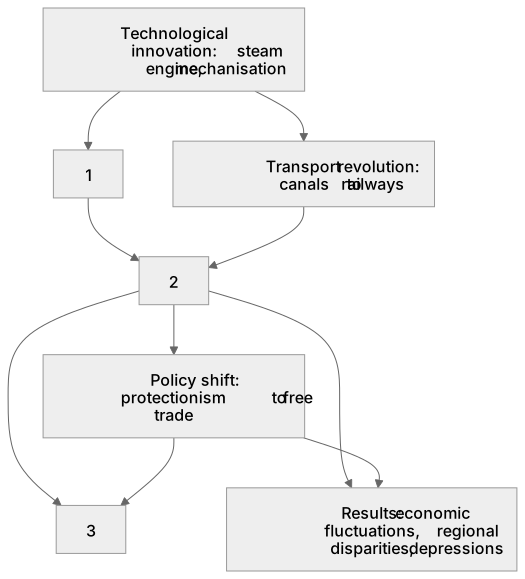
Label the diagram
Some boxes have lost their names. Pick the right name for each number.
1Box 1
2Box 2
3Box 3
There is more to this lesson
The full lesson goes on to check your understanding and help you earn the marks. Create a free account to carry on, with your progress saved.
A week of Premium from your first lesson · Then the free plan continues · No card, no charge
Test your understanding of 1F Industrialisation and the people: Britain, c1783–1885 – through the following key questions:: How and with what results did the economy develop and change?
Active recall beats re-reading. Take an instant quiz now to test what you’ve learned and lock it into long-term memory.
A week of Premium from your first lesson · Then the free plan continues · No card, no charge