AQA · A-Level · History
Course version: 7042 · Version from Sept 2017
Britain, c1783–1885 – through the following key questions:: How was…
Full specification wording
1F Industrialisation and the people: Britain, c1783–1885 – through the following key questions:: How was Britain governed and how did democracy and political organisations change and develop?
Between 1783 and 1885, Britain transitioned from an aristocratic oligarchy to a more representative parliamentary democracy.
Checked against the AQA 7042 specification (opens in a new tab) on .
- Point 1 of 6
- 4 key terms
Study notes
From the checked teaching notes for this specification point.
The idea
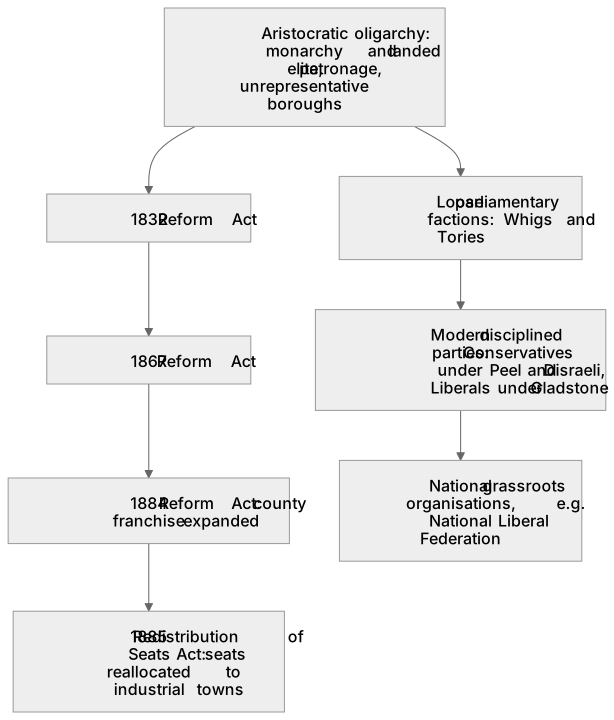
Between 1783 and 1885, Britain transitioned from an aristocratic oligarchy to a more representative parliamentary democracy. Initially, governance was dominated by the monarchy and landed elite through patronage and unrepresentative boroughs. The development of democracy accelerated with the 1832, 1867, and 1884 Reform Acts, which progressively expanded the franchise. Concurrently, the 1885 Redistribution of Seats Act reallocated representation to industrial towns like Manchester. Political organisations also evolved significantly. Loose parliamentary factions transformed into modern, disciplined political parties, such as the Conservatives under Peel and Disraeli, and the Liberals under Gladstone, supported by national grassroots organisations like the National Liberal Federation.
What earns the marks
- Assess the extent of monarchical and aristocratic power in governance and the electoral system prior to 1832.
- Evaluate the impact of the 1832, 1867, and 1884 Reform Acts on the expansion of the franchise and democratic representation.
- Analyse the transition from loose parliamentary factions (Whigs and Tories) to formalised political parties (Liberals and Conservatives).
- Explain the role of extra-parliamentary political organisations, such as the Carlton Club or the National Liberal Federation, in shaping modern party politics.
Common mistakes and how to put them right
Claiming Britain became a full democracy by 1885.
Put it right: State that while the franchise expanded significantly, universal suffrage was not achieved, and women remained entirely excluded from national elections.
Confusing the Whigs and Tories of 1783 with the modern Liberal and Conservative parties of the late 19th century.
Put it right: Trace the specific ideological and organisational evolution, noting Peel's Tamworth Manifesto as a turning point for the Conservatives.
Conflating the 1884 Reform Act with the 1885 Redistribution of Seats Act.
Put it right: Specify that the 1884 Act expanded the county franchise, whereas the 1885 Act redistributed parliamentary seats to better reflect population shifts.
Exam tips
- Use specific examples of rotten boroughs, such as Old Sarum, to illustrate the flaws in governance prior to the 1832 Reform Act.
- When discussing political organisations, contrast the informal patronage networks of the 1780s with the highly structured party machines of the 1880s.
- Distinguish clearly between franchise extension (e.g., the 1884 Act) and seat redistribution (e.g., the 1885 Act) when evaluating democratic changes.
Try the lesson
The start of the 1F Industrialisation and the people: Britain, c1783–1885 – through the following key questions:: How was Britain governed and how did democracy and political organisations change and develop? lesson, made from checked teaching notes for this specification point.
Have a go first
Which of the following was a primary change introduced by the Great Reform Act of 1832 regarding how Britain was governed?
Listen
Between 1783 and 1885, Britain transitioned from an aristocratic oligarchy to a more representative parliamentary democracy. Initially, governance was dominated by the monarchy and landed elite through patronage and unrepresentative boroughs. The development of democracy accelerated with the 1832, 1867, and 1884 Reform Acts, which progressively expanded the franchise. Concurrently, the 1885 Redistribution of Seats Act reallocated representation to industrial towns like Manchester. Political organisations also evolved significantly. Loose parliamentary factions transformed into modern, disciplined political parties, such as the Conservatives under Peel and Disraeli, and the Liberals under Gladstone, supported by national grassroots organisations like the National Liberal Federation. A strong answer earns marks for these points. Assess the extent of monarchical and aristocratic power in governance and the electoral system prior to 1832. Evaluate the impact of the 1832, 1867, and 1884 Reform Acts on the expansion of the franchise and democratic representation. Analyse the transition from loose parliamentary factions (Whigs and Tories) to formalised political parties (Liberals and Conservatives). Explain the role of extra-parliamentary political organisations, such as the Carlton Club or the National Liberal Federation, in shaping modern party politics. A common slip: Claiming Britain became a full democracy by 1885. Instead, State that while the franchise expanded significantly, universal suffrage was not achieved, and women remained entirely excluded from national elections. Exam tip: Use specific examples of rotten boroughs, such as Old Sarum, to illustrate the flaws in governance prior to the 1832 Reform Act.
See it
Key words
Say what each word means before you turn the card.
Parliamentary reform
Try answering aloud or in your head before turning the card.
Party politics
Try answering aloud or in your head before turning the card.
Aristocratic dominance
Try answering aloud or in your head before turning the card.
Democratic evolution
Try answering aloud or in your head before turning the card.
See every definition
- Parliamentary reform
- The 1832, 1867 and 1884 Reform Acts progressively expanded the franchise, advancing democratic representation.
- Party politics
- Loose parliamentary factions transformed into modern, disciplined political parties supported by national grassroots organisations.
- Aristocratic dominance
- Governance was initially dominated by the monarchy and landed elite through patronage and unrepresentative boroughs.
- Democratic evolution
- Britain transitioned from an aristocratic oligarchy to a more representative parliamentary democracy between 1783 and 1885.
Label the diagram
Some boxes have lost their names. Pick the right name for each number.
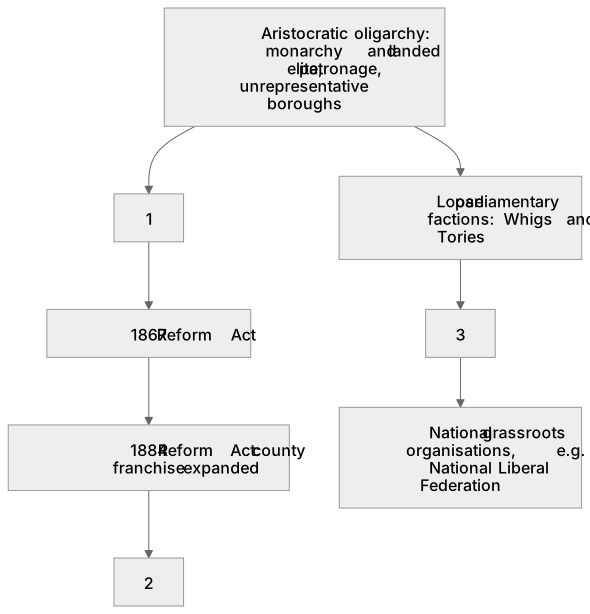
1Box 1
2Box 2
3Box 3
There is more to this lesson
The full lesson goes on to check your understanding and help you earn the marks. Create a free account to carry on, with your progress saved.
A week of Premium from your first lesson · Then the free plan continues · No card, no charge
Test your understanding of 1F Industrialisation and the people: Britain, c1783–1885 – through the following key questions:: How was Britain governed and how did democracy and political organisations change and develop?
Active recall beats re-reading. Take an instant quiz now to test what you’ve learned and lock it into long-term memory.
A week of Premium from your first lesson · Then the free plan continues · No card, no charge