AQA · A-Level · History
Course version: 7042 · Version from Sept 2017
Britain, c1783–1885 – through the following key questions:: What pressures…
Full specification wording
1F Industrialisation and the people: Britain, c1783–1885 – through the following key questions:: What pressures did governments face and how did they respond to these?
British governments between 1783 and 1885 faced immense pressures from industrialisation, population growth, economic fluctuations, and radical political movements.
Checked against the AQA 7042 specification (opens in a new tab) on .
- Point 2 of 6
Study notes
From the checked teaching notes for this specification point.
The idea
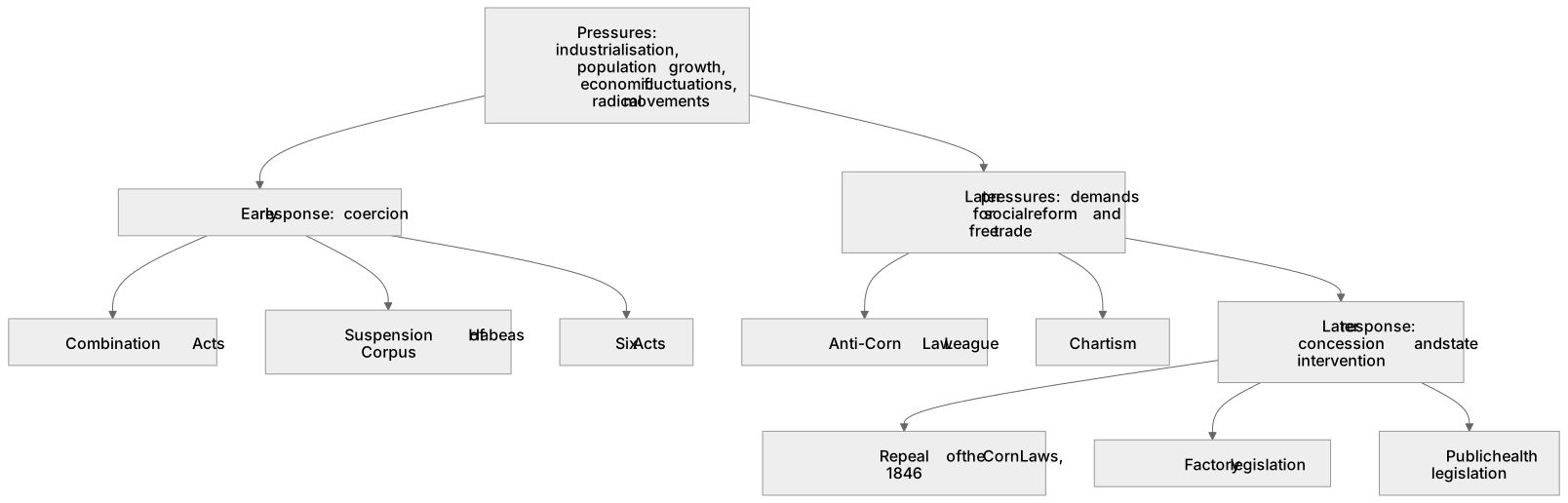
British governments between 1783 and 1885 faced immense pressures from industrialisation, population growth, economic fluctuations, and radical political movements. Early pressures included the threat of the French Revolution and working-class radicalism, to which Pitt's government responded with repressive measures like the Combination Acts and the suspension of Habeas Corpus. Later, governments faced demands for social reform and free trade, exemplified by the Anti-Corn Law League and Chartism. Responses evolved from coercion to concession, such as Peel's repeal of the Corn Laws in 1846 and the passage of factory and public health legislation, demonstrating a shift towards state intervention to manage industrial pressures.
What earns the marks
- Identify and evaluate the economic and demographic pressures caused by rapid industrialisation and urbanisation.
- Assess the threat posed by radical political movements, such as the Luddites, Swing Rioters, and Chartists.
- Analyse the effectiveness of government responses, contrasting early repressive legislation (e.g., the Six Acts) with later reformist policies.
- Evaluate the impact of extra-parliamentary pressure groups, like the Anti-Corn Law League, on government economic policy.
Common mistakes and how to put them right
Treating all government responses as purely repressive throughout the entire period.
Put it right: Highlight the transition from Pitt and Liverpool's coercive measures to the more reformist approaches of Peel, Gladstone, and Disraeli.
Viewing Chartism solely as a failure because its demands were not immediately met.
Put it right: Note that while the movement collapsed, most of its demands were eventually adopted by later governments responding to continued democratic pressure.
Ignoring the impact of external pressures, such as the French Revolution or the Irish Famine.
Put it right: Explicitly link domestic policy shifts, like the repeal of the Corn Laws, to these critical external catalysts.
Exam tips
- Structure essays chronologically or thematically to show how the nature of government responses shifted from coercion to reform over the century.
- Use specific legislation, such as the 1833 Factory Act or the 1848 Public Health Act, as concrete evidence of government responses to social pressures.
- Evaluate the motives behind government concessions, questioning whether they were driven by genuine humanitarianism or the pragmatic need to prevent revolution.
Try the lesson
The start of the 1F Industrialisation and the people: Britain, c1783–1885 – through the following key questions:: What pressures did governments face and how did they respond to these? lesson, made from checked teaching notes for this specification point.
Have a go first
How did William Pitt the Younger's government respond to the political pressures caused by the spread of radical ideas following the French Revolution?
Listen
British governments between 1783 and 1885 faced immense pressures from industrialisation, population growth, economic fluctuations, and radical political movements. Early pressures included the threat of the French Revolution and working-class radicalism, to which Pitt's government responded with repressive measures like the Combination Acts and the suspension of Habeas Corpus. Later, governments faced demands for social reform and free trade, exemplified by the Anti-Corn Law League and Chartism. Responses evolved from coercion to concession, such as Peel's repeal of the Corn Laws in 1846 and the passage of factory and public health legislation, demonstrating a shift towards state intervention to manage industrial pressures. A strong answer earns marks for these points. Identify and evaluate the economic and demographic pressures caused by rapid industrialisation and urbanisation. Assess the threat posed by radical political movements, such as the Luddites, Swing Rioters, and Chartists. Analyse the effectiveness of government responses, contrasting early repressive legislation (e.g., the Six Acts) with later reformist policies. Evaluate the impact of extra-parliamentary pressure groups, like the Anti-Corn Law League, on government economic policy. A common slip: Treating all government responses as purely repressive throughout the entire period. Instead, Highlight the transition from Pitt and Liverpool's coercive measures to the more reformist approaches of Peel, Gladstone, and Disraeli. Exam tip: Structure essays chronologically or thematically to show how the nature of government responses shifted from coercion to reform over the century.
See it
Put the events in order
Put these events in the order they happened, earliest first.
- 1. Passage of the Factory Act
- 2. Passage of the Public Health Act
- 3. Peel's repeal of the Corn Laws
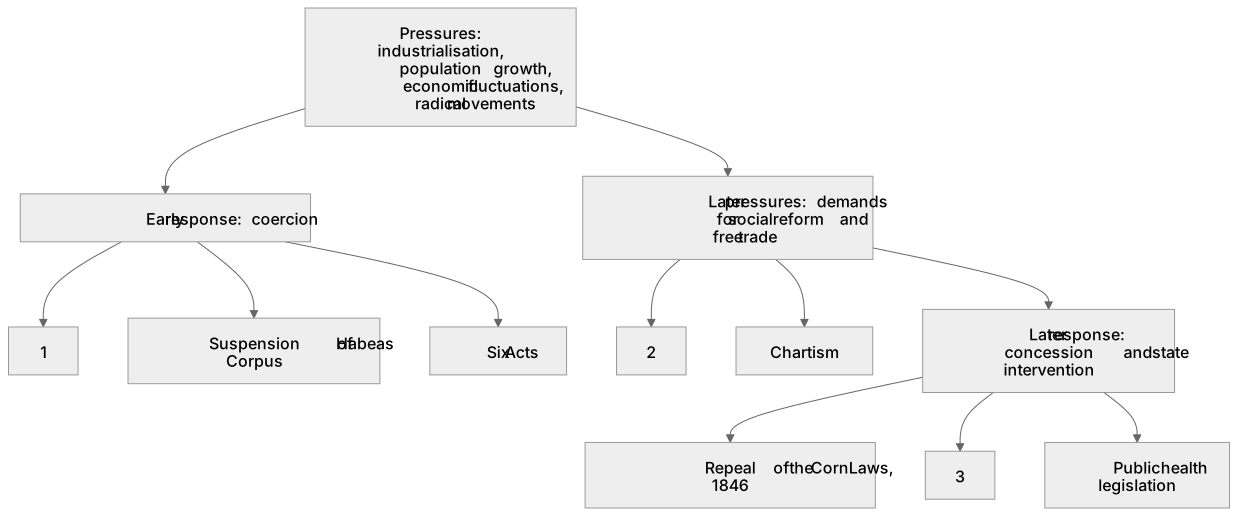
Label the diagram
Some boxes have lost their names. Pick the right name for each number.
1Box 1
2Box 2
3Box 3
There is more to this lesson
The full lesson goes on to check your understanding and help you earn the marks. Create a free account to carry on, with your progress saved.
A week of Premium from your first lesson · Then the free plan continues · No card, no charge
Test your understanding of 1F Industrialisation and the people: Britain, c1783–1885 – through the following key questions:: What pressures did governments face and how did they respond to these?
Active recall beats re-reading. Take an instant quiz now to test what you’ve learned and lock it into long-term memory.
A week of Premium from your first lesson · Then the free plan continues · No card, no charge