AQA · A-Level · History
Course version: 7042 · Version from Sept 2017
Britain, c1851–1964 – consequence in this period through the following key…
Full specification wording
1G Challenge and transformation: Britain, c1851–1964 – consequence in this period through the following key questions:: How and with what effects did society and social policy develop?
This topic requires an analysis of how British society and social policy evolved from 1851 to 1964, and with what effects these changes impacted the population.
Checked against the AQA 7042 specification (opens in a new tab) on .
- Point 4 of 6
- 4 key terms
Study notes
From the checked teaching notes for this specification point.
The idea
This topic requires an analysis of how British society and social policy evolved from 1851 to 1964, and with what effects these changes impacted the population. The development of society involves tracing shifts in class structures, the changing status of women, and the impact of immigration. Crucially, the effects of these developments must be evaluated. This includes assessing how educational reforms like the 1944 Butler Act influenced social mobility, and how public health initiatives improved life expectancy and alleviated poverty.
What earns the marks
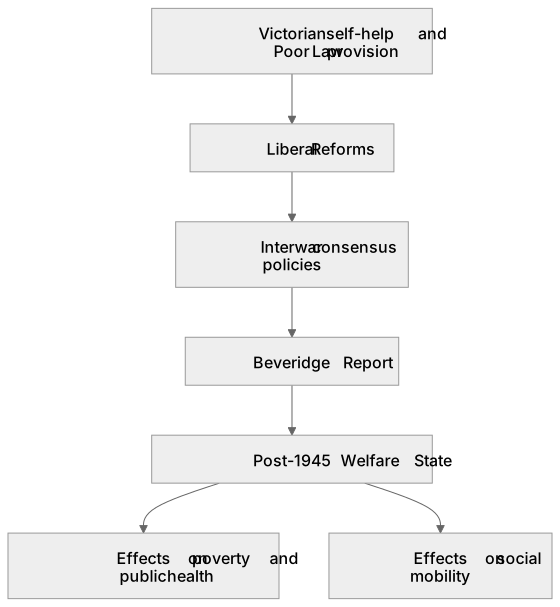
- Trace the evolution of social policy from Victorian philanthropy and the Poor Law to the establishment of the post-war Welfare State.
- Analyse the changing social structure of Britain, including the decline of the landed aristocracy and the expansion of the middle and working classes.
- Evaluate the effects of key legislative milestones, such as the Liberal Social Reforms (1906-1914) and the 1944 Education Act, on social mobility and poverty.
- Assess the impact of societal developments on specific groups, particularly the changing roles and rights of women across the period.
Common mistakes and how to put them right
Assuming the Welfare State was entirely a post-1945 Labour invention.
Put it right: Trace the roots of the Welfare State back to the Liberal Reforms and interwar consensus policies.
Describing social policies without evaluating their actual effects on the population.
Put it right: Link legislation, such as the National Insurance Act, to its tangible impact on poverty levels and public health.
Treating 'society' as a homogenous group experiencing uniform change.
Put it right: Differentiate the effects of social development by class, gender, and region to provide a nuanced analysis.
Exam tips
- Connect social policy developments to their economic contexts, such as how the interwar depression necessitated changes in unemployment relief.
- Use contemporary social investigations, like those by Booth and Rowntree, as evidence to demonstrate the catalyst for early social policy reforms.
- When evaluating the effects of social policy, consider both the intended outcomes and the unintended consequences, such as the persistence of class divides in education.
Try the lesson
The start of the 1G Challenge and transformation: Britain, c1851–1964 – consequence in this period through the following key questions:: How and with what effects did society and social policy develop? lesson, made from checked teaching notes for this specification point.
Have a go first
Which social issue was the 1908 Old Age Pensions Act, introduced by the Liberal government, primarily designed to address?
Listen
This topic requires an analysis of how British society and social policy evolved from 1851 to 1964, and with what effects these changes impacted the population. The development of society involves tracing shifts in class structures, the changing status of women, and the impact of immigration. Crucially, the effects of these developments must be evaluated. This includes assessing how educational reforms like the 1944 Butler Act influenced social mobility, and how public health initiatives improved life expectancy and alleviated poverty. A strong answer earns marks for these points. Trace the evolution of social policy from Victorian philanthropy and the Poor Law to the establishment of the post-war Welfare State. Analyse the changing social structure of Britain, including the decline of the landed aristocracy and the expansion of the middle and working classes. Evaluate the effects of key legislative milestones, such as the Liberal Social Reforms (1906-1914) and the 1944 Education Act, on social mobility and poverty. Assess the impact of societal developments on specific groups, particularly the changing roles and rights of women across the period. Exam tip: Connect social policy developments to their economic contexts, such as how the interwar depression necessitated changes in unemployment relief.
See it
Key words
Say what each word means before you turn the card.
The evolution of the Welfare State
Try answering aloud or in your head before turning the card.
Class structure and social mobility
Try answering aloud or in your head before turning the card.
Gender roles and women's emancipation
Try answering aloud or in your head before turning the card.
Public health and poverty alleviation
Try answering aloud or in your head before turning the card.
See every definition
- The evolution of the Welfare State
- The transition from Victorian self-help and Poor Law provision to the comprehensive post-1945 Welfare State, including the Liberal Reforms and the Beveridge Report.
- Class structure and social mobility
- Shifts in class structures, including the decline of the landed aristocracy and the expansion of the middle and working classes, and how educational reforms influenced mobility.
- Gender roles and women's emancipation
- The changing status of women and their changing roles and rights across the period.
- Public health and poverty alleviation
- How public health initiatives improved life expectancy and alleviated poverty, with effects evaluated on the population.
Label the diagram
Some boxes have lost their names. Pick the right name for each number.
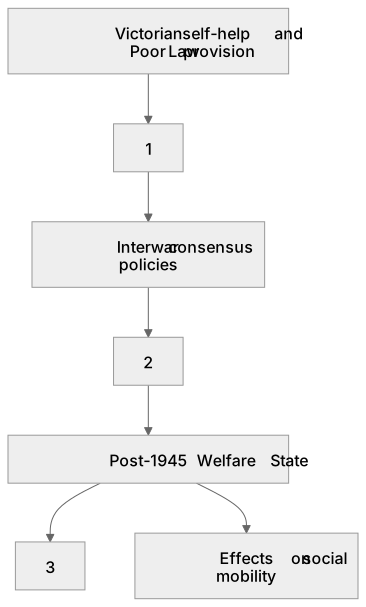
1Box 1
2Box 2
3Box 3
There is more to this lesson
The full lesson goes on to check your understanding and help you earn the marks. Create a free account to carry on, with your progress saved.
A week of Premium from your first lesson · Then the free plan continues · No card, no charge
Test your understanding of 1G Challenge and transformation: Britain, c1851–1964 – consequence in this period through the following key questions:: How and with what effects did society and social policy develop?
Active recall beats re-reading. Take an instant quiz now to test what you’ve learned and lock it into long-term memory.
A week of Premium from your first lesson · Then the free plan continues · No card, no charge