AQA · A-Level · History
Course version: 7042 · Version from Sept 2017
Britain, c1851–1964 – consequence in this period through the following key…
Full specification wording
1G Challenge and transformation: Britain, c1851–1964 – consequence in this period through the following key questions:: How and with what effects did the economy develop?
Between 1851 and 1964, the British economy transitioned from the 'Workshop of the World' to a mixed economy managing post-imperial decline.
Checked against the AQA 7042 specification (opens in a new tab) on .
- Point 3 of 6
Study notes
From the checked teaching notes for this specification point.
The idea
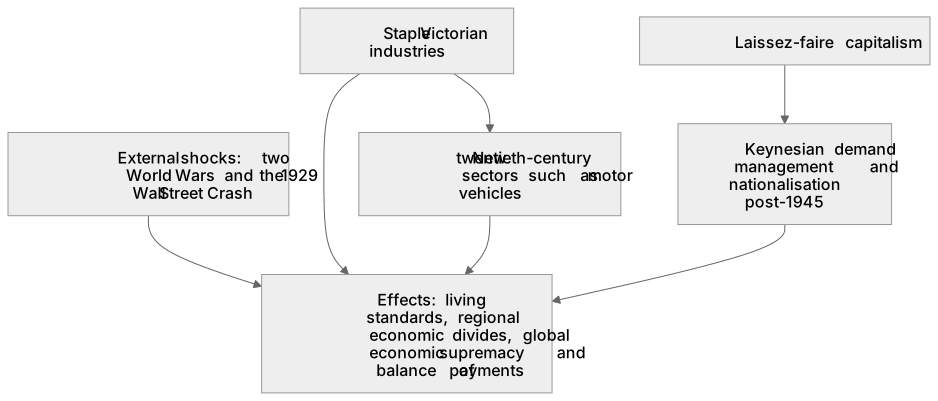
Between 1851 and 1964, the British economy transitioned from the 'Workshop of the World' to a mixed economy managing post-imperial decline. The role of the state is crucial, moving from laissez-faire capitalism to Keynesian demand management and nationalisation post-1945. This includes assessing the impact on living standards, the creation of regional economic divides during the interwar depression, and the long-term consequences for Britain's global economic supremacy and balance of payments.
What earns the marks
- Identify and explain the structural shifts in the British economy, such as the decline of staple industries and the rise of new manufacturing and service sectors.
- Evaluate the changing role of government in economic management, contrasting nineteenth-century laissez-faire policies with twentieth-century Keynesianism and nationalisation.
- Assess the effects of economic development on different social classes and regions, particularly the North-South divide during the interwar years.
- Analyse the impact of external shocks, such as the two World Wars and the 1929 Wall Street Crash, on Britain's economic trajectory and global standing.
Common mistakes and how to put them right
Treating the entire period as a continuous economic decline.
Put it right: Acknowledge periods of significant growth and rising living standards, such as the mid-Victorian boom and the post-1945 affluent society.
Confusing the economic policies of different eras, such as applying Keynesian principles to late nineteenth-century governments.
Put it right: Clearly distinguish between laissez-faire, protectionism, and post-1945 consensus economics.
Ignoring the 'effects' clause of the question and only describing economic changes.
Put it right: Link economic developments to their tangible impacts on living standards, employment, and Britain's international status.
Exam tips
- Use specific statistical evidence, such as unemployment rates or export volumes, to substantiate claims about economic growth or depression.
- When discussing economic effects, differentiate between short-term impacts, like post-war slumps, and long-term structural changes.
- Structure essays around key turning points, such as the abandonment of the Gold Standard or the implementation of the 1944 White Paper on Employment.
Try the lesson
The start of the 1G Challenge and transformation: Britain, c1851–1964 – consequence in this period through the following key questions:: How and with what effects did the economy develop? lesson, made from checked teaching notes for this specification point.
Have a go first
What was a primary cause of the severe agricultural depression experienced in Britain during the final quarter of the nineteenth century?
Listen
Between 1851 and 1964, the British economy transitioned from the 'Workshop of the World' to a mixed economy managing post-imperial decline. The role of the state is crucial, moving from laissez-faire capitalism to Keynesian demand management and nationalisation post-1945. This includes assessing the impact on living standards, the creation of regional economic divides during the interwar depression, and the long-term consequences for Britain's global economic supremacy and balance of payments. A strong answer earns marks for these points. Identify and explain the structural shifts in the British economy, such as the decline of staple industries and the rise of new manufacturing and service sectors. Evaluate the changing role of government in economic management, contrasting nineteenth-century laissez-faire policies with twentieth-century Keynesianism and nationalisation. Assess the effects of economic development on different social classes and regions, particularly the North-South divide during the interwar years. Analyse the impact of external shocks, such as the two World Wars and the 1929 Wall Street Crash, on Britain's economic trajectory and global standing. Exam tip: Use specific statistical evidence, such as unemployment rates or export volumes, to substantiate claims about economic growth or depression.
See it
Label the diagram
Some boxes have lost their names. Pick the right name for each number.
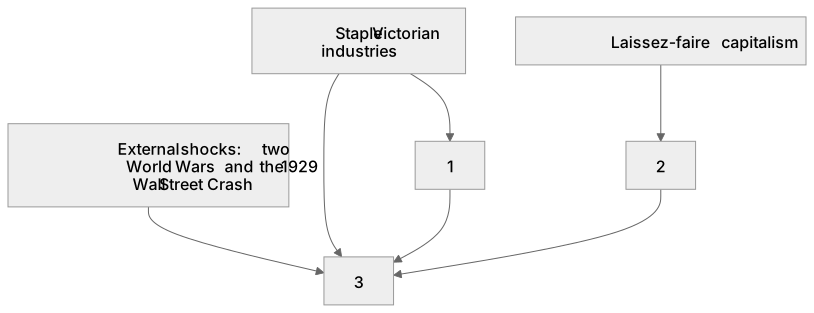
1Box 1
2Box 2
3Box 3
There is more to this lesson
The full lesson goes on to check your understanding and help you earn the marks. Create a free account to carry on, with your progress saved.
A week of Premium from your first lesson · Then the free plan continues · No card, no charge
Test your understanding of 1G Challenge and transformation: Britain, c1851–1964 – consequence in this period through the following key questions:: How and with what effects did the economy develop?
Active recall beats re-reading. Take an instant quiz now to test what you’ve learned and lock it into long-term memory.
A week of Premium from your first lesson · Then the free plan continues · No card, no charge