AQA · A-Level · History
Course version: 7042 · Version from Sept 2017
Britain, c1851–1964 – Reform and challenge, c1851–c1886: Economic…
Full specification wording
1G Challenge and transformation: Britain, c1851–1964 – Reform and challenge, c1851–c1886: Economic developments: agriculture, trade and industry; economic ideologies; boom and 'the workshop of the world'; the onset of Depression
Between 1851 and 1873, Britain experienced an unprecedented economic boom, earning the title 'the workshop of the world'.
Checked against the AQA 7042 specification (opens in a new tab) on .
- Point 3 of 6
Study notes
From the checked teaching notes for this specification point.
The idea
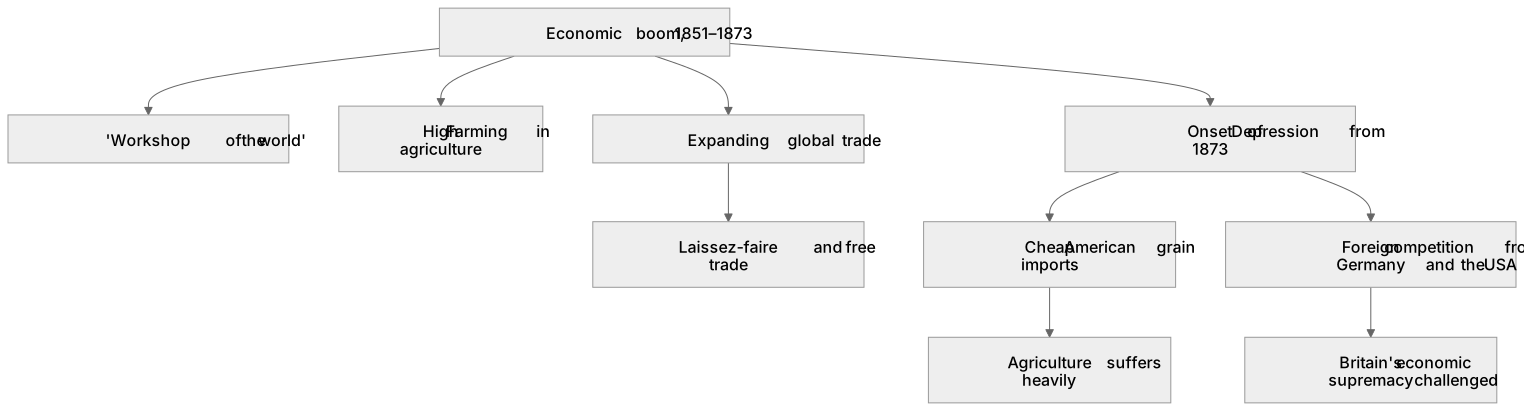
Between 1851 and 1873, Britain experienced an unprecedented economic boom, earning the title 'the workshop of the world'. This era was characterised by industrial dominance in coal, iron, and textiles, showcased globally at the 1851 Great Exhibition. Agriculture thrived through 'High Farming' techniques and capital investment, while expanding global trade was underpinned by the prevailing economic ideology of laissez-faire and free trade. However, this golden age gave way to the onset of the Great Depression from 1873. British agriculture suffered heavily from cheap American grain imports, and industry faced mounting foreign competition from newly industrialising nations like Germany and the USA, challenging Britain's economic supremacy.
What earns the marks
- Explain the concept of 'the workshop of the world' using evidence of Britain's dominance in staple industries like coal, iron, and cotton textiles.
- Analyse the impact of laissez-faire economic ideologies and free trade policies on British economic expansion and global trade networks.
- Evaluate the success of 'High Farming' in agriculture, noting the use of artificial fertilisers and improved drainage before 1873.
- Assess the causes of the onset of Depression post-1873, specifically highlighting foreign tariffs, the influx of cheap American prairie wheat, and increased industrial competition.
Common mistakes and how to put them right
Assuming the post-1873 Depression was a period of absolute economic decline.
Put it right by explaining it was a period of slower growth, shrinking profit margins, and deflation rather than total collapse.
Treating agriculture and industry as entirely separate entities.
Put it right by showing how industrial transport like railways initially aided agriculture but later facilitated cheap foreign imports.
Overstating the government's commitment to laissez-faire.
Put it right by noting that while free trade dominated, the state still intervened in areas like factory legislation and public health.
Exam tips
- Use the 1851 Great Exhibition as a concrete starting point to illustrate Britain's mid-century industrial and trading confidence.
- When discussing the onset of the Depression, differentiate between the severe, structural impact on arable farming and the more nuanced effects on industry and working-class living standards.
- Link economic ideologies directly to government policies, such as Gladstone's budgets, to demonstrate how theory influenced practical economic development.
Try the lesson
The start of the 1G Challenge and transformation: Britain, c1851–1964 – Reform and challenge, c1851–c1886: Economic developments: agriculture, trade and industry; economic ideologies; boom and 'the workshop of the world'; the onset of Depression lesson, made from checked teaching notes for this specification point.
Have a go first
Which economic ideology was most closely associated with Britain's mid-Victorian boom and its status as the 'workshop of the world'?
Listen
Between 1851 and 1873, Britain experienced an unprecedented economic boom, earning the title 'the workshop of the world'. This era was characterised by industrial dominance in coal, iron, and textiles, showcased globally at the 1851 Great Exhibition. Agriculture thrived through 'High Farming' techniques and capital investment, while expanding global trade was underpinned by the prevailing economic ideology of laissez-faire and free trade. However, this golden age gave way to the onset of the Great Depression from 1873. British agriculture suffered heavily from cheap American grain imports, and industry faced mounting foreign competition from newly industrialising nations like Germany and the USA, challenging Britain's economic supremacy. A strong answer earns marks for these points. Explain the concept of 'the workshop of the world' using evidence of Britain's dominance in staple industries like coal, iron, and cotton textiles. Analyse the impact of laissez-faire economic ideologies and free trade policies on British economic expansion and global trade networks. Evaluate the success of 'High Farming' in agriculture, noting the use of artificial fertilisers and improved drainage before 1873. Assess the causes of the onset of Depression post-1873, specifically highlighting foreign tariffs, the influx of cheap American prairie wheat, and increased industrial competition. A common slip: Assuming the post-1873 Depression was a period of absolute economic decline. Instead, explaining it was a period of slower growth, shrinking profit margins, and deflation rather than total collapse. Exam tip: Use the 1851 Great Exhibition as a concrete starting point to illustrate Britain's mid-century industrial and trading confidence.
See it
Label the diagram
Some boxes have lost their names. Pick the right name for each number.
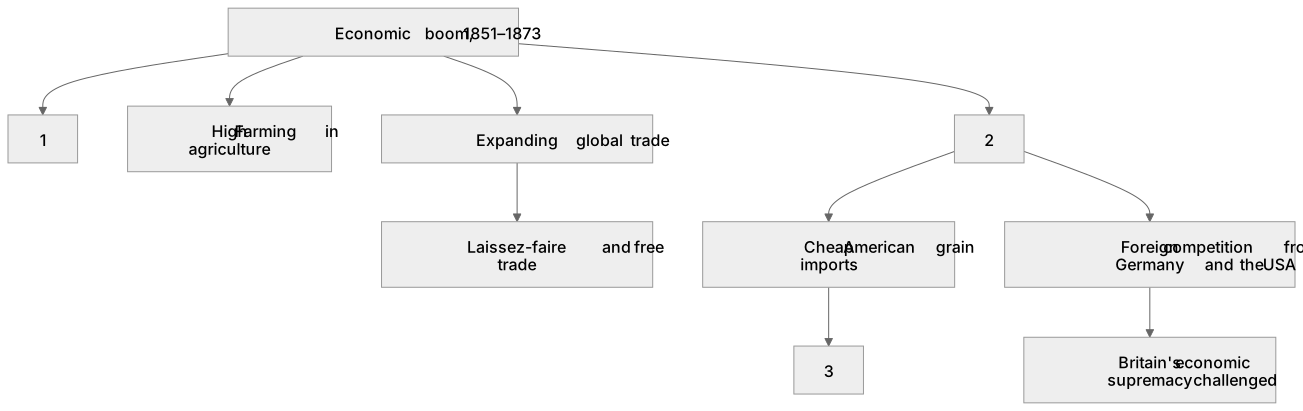
1Box 1
2Box 2
3Box 3
There is more to this lesson
The full lesson goes on to check your understanding and help you earn the marks. Create a free account to carry on, with your progress saved.
A week of Premium from your first lesson · Then the free plan continues · No card, no charge
Test your understanding of 1G Challenge and transformation: Britain, c1851–1964 – Reform and challenge, c1851–c1886: Economic developments: agriculture, trade and industry; economic ideologies; boom and 'the workshop of the world'; the onset of Depression
Active recall beats re-reading. Take an instant quiz now to test what you’ve learned and lock it into long-term memory.
A week of Premium from your first lesson · Then the free plan continues · No card, no charge