AQA · A-Level · History
Course version: 7042 · Version from Sept 2017
Britain, c1851–1964 – Reform and challenge, c1851–c1886: Political…
Full specification wording
1G Challenge and transformation: Britain, c1851–1964 – Reform and challenge, c1851–c1886: Political developments under Gladstone and Disraeli; liberalism, conservatism and the bases of their support; the extension of the franchise
The Gladstone and Disraeli rivalry defined late 19th-century politics.
Checked against the AQA 7042 specification (opens in a new tab) on .
- Point 2 of 6
- 4 key terms
Study notes
From the checked teaching notes for this specification point.
The idea
The Gladstone and Disraeli rivalry defined late 19th-century politics. Gladstone’s Liberalism championed free trade, retrenchment, and reform, drawing support from nonconformists, the middle class, and artisans. Disraeli’s One Nation Conservatism emphasised paternalism, empire, and traditional institutions, appealing to the aristocracy, the Anglican Church, and working-class voters. A defining development was the extension of the franchise. Disraeli’s 1867 Second Reform Act enfranchised the urban working class, while Gladstone’s 1884 Act extended voting rights to rural areas. These democratic reforms forced both leaders to adapt their national party organisations to secure their shifting bases of support and win newly enfranchised voters.
What earns the marks
- Compare the core ideological principles of Gladstonian Liberalism and Disraelian Conservatism.
- Analyse how the 1867 and 1884 Reform Acts altered the electoral landscape and the bases of party support.
- Evaluate the effectiveness of Disraeli's social reforms in securing working-class support for the Conservative Party.
- Assess the impact of Gladstone's institutional reforms, such as the 1870 Education Act, on his nonconformist support base.
Common mistakes and how to put them right
Claiming the 1867 Reform Act introduced universal male suffrage.
Put it right by specifying it enfranchised urban male householders, leaving many without the vote.
Assuming working-class voters exclusively supported the Liberals.
Put it right by explaining Disraeli's success in attracting working-class Tory support through One Nation Conservatism.
Confusing the terms of the 1867 and 1884 Reform Acts.
Put it right by attributing the urban franchise extension to Disraeli (1867) and the rural extension to Gladstone (1884).
Exam tips
- Link specific legislative acts, like the 1872 Secret Ballot Act, directly to the broader theme of franchise extension and democratic development.
- When discussing bases of support, explicitly mention the role of religion, such as Anglican support for Conservatives and Nonconformist support for Liberals.
- Use the concept of 'Tory Democracy' to explain how Disraeli adapted Conservatism to survive in a more democratic political system.
Try the lesson
The start of the 1G Challenge and transformation: Britain, c1851–1964 – Reform and challenge, c1851–c1886: Political developments under Gladstone and Disraeli; liberalism, conservatism and the bases of their support; the extension of the franchise lesson, made from checked teaching notes for this specification point.
Have a go first
Which demographic group was the primary beneficiary of the franchise extension in the 1884 Representation of the People Act?
Listen
The Gladstone and Disraeli rivalry defined late 19th-century politics. Gladstone’s Liberalism championed free trade, retrenchment, and reform, drawing support from nonconformists, the middle class, and artisans. Disraeli’s One Nation Conservatism emphasised paternalism, empire, and traditional institutions, appealing to the aristocracy, the Anglican Church, and working-class voters. A defining development was the extension of the franchise. Disraeli’s 1867 Second Reform Act enfranchised the urban working class, while Gladstone’s 1884 Act extended voting rights to rural areas. These democratic reforms forced both leaders to adapt their national party organisations to secure their shifting bases of support and win newly enfranchised voters. A strong answer earns marks for these points. Compare the core ideological principles of Gladstonian Liberalism and Disraelian Conservatism. Analyse how the 1867 and 1884 Reform Acts altered the electoral landscape and the bases of party support. Evaluate the effectiveness of Disraeli's social reforms in securing working-class support for the Conservative Party. Assess the impact of Gladstone's institutional reforms, such as the 1870 Education Act, on his nonconformist support base. A common slip: Claiming the 1867 Reform Act introduced universal male suffrage. Instead, specifying it enfranchised urban male householders, leaving many without the vote. Exam tip: Link specific legislative acts, like the 1872 Secret Ballot Act, directly to the broader theme of franchise extension and democratic development.
See it
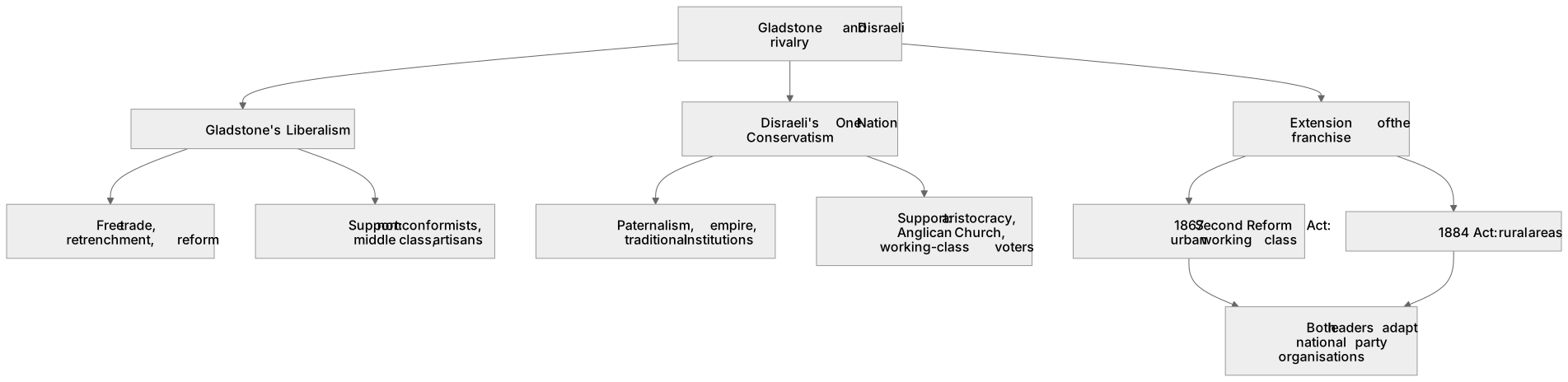
Key words
Say what each word means before you turn the card.
Franchise extension
Try answering aloud or in your head before turning the card.
Liberalism
Try answering aloud or in your head before turning the card.
Conservatism
Try answering aloud or in your head before turning the card.
Party organisation
Try answering aloud or in your head before turning the card.
See every definition
- Franchise extension
- A defining development in which Disraeli's 1867 Second Reform Act enfranchised the urban working class and Gladstone's 1884 Act extended voting rights to rural areas.
- Liberalism
- Gladstone's Liberalism championed free trade, retrenchment and reform, drawing support from nonconformists, the middle class and artisans.
- Conservatism
- Disraeli's One Nation Conservatism emphasised paternalism, empire and traditional institutions, appealing to the aristocracy, the Anglican Church and working-class voters.
- Party organisation
- National party organisations were adapted by both leaders to secure their shifting bases of support and win newly enfranchised voters.
Label the diagram
Some boxes have lost their names. Pick the right name for each number.
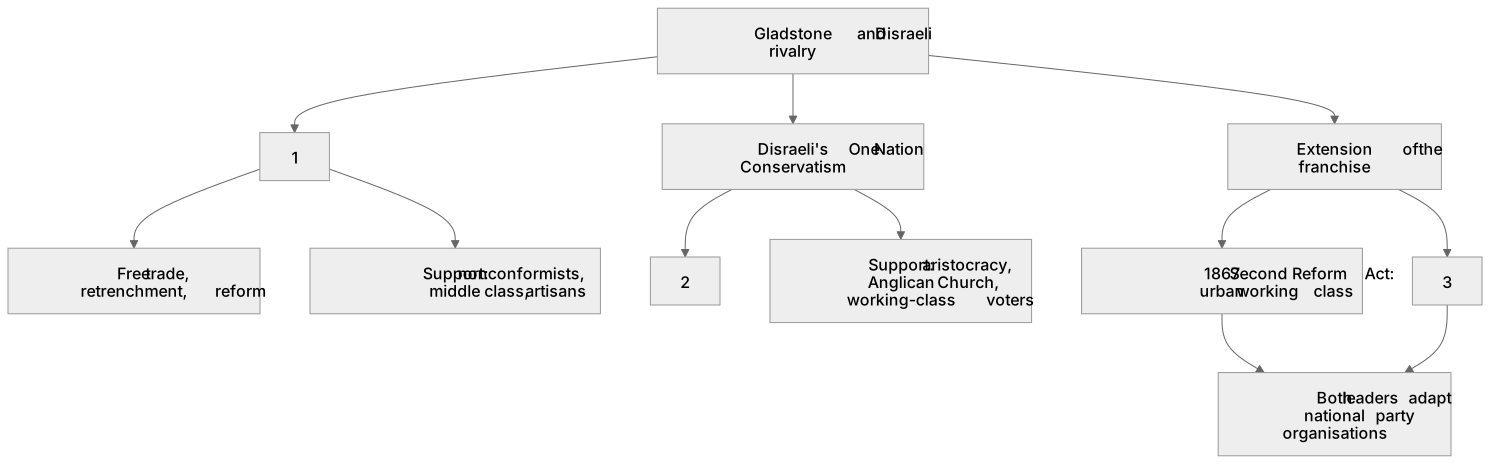
1Box 1
2Box 2
3Box 3
There is more to this lesson
The full lesson goes on to check your understanding and help you earn the marks. Create a free account to carry on, with your progress saved.
A week of Premium from your first lesson · Then the free plan continues · No card, no charge
Test your understanding of 1G Challenge and transformation: Britain, c1851–1964 – Reform and challenge, c1851–c1886: Political developments under Gladstone and Disraeli; liberalism, conservatism and the bases of their support; the extension of the franchise
Active recall beats re-reading. Take an instant quiz now to test what you’ve learned and lock it into long-term memory.
A week of Premium from your first lesson · Then the free plan continues · No card, no charge