AQA · A-Level · History
Course version: 7042 · Version from Sept 2017
Britain, c1851–1964 – Reform and challenge, c1851–c1886: The political…
Full specification wording
1G Challenge and transformation: Britain, c1851–1964 – Reform and challenge, c1851–c1886: The political system: parliament and the workings of mid-19th century democracy; ruling elites; prime ministers; parties and party realignment to 1867
In 1851, Britain's political system was dominated by aristocratic ruling elites, despite the 1832 Reform Act.
Checked against the AQA 7042 specification (opens in a new tab) on .
- Point 1 of 6
- 4 key terms
Study notes
From the checked teaching notes for this specification point.
The idea
In 1851, Britain's political system was dominated by aristocratic ruling elites, despite the 1832 Reform Act. Parliament functioned as a limited democracy where landownership dictated influence, and the franchise excluded the working classes. Prime ministers like Palmerston, Derby, and Russell navigated a fluid political landscape characterised by loose factions rather than rigid modern parties. A crucial development was party realignment, culminating in the 1859 Willis's Rooms meeting, which united Whigs, Peelites, and Radicals to form the Liberal Party. Meanwhile, the Conservatives struggled to shed their protectionist image. This period of shifting allegiances and elite dominance set the stage for the 1867 Second Reform Act, which fundamentally altered the workings of democracy by expanding the electorate.
What earns the marks
- Evaluate the extent of aristocratic dominance in the Cabinet and Parliament between 1851 and 1867.
- Analyse the impact of key prime ministers, such as Palmerston's foreign policy focus and domestic conservatism, on party cohesion.
- Assess the significance of the 1859 Willis's Rooms meeting in the formal creation of the Liberal Party from disparate factions.
- Explain the limitations of mid-19th century democracy, specifically the restricted franchise and unequal constituency sizes prior to 1867.
Common mistakes and how to put them right
Assuming modern, highly disciplined political parties existed in the 1850s.
Put it right by describing them as loose coalitions of Whigs, Peelites, Radicals, and Tories.
Overstating the democratic nature of Parliament before 1867.
Put it right by emphasising that the ruling elite and landed aristocracy still controlled the political system.
Confusing the roles of prime ministers.
Put it right by distinguishing Palmerston's resistance to parliamentary reform from Russell's attempts to introduce it.
Exam tips
- Use the formation of the Liberal Party in 1859 as a primary example of party realignment when discussing political instability.
- Contrast the political influence of the landed elite in the House of Lords with the growing economic power of the middle classes in the Commons.
- When evaluating prime ministers, link their individual leadership styles to the broader factionalism of the 1850s and 1860s.
Try the lesson
The start of the 1G Challenge and transformation: Britain, c1851–1964 – Reform and challenge, c1851–c1886: The political system: parliament and the workings of mid-19th century democracy; ruling elites; prime ministers; parties and party realignment to 1867 lesson, made from checked teaching notes for this specification point.
Have a go first
Which group predominantly controlled the British political system and Parliament in the mid-19th century prior to the 1867 Reform Act?
Listen
In 1851, Britain's political system was dominated by aristocratic ruling elites, despite the 1832 Reform Act. Parliament functioned as a limited democracy where landownership dictated influence, and the franchise excluded the working classes. Prime ministers like Palmerston, Derby, and Russell navigated a fluid political landscape characterised by loose factions rather than rigid modern parties. A crucial development was party realignment, culminating in the 1859 Willis's Rooms meeting, which united Whigs, Peelites, and Radicals to form the Liberal Party. Meanwhile, the Conservatives struggled to shed their protectionist image. This period of shifting allegiances and elite dominance set the stage for the 1867 Second Reform Act, which fundamentally altered the workings of democracy by expanding the electorate. A strong answer earns marks for these points. Evaluate the extent of aristocratic dominance in the Cabinet and Parliament between 1851 and 1867. Analyse the impact of key prime ministers, such as Palmerston's foreign policy focus and domestic conservatism, on party cohesion. Assess the significance of the 1859 Willis's Rooms meeting in the formal creation of the Liberal Party from disparate factions. Explain the limitations of mid-19th century democracy, specifically the restricted franchise and unequal constituency sizes prior to 1867. A common slip: Assuming modern, highly disciplined political parties existed in the 1850s. Instead, describing them as loose coalitions of Whigs, Peelites, Radicals, and Tories. Exam tip: Use the formation of the Liberal Party in 1859 as a primary example of party realignment when discussing political instability.
See it
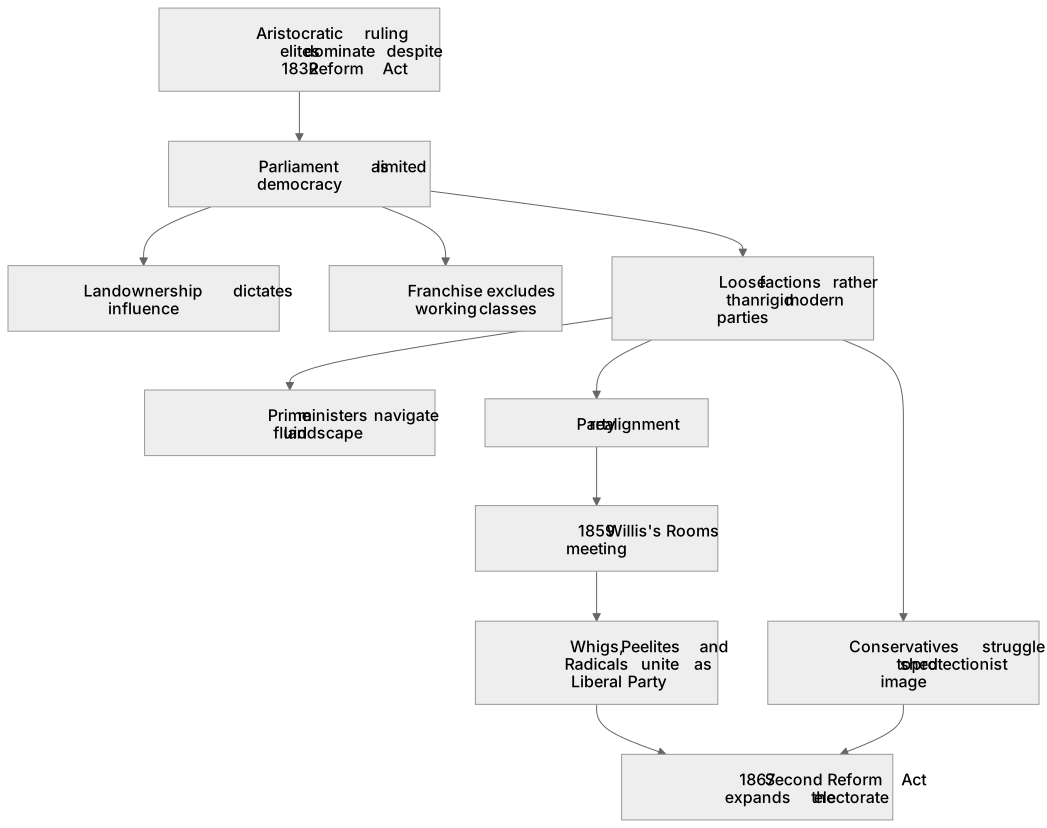
Key words
Say what each word means before you turn the card.
Aristocratic dominance
Try answering aloud or in your head before turning the card.
Party realignment
Try answering aloud or in your head before turning the card.
Evolution of democracy
Try answering aloud or in your head before turning the card.
Executive leadership
Try answering aloud or in your head before turning the card.
See every definition
- Aristocratic dominance
- The control of Britain's political system by aristocratic ruling elites, with landownership dictating influence in Parliament despite the 1832 Reform Act.
- Party realignment
- A crucial development in the fluid political landscape, culminating in the 1859 Willis's Rooms meeting which united Whigs, Peelites and Radicals to form the Liberal Party.
- Evolution of democracy
- The altering of the workings of democracy through the 1867 Second Reform Act, which expanded the electorate beyond the limited democracy of 1851.
- Executive leadership
- The role of prime ministers such as Palmerston, Derby and Russell in navigating a political landscape characterised by loose factions rather than rigid modern parties.
Label the diagram
Some boxes have lost their names. Pick the right name for each number.
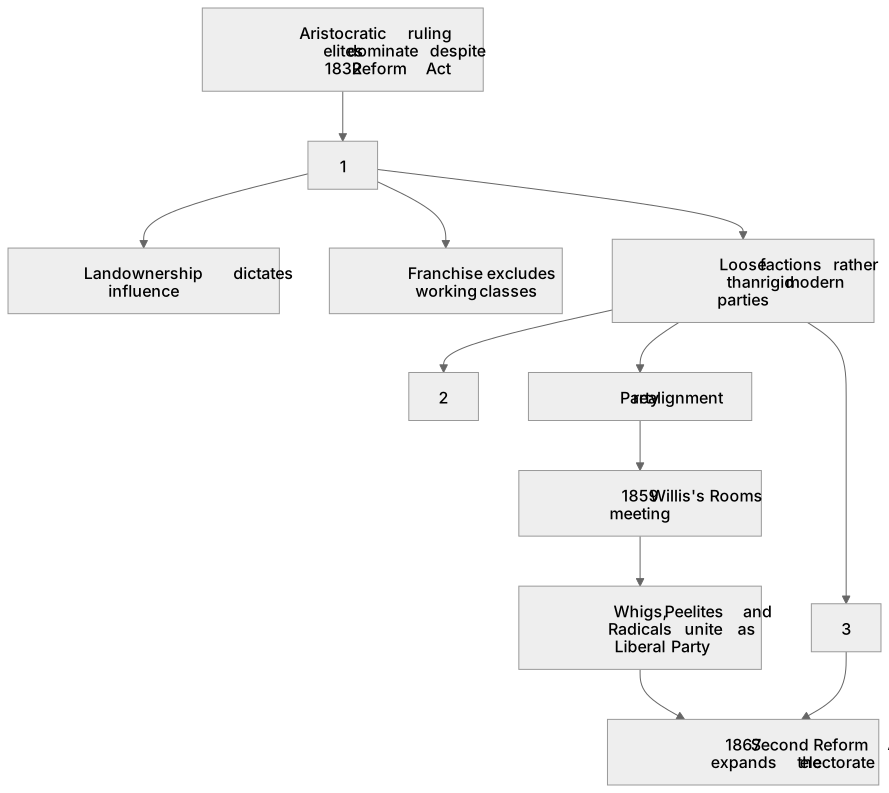
1Box 1
2Box 2
3Box 3
There is more to this lesson
The full lesson goes on to check your understanding and help you earn the marks. Create a free account to carry on, with your progress saved.
A week of Premium from your first lesson · Then the free plan continues · No card, no charge
Test your understanding of 1G Challenge and transformation: Britain, c1851–1964 – Reform and challenge, c1851–c1886: The political system: parliament and the workings of mid-19th century democracy; ruling elites; prime ministers; parties and party realignment to 1867
Active recall beats re-reading. Take an instant quiz now to test what you’ve learned and lock it into long-term memory.
A week of Premium from your first lesson · Then the free plan continues · No card, no charge