AQA · A-Level · History
Course version: 7042 · Version from Sept 2017
Britain, c1851–1964 – Transformation and change, 1939–1964 (A-level only):…
Full specification wording
1G Challenge and transformation: Britain, c1851–1964 – Transformation and change, 1939–1964 (A-level only): Developments in social policy: the Beveridge Report; the Butler Act; the growth of the Welfare State, including the NHS; the growth of education
The period 1939–1964 witnessed a profound transformation in British social policy, laying the foundations of the modern Welfare State.
Checked against the AQA 7042 specification (opens in a new tab) on .
- Point 5 of 6
- 4 key terms
Study notes
From the checked teaching notes for this specification point.
The idea
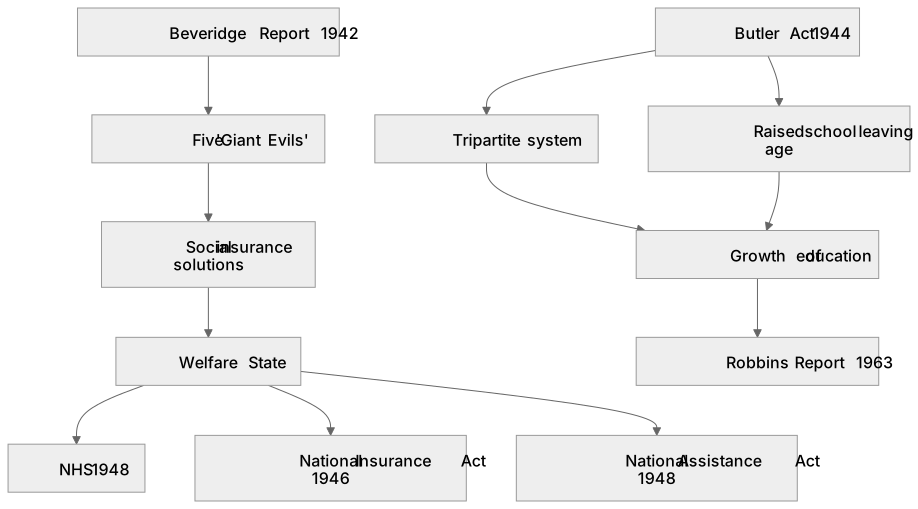
The period 1939–1964 witnessed a profound transformation in British social policy, laying the foundations of the modern Welfare State. The 1942 Beveridge Report identified five 'Giant Evils' and proposed a comprehensive system of social insurance. This vision was realised through the post-war Labour government's creation of the Welfare State, most notably the establishment of the National Health Service (NHS) in 1948, providing free healthcare at the point of use. Education also expanded significantly; the 1944 Butler Act introduced the tripartite system and raised the school leaving age, while subsequent decades saw further growth in educational provision, including the expansion of higher education and the beginnings of the comprehensive debate, reflecting a drive towards greater social equality.
What earns the marks
- Identify the five 'Giant Evils' outlined in the 1942 Beveridge Report (Want, Disease, Ignorance, Squalor, Idleness) and the proposed social insurance solutions.
- Explain the provisions and impact of the 1944 Butler Education Act, including the tripartite system of grammar, secondary modern, and technical schools.
- Analyse the legislative steps taken by the Attlee government to build the Welfare State, such as the National Insurance Act 1946 and the National Assistance Act 1948.
- Evaluate the significance of the creation of the NHS in 1948 under Aneurin Bevan and its foundational principle of universal, free healthcare.
- Assess the continued growth of education in the 1950s and early 1960s, including the Robbins Report of 1963 and the subsequent expansion of university places.
Common mistakes and how to put them right
Attributing the creation of the Welfare State solely to the Labour Party.
Put it right by acknowledging the cross-party consensus and the wartime coalition's role, including the Liberal William Beveridge and Conservative R.A. Butler.
Confusing the Butler Act with later comprehensive reforms.
Put it right by specifying that the 1944 Act established the tripartite system based on the 11-plus examination, which separated children by perceived academic ability.
Assuming the NHS was universally welcomed by medical professionals.
Put it right by noting the initial fierce opposition from the British Medical Association (BMA) which Bevan had to overcome through compromise.
Exam tips
- Link the Beveridge Report's 'Giant Evils' directly to the specific legislation designed to tackle them, such as the NHS for 'Disease' and the Butler Act for 'Ignorance'.
- When evaluating the Welfare State, consider both its immediate successes in reducing poverty and improving public health, and the long-term financial pressures it created.
- Use the Butler Act to discuss social mobility, evaluating whether the tripartite system genuinely provided 'parity of esteem' between different school types as intended.
Try the lesson
The start of the 1G Challenge and transformation: Britain, c1851–1964 – Transformation and change, 1939–1964 (A-level only): Developments in social policy: the Beveridge Report; the Butler Act; the growth of the Welfare State, including the NHS; the growth of education lesson, made from checked teaching notes for this specification point.
Have a go first
Which of the following was the primary recommendation of the 1942 Beveridge Report regarding social security in Britain?
Listen
The period 1939–1964 witnessed a profound transformation in British social policy, laying the foundations of the modern Welfare State. The 1942 Beveridge Report identified five 'Giant Evils' and proposed a comprehensive system of social insurance. This vision was realised through the post-war Labour government's creation of the Welfare State, most notably the establishment of the National Health Service (NHS) in 1948, providing free healthcare at the point of use. Education also expanded significantly; the 1944 Butler Act introduced the tripartite system and raised the school leaving age, while subsequent decades saw further growth in educational provision, including the expansion of higher education and the beginnings of the comprehensive debate, reflecting a drive towards greater social equality. A strong answer earns marks for these points. Identify the five 'Giant Evils' outlined in the 1942 Beveridge Report (Want, Disease, Ignorance, Squalor, Idleness) and the proposed social insurance solutions. Explain the provisions and impact of the 1944 Butler Education Act, including the tripartite system of grammar, secondary modern, and technical schools. Analyse the legislative steps taken by the Attlee government to build the Welfare State, such as the National Insurance Act 1946 and the National Assistance Act 1948. Evaluate the significance of the creation of the NHS in 1948 under Aneurin Bevan and its foundational principle of universal, free healthcare. A common slip: Attributing the creation of the Welfare State solely to the Labour Party. Instead, acknowledging the cross-party consensus and the wartime coalition's role, including the Liberal William Beveridge and Conservative R.A. Butler. Exam tip: Link the Beveridge Report's 'Giant Evils' directly to the specific legislation designed to tackle them, such as the NHS for 'Disease' and the Butler Act for 'Ignorance'.
See it
Put the events in order
Put these events in the order they happened, earliest first.
- 1. Butler Act introduced the tripartite system
- 2. Beveridge Report identified five 'Giant Evils'
- 3. Robbins Report led to expansion of university places
- 4. National Insurance Act passed by the Attlee government
- 5. NHS created under Aneurin Bevan
Key words
Say what each word means before you turn the card.
Beveridge Report
Try answering aloud or in your head before turning the card.
Butler Act
Try answering aloud or in your head before turning the card.
Welfare State
Try answering aloud or in your head before turning the card.
NHS
Try answering aloud or in your head before turning the card.
See every definition
- Beveridge Report
- The 1942 report identified five 'Giant Evils' and proposed a comprehensive system of social insurance.
- Butler Act
- The 1944 Act introduced the tripartite system and raised the school leaving age.
- Welfare State
- Built by the post-war Labour government, it included the NHS and provided free healthcare at the point of use.
- NHS
- Established in 1948, it provided free healthcare at the point of use.
Label the diagram
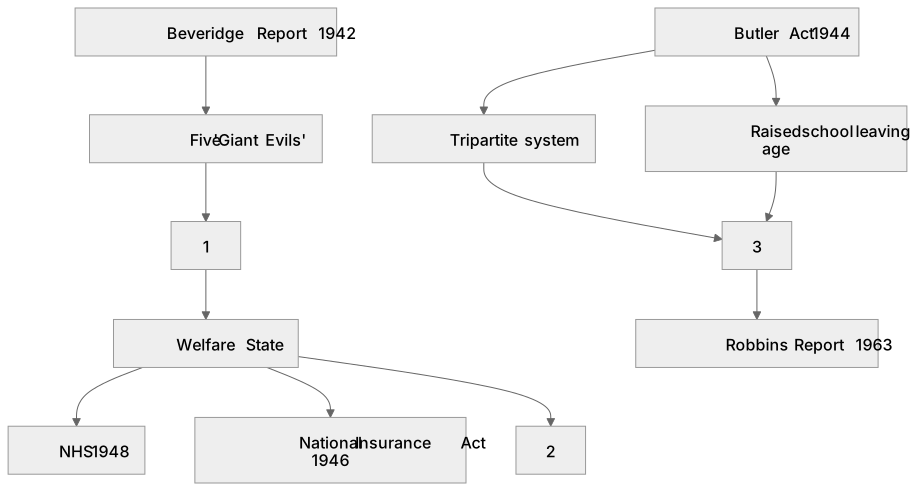
Some boxes have lost their names. Pick the right name for each number.
1Box 1
2Box 2
3Box 3
There is more to this lesson
The full lesson goes on to check your understanding and help you earn the marks. Create a free account to carry on, with your progress saved.
A week of Premium from your first lesson · Then the free plan continues · No card, no charge
Test your understanding of 1G Challenge and transformation: Britain, c1851–1964 – Transformation and change, 1939–1964 (A-level only): Developments in social policy: the Beveridge Report; the Butler Act; the growth of the Welfare State, including the NHS; the growth of education
Active recall beats re-reading. Take an instant quiz now to test what you’ve learned and lock it into long-term memory.
A week of Premium from your first lesson · Then the free plan continues · No card, no charge