AQA · A-Level · History
Course version: 7042 · Version from Sept 2017
Britain, c1851–1964 – Transformation and change, 1939–1964 (A-level only):…
Full specification wording
1G Challenge and transformation: Britain, c1851–1964 – Transformation and change, 1939–1964 (A-level only): The condition of Ireland and Anglo-Irish relations: continuing north/south friction including riots of September 1964; beginnings of civil rights campaign
Anglo-Irish relations and the condition of Ireland remained tense between 1939 and 1964, characterised by deep-rooted sectarian divisions and continuing north/south friction.
Checked against the AQA 7042 specification (opens in a new tab) on .
- Point 6 of 6
- 4 key terms
Study notes
From the checked teaching notes for this specification point.
The idea
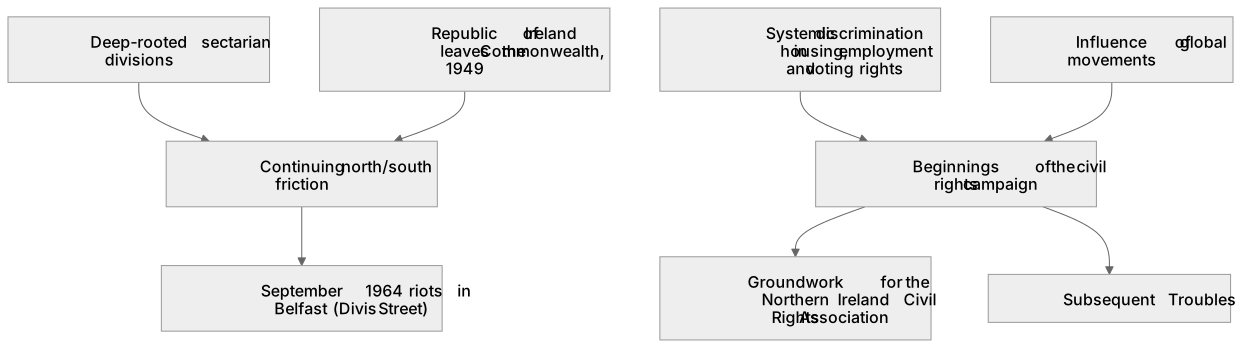
Anglo-Irish relations and the condition of Ireland remained tense between 1939 and 1964, characterised by deep-rooted sectarian divisions and continuing north/south friction. The Republic of Ireland's departure from the Commonwealth in 1949 solidified partition, exacerbating tensions with Northern Ireland. This friction culminated in events like the September 1964 Divis Street riots in Belfast, sparked by the display of an Irish tricolour during an election campaign. Concurrently, the period saw the beginnings of the civil rights campaign in Northern Ireland. Influenced by global movements, Catholics began organising to protest against systemic discrimination in housing, employment, and voting rights, laying the groundwork for the Northern Ireland Civil Rights Association and the subsequent Troubles.
What earns the marks
- Analyse the causes of continuing north/south friction, including the Republic of Ireland Act 1948 and the Ireland Act 1949 which guaranteed Northern Ireland's position within the UK.
- Describe the events and significance of the September 1964 riots in Belfast (Divis Street riots) as a manifestation of underlying sectarian tensions and unionist anxieties.
- Identify the systemic grievances of the Catholic minority in Northern Ireland, such as gerrymandering, unfair housing allocation, and employment discrimination.
- Trace the early origins of the civil rights campaign in the early 1960s, noting the influence of international civil rights movements and the emergence of groups like the Campaign for Social Justice (CSJ).
Common mistakes and how to put them right
Confusing the early 1960s civil rights campaign with the later, more violent phase of the Troubles.
Put it right by emphasising that the initial movement focused on peaceful protest and legislative reform.
Assuming the September 1964 riots were a spontaneous, isolated event.
Put it right by contextualising them within the long-standing unionist suppression of nationalist symbols, specifically the flying of the Irish tricolour.
Treating 'Ireland' as a single political entity in this period.
Put it right: Clearly distinguishing between the independent Republic of Ireland (south) and Northern Ireland (part of the UK) when discussing Anglo-Irish relations.
Exam tips
- Use the September 1964 riots as a specific case study to illustrate the volatility of sectarian relations and the fragility of peace before the official start of the Troubles.
- Connect the beginnings of the civil rights campaign to broader social changes, such as the emergence of a university-educated Catholic middle class benefiting from the post-war growth in education.
- When discussing Anglo-Irish relations, ensure you address the political stances of both the British government in Westminster and the Stormont government towards the Republic.
Try the lesson
The start of the 1G Challenge and transformation: Britain, c1851–1964 – Transformation and change, 1939–1964 (A-level only): The condition of Ireland and Anglo-Irish relations: continuing north/south friction including riots of September 1964; beginnings of civil rights campaign lesson, made from checked teaching notes for this specification point.
Have a go first
What was the immediate catalyst for the severe riots that occurred in West Belfast in September 1964?
Listen
Anglo-Irish relations and the condition of Ireland remained tense between 1939 and 1964, characterised by deep-rooted sectarian divisions and continuing north/south friction. The Republic of Ireland's departure from the Commonwealth in 1949 solidified partition, exacerbating tensions with Northern Ireland. This friction culminated in events like the September 1964 Divis Street riots in Belfast, sparked by the display of an Irish tricolour during an election campaign. Concurrently, the period saw the beginnings of the civil rights campaign in Northern Ireland. Influenced by global movements, Catholics began organising to protest against systemic discrimination in housing, employment, and voting rights, laying the groundwork for the Northern Ireland Civil Rights Association and the subsequent Troubles. A strong answer earns marks for these points. Analyse the causes of continuing north/south friction, including the Republic of Ireland Act 1948 and the Ireland Act 1949 which guaranteed Northern Ireland's position within the UK. Describe the events and significance of the September 1964 riots in Belfast (Divis Street riots) as a manifestation of underlying sectarian tensions and unionist anxieties. Identify the systemic grievances of the Catholic minority in Northern Ireland, such as gerrymandering, unfair housing allocation, and employment discrimination. Trace the early origins of the civil rights campaign in the early 1960s, noting the influence of international civil rights movements and the emergence of groups like the Campaign for Social Justice (CSJ). A common slip: Confusing the early 1960s civil rights campaign with the later, more violent phase of the Troubles. Instead, emphasising that the initial movement focused on peaceful protest and legislative reform. Exam tip: Use the September 1964 riots as a specific case study to illustrate the volatility of sectarian relations and the fragility of peace before the official start of the Troubles.
See it
Put the events in order
Put these events in the order they happened, earliest first.
- 1. Republic of Ireland Act
- 2. Divis Street riots in Belfast
- 3. Ireland Act guaranteed Northern Ireland's position within the UK
Key words
Say what each word means before you turn the card.
Sectarianism and division
Try answering aloud or in your head before turning the card.
Civil rights and discrimination
Try answering aloud or in your head before turning the card.
Anglo-Irish diplomacy
Try answering aloud or in your head before turning the card.
Political protest and violence
Try answering aloud or in your head before turning the card.
See every definition
- Sectarianism and division
- Deep-rooted sectarian divisions characterised the condition of Ireland and Anglo-Irish relations between 1939 and 1964.
- Civil rights and discrimination
- Catholics began organising to protest against systemic discrimination in housing, employment, and voting rights in Northern Ireland.
- Anglo-Irish diplomacy
- Anglo-Irish relations remained tense, with continuing north/south friction and the Republic of Ireland's departure from the Commonwealth in 1949 solidifying partition.
- Political protest and violence
- The beginnings of the civil rights campaign saw Catholics organising peaceful protest, while the September 1964 Divis Street riots in Belfast manifested underlying sectarian tensions.
Label the diagram
Some boxes have lost their names. Pick the right name for each number.
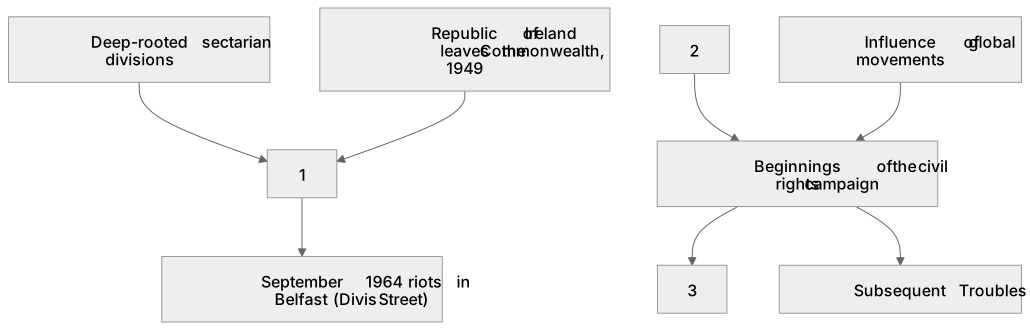
1Box 1
2Box 2
3Box 3
There is more to this lesson
The full lesson goes on to check your understanding and help you earn the marks. Create a free account to carry on, with your progress saved.
A week of Premium from your first lesson · Then the free plan continues · No card, no charge
Test your understanding of 1G Challenge and transformation: Britain, c1851–1964 – Transformation and change, 1939–1964 (A-level only): The condition of Ireland and Anglo-Irish relations: continuing north/south friction including riots of September 1964; beginnings of civil rights campaign
Active recall beats re-reading. Take an instant quiz now to test what you’ve learned and lock it into long-term memory.
A week of Premium from your first lesson · Then the free plan continues · No card, no charge