AQA · A-Level · History
Course version: 7042 · Version from Sept 2017
How important was the role of individuals and groups and how were they…
Full specification wording
1H Tsarist and Communist Russia, 1855–1964 – consequence in this period through the following key questions:: How important was the role of individuals and groups and how were they affected by developments?
This topic requires evaluating the agency of individuals and groups, alongside how historical developments impacted them between 1855 and 1964.
Checked against the AQA 7042 specification (opens in a new tab) on .
- Point 6 of 6
- 3 key terms
Study notes
From the checked teaching notes for this specification point.
The idea
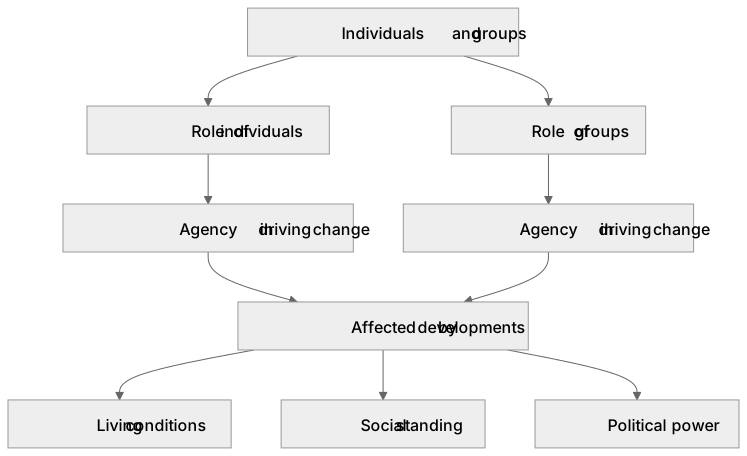
This topic requires evaluating the agency of individuals and groups, alongside how historical developments impacted them between 1855 and 1964. Equally important is the role of groups, including the peasantry, the proletariat, and the nomenklatura.
What earns the marks
- Evaluate the extent to which individual leaders personally drove historical change versus reacting to broader socio-economic circumstances.
- Assess the role of specific social groups, such as the peasantry or industrial workers, in precipitating crises or supporting the state apparatus.
- Analyse the impact of major developments, like the Emancipation of the Serfs or the Five-Year Plans, on the living and working conditions of different classes.
- Compare the changing status and influence of the traditional nobility under the Tsars with the emergence of the Communist Party elite (nomenklatura).
Common mistakes and how to put them right
Focusing solely on leaders and ignoring the role of social groups.
Put it right: Ensure answers balance top-down individual actions with bottom-up group pressures.
Describing developments without explaining their impact on people.
Put it right: Explicitly link events like collectivisation to the resulting social and economic effects on the peasantry.
Treating groups like 'the peasants' as a single homogeneous bloc.
Put it right: Acknowledge divisions within groups, such as the distinction between kulaks and poorer peasants.
Exam tips
- When discussing an individual's importance, contrast their personal agency with broader structural or economic factors that limited their choices.
- Use specific statistics or examples of living conditions to demonstrate exactly how a group was affected by a major policy development.
- Structure essays to explicitly address both halves of the question: the groups' active role in causing events and their passive experience of being affected by them.
Try the lesson
The start of the 1H Tsarist and Communist Russia, 1855–1964 – consequence in this period through the following key questions:: How important was the role of individuals and groups and how were they affected by developments? lesson, made from checked teaching notes for this specification point.
Have a go first
What was the primary role of Alexander II in the major social developments of Russia during the 1860s?
Listen
This topic requires evaluating the agency of individuals and groups, alongside how historical developments impacted them between 1855 and 1964. Equally important is the role of groups, including the peasantry, the proletariat, and the nomenklatura. A strong answer earns marks for these points. Evaluate the extent to which individual leaders personally drove historical change versus reacting to broader socio-economic circumstances. Assess the role of specific social groups, such as the peasantry or industrial workers, in precipitating crises or supporting the state apparatus. Analyse the impact of major developments, like the Emancipation of the Serfs or the Five-Year Plans, on the living and working conditions of different classes. Compare the changing status and influence of the traditional nobility under the Tsars with the emergence of the Communist Party elite (nomenklatura). A common slip: Focusing solely on leaders and ignoring the role of social groups. Instead, ensure answers balance top-down individual actions with bottom-up group pressures. Exam tip: When discussing an individual's importance, contrast their personal agency with broader structural or economic factors that limited their choices.
See it
Key words
Say what each word means before you turn the card.
Leadership and Agency
Try answering aloud or in your head before turning the card.
Impact of State Policy
Try answering aloud or in your head before turning the card.
Top-down versus Bottom-up History
Try answering aloud or in your head before turning the card.
See every definition
- Leadership and Agency
- Evaluating the agency of individuals and groups, including the influence of key individuals and the role of groups in driving change.
- Impact of State Policy
- Analysing the impact of major developments on the living and working conditions of different classes.
- Top-down versus Bottom-up History
- Balancing top-down individual actions with bottom-up group pressures, rather than focusing solely on leaders and ignoring social groups.
There is more to this lesson
The full lesson goes on to check your understanding and help you earn the marks. Create a free account to carry on, with your progress saved.
A week of Premium from your first lesson · Then the free plan continues · No card, no charge
Test your understanding of 1H Tsarist and Communist Russia, 1855–1964 – consequence in this period through the following key questions:: How important was the role of individuals and groups and how were they affected by developments?
Active recall beats re-reading. Take an instant quiz now to test what you’ve learned and lock it into long-term memory.
A week of Premium from your first lesson · Then the free plan continues · No card, no charge