AQA · A-Level · History
Course version: 7042 · Version from Sept 2017
How important were ideas and ideology?
Full specification wording
1H Tsarist and Communist Russia, 1855–1964 – consequence in this period through the following key questions:: How important were ideas and ideology?
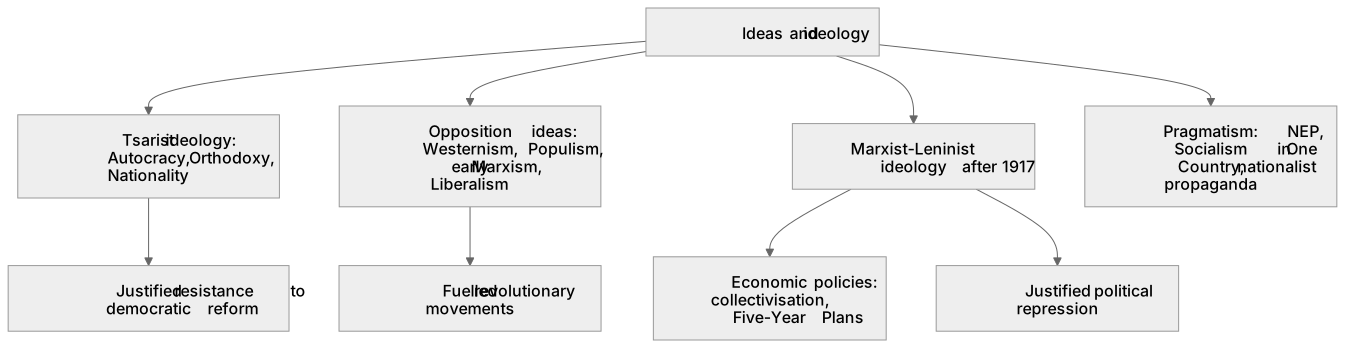
Under the Tsars, the ideology of autocracy, underpinned by Orthodoxy and Official Nationality, justified resistance to democratic reform, while opposing ideas like Westernism, Populism, and early…
Checked against the AQA 7042 specification (opens in a new tab) on .
- Point 5 of 6
- 2 key terms
Study notes
From the checked teaching notes for this specification point.
The idea
Under the Tsars, the ideology of autocracy, underpinned by Orthodoxy and Official Nationality, justified resistance to democratic reform, while opposing ideas like Westernism, Populism, and early Marxism fuelled revolutionary movements. Following 1917, Marxist-Leninist ideology became the state's driving force, dictating economic policies such as collectivisation and the Five-Year Plans, and justifying political repression.
What earns the marks
- Evaluate the role of Tsarist ideologies, specifically Autocracy, Orthodoxy, and Nationality, in maintaining the status quo and resisting political reform.
- Assess the impact of opposition ideas, such as Populism, Marxism, and Liberalism, in undermining the Tsarist regime leading up to the 1917 revolutions.
- Analyse how Marxist-Leninist ideology shaped early Soviet policies, including the implementation of War Communism and the justification of the Red Terror.
- Examine instances where ideological goals were compromised for pragmatic reasons, such as the introduction of the New Economic Policy (NEP) or nationalist propaganda during the Great Patriotic War.
Common mistakes and how to put them right
Treating Tsarist Russia as devoid of ideology.
Put it right: Recognise that 'Autocracy, Orthodoxy, and Nationality' functioned as a powerful, conservative state ideology.
Assuming Soviet policy was always strictly Marxist.
Put it right: Identify pragmatic shifts, such as Stalin's 'Socialism in One Country', which adapted ideology to suit political realities.
Conflating the ideas of different opposition groups.
Put it right: Clearly distinguish between the agrarian focus of the Populists (Narodniks) and the proletarian focus of the Marxists.
Exam tips
- Always link specific policies, such as collectivisation or Russification, back to their underlying ideological justifications.
- Use the concept of pragmatism as a counter-argument when evaluating the overall importance of ideology in driving state decisions.
- Track the evolution of Marxist ideology from Lenin to Stalin and Khrushchev to demonstrate a nuanced understanding of ideological change over time.
Try the lesson
The start of the 1H Tsarist and Communist Russia, 1855–1964 – consequence in this period through the following key questions:: How important were ideas and ideology? lesson, made from checked teaching notes for this specification point.
Have a go first
How did Marxist-Leninist ideology primarily influence the implementation of the First Five-Year Plan and collectivisation under Stalin?
Listen
Under the Tsars, the ideology of autocracy, underpinned by Orthodoxy and Official Nationality, justified resistance to democratic reform, while opposing ideas like Westernism, Populism, and early Marxism fuelled revolutionary movements. Following 1917, Marxist-Leninist ideology became the state's driving force, dictating economic policies such as collectivisation and the Five-Year Plans, and justifying political repression. A strong answer earns marks for these points. Evaluate the role of Tsarist ideologies, specifically Autocracy, Orthodoxy, and Nationality, in maintaining the status quo and resisting political reform. Assess the impact of opposition ideas, such as Populism, Marxism, and Liberalism, in undermining the Tsarist regime leading up to the 1917 revolutions. Analyse how Marxist-Leninist ideology shaped early Soviet policies, including the implementation of War Communism and the justification of the Red Terror. Examine instances where ideological goals were compromised for pragmatic reasons, such as the introduction of the New Economic Policy (NEP) or nationalist propaganda during the Great Patriotic War. A common slip: Treating Tsarist Russia as devoid of ideology. Instead, recognise that 'Autocracy, Orthodoxy, and Nationality' functioned as a powerful, conservative state ideology. Exam tip: Always link specific policies, such as collectivisation or Russification, back to their underlying ideological justifications.
See it
Key words
Say what each word means before you turn the card.
Autocracy
Try answering aloud or in your head before turning the card.
Opposition and Dissent
Try answering aloud or in your head before turning the card.
See every definition
- Autocracy
- A Tsarist ideology, underpinned by Orthodoxy and Official Nationality, that justified resistance to democratic reform.
- Opposition and Dissent
- Opposing ideas such as Westernism, Populism and early Marxism that fuelled revolutionary movements against the Tsarist regime.
Label the diagram
Some boxes have lost their names. Pick the right name for each number.
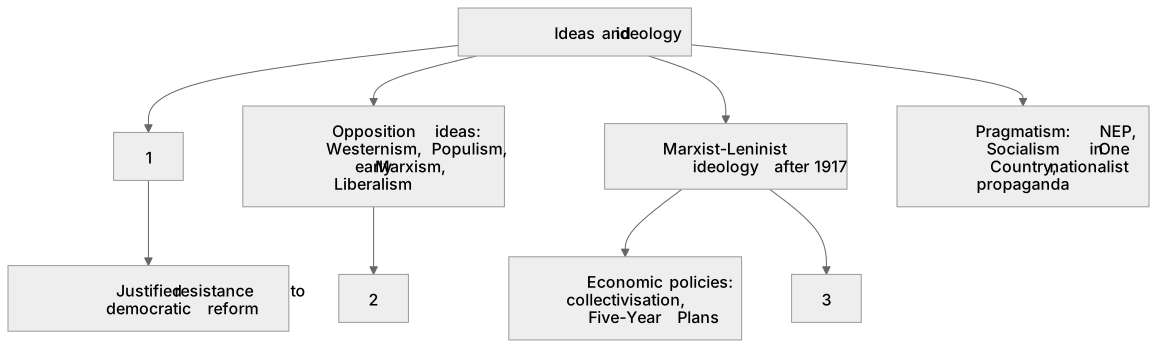
1Box 1
2Box 2
3Box 3
There is more to this lesson
The full lesson goes on to check your understanding and help you earn the marks. Create a free account to carry on, with your progress saved.
A week of Premium from your first lesson · Then the free plan continues · No card, no charge
Test your understanding of 1H Tsarist and Communist Russia, 1855–1964 – consequence in this period through the following key questions:: How important were ideas and ideology?
Active recall beats re-reading. Take an instant quiz now to test what you’ve learned and lock it into long-term memory.
A week of Premium from your first lesson · Then the free plan continues · No card, no charge