AQA · A-Level · History
Course version: 7042 · Version from Sept 2017
What was the extent of social and cultural change?
Full specification wording
1H Tsarist and Communist Russia, 1855–1964 – consequence in this period through the following key questions:: What was the extent of social and cultural change?
Evaluating the extent of social and cultural change requires analysing how daily life, class structures, and cultural expression transformed between 1855 and 1964.
Checked against the AQA 7042 specification (opens in a new tab) on .
- Point 4 of 6
- 4 key terms
Study notes
From the checked teaching notes for this specification point.
The idea
Evaluating the extent of social and cultural change requires analysing how daily life, class structures, and cultural expression transformed between 1855 and 1964. Socially, you must trace the shift from a rigid Tsarist hierarchy to a supposedly classless Soviet society, noting how urbanisation and the Emancipation of the Serfs altered living conditions. Culturally, assess the transition from Orthodox Church dominance to the Soviet imposition of Marxist-Leninist ideology, Socialist Realism, and mass education. To determine the extent of change, contrast these radical shifts with underlying continuities, such as the persistent authoritarian control over cultural life and the enduring hardships faced by the Russian peasantry.
What earns the marks
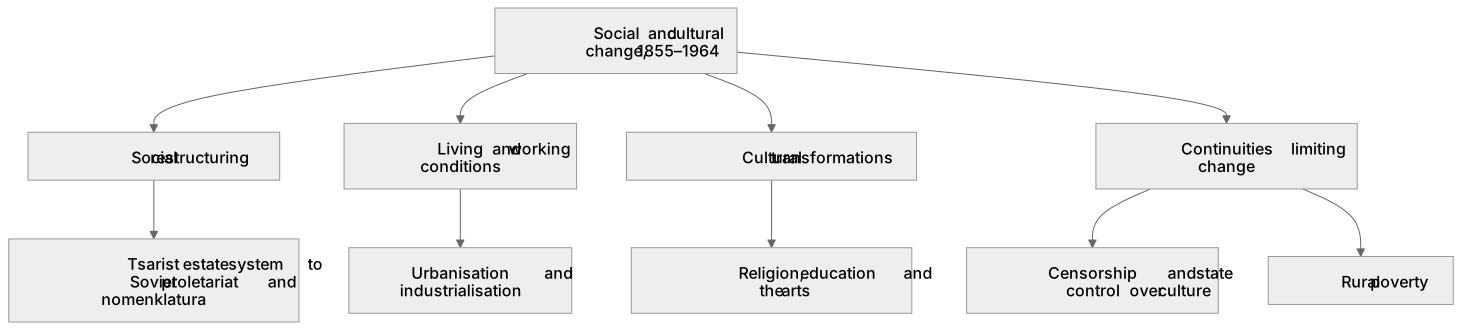
- Analyse the extent of social restructuring, from the Tsarist estate system to the Soviet proletariat and nomenklatura.
- Evaluate changes in living and working conditions, noting the impact of rapid urbanisation and industrialisation on both Tsarist workers and Soviet citizens.
- Assess cultural transformations, including the shifting role of religion, education, and the arts under different regimes.
- Identify continuities that limit the extent of change, such as the persistent use of censorship, state control over culture, and rural poverty.
Common mistakes and how to put them right
Focusing solely on social change while neglecting cultural developments.
Put it right: Ensure equal weight is given to both social structures, such as class, and culture, such as religion and the arts.
Arguing that 1917 brought a complete break with the past.
Put it right: Highlight continuities, such as the replacement of Tsarist censorship with Soviet Socialist Realism, demonstrating ongoing state control.
Treating the peasantry as a static group.
Put it right: Detail how their social position evolved from emancipated serfs to collectivised state workers, while noting the continuity of their exploitation.
Exam tips
- Use the concept of 'extent' to build a nuanced argument, acknowledging areas of radical transformation alongside significant continuities.
- Group cultural changes thematically, such as the role of religion or the purpose of education, to facilitate direct comparisons between Tsars and Communists.
- Support arguments about social change with specific references to demographic shifts, such as the massive growth of the urban proletariat in the 1930s.
Try the lesson
The start of the 1H Tsarist and Communist Russia, 1855–1964 – consequence in this period through the following key questions:: What was the extent of social and cultural change? lesson, made from checked teaching notes for this specification point.
Have a go first
How did the 1861 Emancipation Edict fundamentally alter the social structure of the Russian countryside?
Listen
Evaluating the extent of social and cultural change requires analysing how daily life, class structures, and cultural expression transformed between 1855 and 1964. Socially, you must trace the shift from a rigid Tsarist hierarchy to a supposedly classless Soviet society, noting how urbanisation and the Emancipation of the Serfs altered living conditions. Culturally, assess the transition from Orthodox Church dominance to the Soviet imposition of Marxist-Leninist ideology, Socialist Realism, and mass education. To determine the extent of change, contrast these radical shifts with underlying continuities, such as the persistent authoritarian control over cultural life and the enduring hardships faced by the Russian peasantry. A strong answer earns marks for these points. Analyse the extent of social restructuring, from the Tsarist estate system to the Soviet proletariat and nomenklatura. Evaluate changes in living and working conditions, noting the impact of rapid urbanisation and industrialisation on both Tsarist workers and Soviet citizens. Assess cultural transformations, including the shifting role of religion, education, and the arts under different regimes. Identify continuities that limit the extent of change, such as the persistent use of censorship, state control over culture, and rural poverty. A common slip: Focusing solely on social change while neglecting cultural developments. Instead, ensure equal weight is given to both social structures, such as class, and culture, such as religion and the arts. Exam tip: Use the concept of 'extent' to build a nuanced argument, acknowledging areas of radical transformation alongside significant continuities.
See it
Key words
Say what each word means before you turn the card.
Social class and hierarchy
Try answering aloud or in your head before turning the card.
Religion and ideology
Try answering aloud or in your head before turning the card.
Education and the arts
Try answering aloud or in your head before turning the card.
Urbanisation and living conditions
Try answering aloud or in your head before turning the card.
See every definition
- Social class and hierarchy
- The shift from a rigid Tsarist hierarchy to a supposedly classless Soviet society, including the Tsarist estate system, the Soviet proletariat and the nomenklatura.
- Religion and ideology
- The transition from Orthodox Church dominance to the Soviet imposition of Marxist-Leninist ideology, alongside the shifting role of religion under different regimes.
- Education and the arts
- Cultural transformations including mass education and Socialist Realism, with the arts assessed as part of cultural life under Tsarist and Communist rule.
- Urbanisation and living conditions
- Rapid urbanisation and industrialisation altered living conditions, affecting both Tsarist workers and Soviet citizens and the enduring hardships faced by the Russian peasantry.
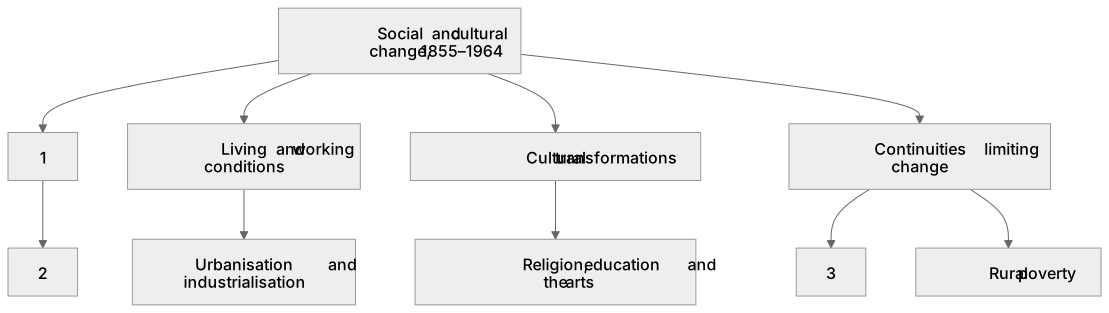
Label the diagram
Some boxes have lost their names. Pick the right name for each number.
1Box 1
2Box 2
3Box 3
There is more to this lesson
The full lesson goes on to check your understanding and help you earn the marks. Create a free account to carry on, with your progress saved.
A week of Premium from your first lesson · Then the free plan continues · No card, no charge
Test your understanding of 1H Tsarist and Communist Russia, 1855–1964 – consequence in this period through the following key questions:: What was the extent of social and cultural change?
Active recall beats re-reading. Take an instant quiz now to test what you’ve learned and lock it into long-term memory.
A week of Premium from your first lesson · Then the free plan continues · No card, no charge