AQA · A-Level · History
Course version: 7042 · Version from Sept 2017
Political authority, opposition and government: the Bolshevik takeover and…
Full specification wording
1H Tsarist and Communist Russia, 1855–1964 – The collapse of autocracy, 1894–1917: Political authority, opposition and government: the Bolshevik takeover and the establishment of Bolshevik government by December 1917; opposition
The Bolshevik takeover in October 1917 capitalised on the Provisional Government's weakness, driven by Lenin's strategic vision and Trotsky's organisation of the Military Revolutionary Committee.
Checked against the AQA 7042 specification (opens in a new tab) on .
- Point 6 of 6
- 4 key terms
Study notes
From the checked teaching notes for this specification point.
The idea
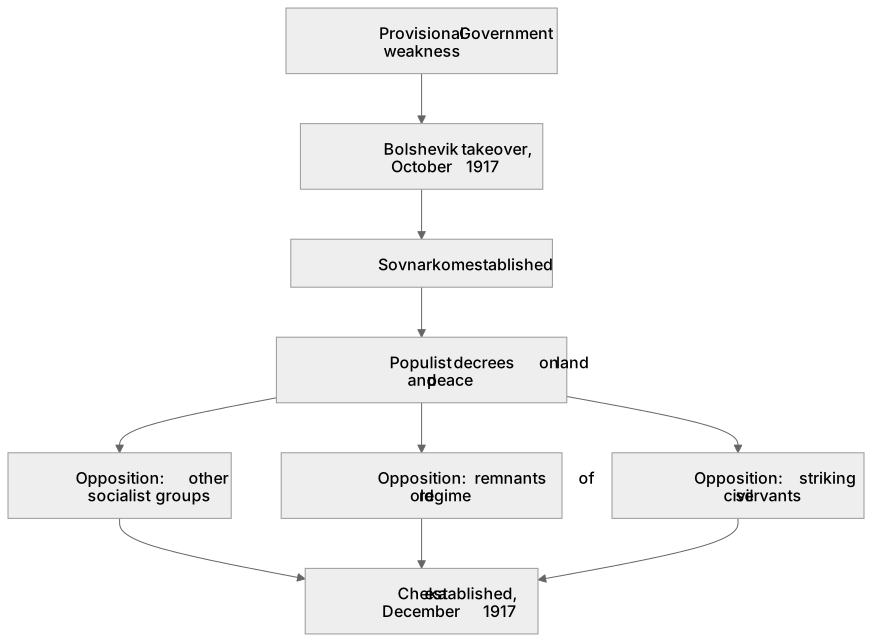
The Bolshevik takeover in October 1917 capitalised on the Provisional Government's weakness, driven by Lenin's strategic vision and Trotsky's organisation of the Military Revolutionary Committee. Following the storming of the Winter Palace, the Bolsheviks rapidly established a new government, the Sovnarkom, exclusively composed of Bolsheviks. By December 1917, they consolidated political authority through a series of populist decrees on land and peace, designed to win peasant and soldier support. However, they faced immediate opposition from other socialist groups, the remnants of the old regime, and striking civil servants. To crush this opposition and secure their fragile government, the Bolsheviks established the Cheka in December 1917, marking a swift return to authoritarian state control.
What earns the marks
- Detail the mechanics of the Bolshevik takeover, highlighting the role of the Military Revolutionary Committee and the weakness of Kerensky's forces.
- Explain the establishment of the Sovnarkom as a one-party government, bypassing the Petrograd Soviet and alienating other socialist factions.
- Analyse the early Bolshevik decrees, such as the Decree on Land and Decree on Peace, as pragmatic tools to consolidate political authority.
- Identify the sources of early opposition, including Mensheviks, Right SRs, civil service strikes, and the initial formation of anti-Bolshevik military units.
- Evaluate the creation of the Cheka in December 1917 as a decisive mechanism to suppress opposition and enforce the new government's will.
Common mistakes and how to put them right
Describing the October Revolution as a massive popular uprising.
Put it right by characterising it as a relatively small, well-organised coup d'état.
Assuming the Bolsheviks had total control of Russia by December 1917.
Put it right by noting their authority was largely confined to Petrograd, Moscow, and major industrial centres.
Stating that the Bolsheviks immediately implemented pure Marxist economics.
Put it right by explaining their initial pragmatic approach, such as state capitalism and legitimising peasant land seizures.
Exam tips
- Contrast the roles of Lenin as the ideological driver and Trotsky as the tactical organiser to provide a nuanced analysis of the takeover.
- Use the early decrees to demonstrate how the Bolsheviks prioritised immediate survival and popular appeasement over strict ideological purity.
- Highlight the establishment of the Cheka to argue that the Bolsheviks relied on coercion from the very beginning of their government.
Try the lesson
The start of the 1H Tsarist and Communist Russia, 1855–1964 – The collapse of autocracy, 1894–1917: Political authority, opposition and government: the Bolshevik takeover and the establishment of Bolshevik government by December 1917; opposition lesson, made from checked teaching notes for this specification point.
Have a go first
Which key event marked the culmination of the Bolshevik takeover of power in Petrograd in October 1917?
Listen
The Bolshevik takeover in October 1917 capitalised on the Provisional Government's weakness, driven by Lenin's strategic vision and Trotsky's organisation of the Military Revolutionary Committee. Following the storming of the Winter Palace, the Bolsheviks rapidly established a new government, the Sovnarkom, exclusively composed of Bolsheviks. By December 1917, they consolidated political authority through a series of populist decrees on land and peace, designed to win peasant and soldier support. However, they faced immediate opposition from other socialist groups, the remnants of the old regime, and striking civil servants. To crush this opposition and secure their fragile government, the Bolsheviks established the Cheka in December 1917, marking a swift return to authoritarian state control. A strong answer earns marks for these points. Detail the mechanics of the Bolshevik takeover, highlighting the role of the Military Revolutionary Committee and the weakness of Kerensky's forces. Explain the establishment of the Sovnarkom as a one-party government, bypassing the Petrograd Soviet and alienating other socialist factions. Analyse the early Bolshevik decrees, such as the Decree on Land and Decree on Peace, as pragmatic tools to consolidate political authority. Identify the sources of early opposition, including Mensheviks, Right SRs, civil service strikes, and the initial formation of anti-Bolshevik military units. A common slip: Describing the October Revolution as a massive popular uprising. Instead, characterising it as a relatively small, well-organised coup d'état. Exam tip: Contrast the roles of Lenin as the ideological driver and Trotsky as the tactical organiser to provide a nuanced analysis of the takeover.
See it
Key words
Say what each word means before you turn the card.
Revolution and seizure of power
Try answering aloud or in your head before turning the card.
Consolidation of political authority
Try answering aloud or in your head before turning the card.
Political opposition and state coercion
Try answering aloud or in your head before turning the card.
Ideology versus pragmatism
Try answering aloud or in your head before turning the card.
See every definition
- Revolution and seizure of power
- The Bolshevik takeover in October 1917 capitalised on the Provisional Government's weakness, driven by Lenin's strategic vision and Trotsky's organisation of the Military Revolutionary Committee.
- Consolidation of political authority
- By December 1917, the Bolsheviks consolidated political authority through a series of populist decrees on land and peace, designed to win peasant and soldier support.
- Political opposition and state coercion
- To crush opposition and secure their fragile government, the Bolsheviks established the Cheka in December 1917, marking a swift return to authoritarian state control.
- Ideology versus pragmatism
- The early Bolshevik decrees, such as the Decree on Land and Decree on Peace, served as pragmatic tools to consolidate political authority.
Label the diagram
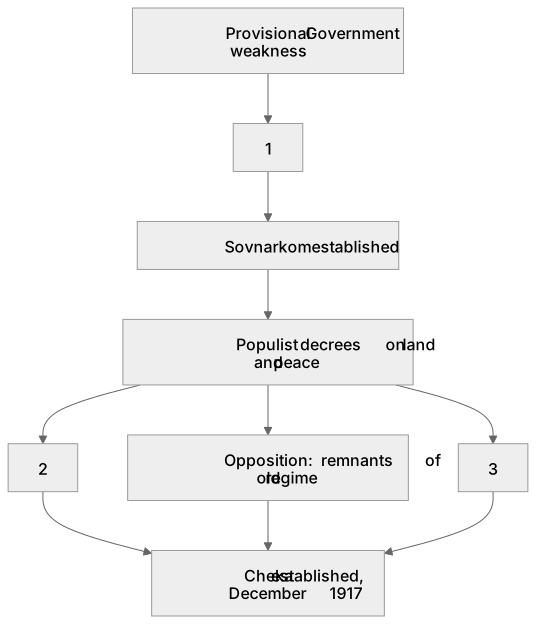
Some boxes have lost their names. Pick the right name for each number.
1Box 1
2Box 2
3Box 3
There is more to this lesson
The full lesson goes on to check your understanding and help you earn the marks. Create a free account to carry on, with your progress saved.
A week of Premium from your first lesson · Then the free plan continues · No card, no charge
Test your understanding of 1H Tsarist and Communist Russia, 1855–1964 – The collapse of autocracy, 1894–1917: Political authority, opposition and government: the Bolshevik takeover and the establishment of Bolshevik government by December 1917; opposition
Active recall beats re-reading. Take an instant quiz now to test what you’ve learned and lock it into long-term memory.
A week of Premium from your first lesson · Then the free plan continues · No card, no charge