AQA · A-Level · History
Course version: 7042 · Version from Sept 2017
Political authority, opposition and the state of Russia in wartime: the…
Full specification wording
1H Tsarist and Communist Russia, 1855–1964 – The collapse of autocracy, 1894–1917: Political authority, opposition and the state of Russia in wartime: the political, economic and social problems of wartime; opposition and the collapse of autocracy; the political developments of 1917
The First World War severely strained Russia, exposing deep political, economic, and social flaws.
Checked against the AQA 7042 specification (opens in a new tab) on .
- Point 5 of 6
- 4 key terms
Study notes
From the checked teaching notes for this specification point.
The idea
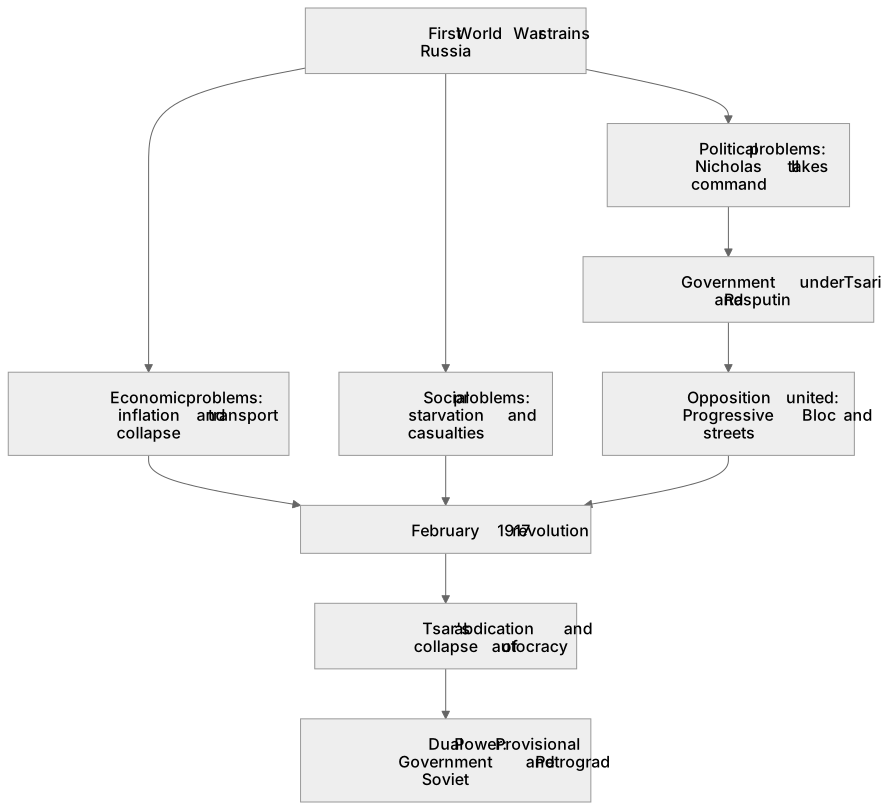
The First World War severely strained Russia, exposing deep political, economic, and social flaws. Economically, inflation surged and transport networks collapsed, preventing food and munitions from reaching cities and the front. Socially, urban starvation and massive casualties destroyed morale. Politically, Nicholas II's disastrous decision to take personal command of the army in 1915 left the government in the hands of the Tsarina and Rasputin, uniting opposition across the Duma (Progressive Bloc) and the streets. This culminated in the February 1917 revolution, forcing the Tsar's abdication and collapsing the autocracy. The subsequent political developments of 1917 saw a fragile Dual Power emerge between the unelected Provisional Government and the Petrograd Soviet, creating a power vacuum ripe for further radical opposition.
What earns the marks
- Identify the economic impact of the First World War, such as hyperinflation and the collapse of the railway system leading to urban bread shortages.
- Explain the social consequences of the war, including mass conscription, high casualties, and declining living standards in Petrograd.
- Analyse the political crisis caused by Nicholas II assuming the role of Commander-in-Chief and the resulting ministerial leapfrog under Alexandra.
- Evaluate the collapse of autocracy in February 1917 as a combination of spontaneous popular protests and the critical loss of military support.
- Assess the political developments of 1917, specifically the inherent weaknesses of the Dual Power arrangement between the Provisional Government and the Petrograd Soviet.
Common mistakes and how to put them right
Claiming the Bolsheviks led the February Revolution.
Put it right by noting that February was largely spontaneous and most Bolshevik leaders were in exile.
Confusing the Provisional Government with the Petrograd Soviet.
Put it right by distinguishing the middle-class, formal Provisional Government from the socialist, worker-led Soviet.
Stating that the First World War was the sole cause of the autocracy's collapse.
Put it right by linking wartime pressures to pre-existing structural weaknesses and the Tsar's long-term political inflexibility.
Exam tips
- Link economic failures, such as transport collapse, directly to social unrest in Petrograd to build a multi-causal argument.
- Use the formation of the Progressive Bloc to demonstrate how the Tsar alienated even his natural conservative supporters.
- When discussing 1917, explicitly evaluate how the Provisional Government's decision to continue the war undermined its political authority.
Try the lesson
The start of the 1H Tsarist and Communist Russia, 1855–1964 – The collapse of autocracy, 1894–1917: Political authority, opposition and the state of Russia in wartime: the political, economic and social problems of wartime; opposition and the collapse of autocracy; the political developments of 1917 lesson, made from checked teaching notes for this specification point.
Have a go first
Which of the following was a primary economic problem faced by the Russian Empire during the First World War that contributed to the collapse of autocracy?
Listen
The First World War severely strained Russia, exposing deep political, economic, and social flaws. Economically, inflation surged and transport networks collapsed, preventing food and munitions from reaching cities and the front. Socially, urban starvation and massive casualties destroyed morale. Politically, Nicholas II's disastrous decision to take personal command of the army in 1915 left the government in the hands of the Tsarina and Rasputin, uniting opposition across the Duma (Progressive Bloc) and the streets. This culminated in the February 1917 revolution, forcing the Tsar's abdication and collapsing the autocracy. The subsequent political developments of 1917 saw a fragile Dual Power emerge between the unelected Provisional Government and the Petrograd Soviet, creating a power vacuum ripe for further radical opposition. A strong answer earns marks for these points. Identify the economic impact of the First World War, such as hyperinflation and the collapse of the railway system leading to urban bread shortages. Explain the social consequences of the war, including mass conscription, high casualties, and declining living standards in Petrograd. Analyse the political crisis caused by Nicholas II assuming the role of Commander-in-Chief and the resulting ministerial leapfrog under Alexandra. Evaluate the collapse of autocracy in February 1917 as a combination of spontaneous popular protests and the critical loss of military support. A common slip: Claiming the Bolsheviks led the February Revolution. Instead, noting that February was largely spontaneous and most Bolshevik leaders were in exile. Exam tip: Link economic failures, such as transport collapse, directly to social unrest in Petrograd to build a multi-causal argument.
See it
Key words
Say what each word means before you turn the card.
Impact of war on society and government
Try answering aloud or in your head before turning the card.
Collapse of autocratic authority
Try answering aloud or in your head before turning the card.
Economic dislocation and social unrest
Try answering aloud or in your head before turning the card.
Emergence of dual power
Try answering aloud or in your head before turning the card.
See every definition
- Impact of war on society and government
- The First World War severely strained Russia, exposing deep political, economic and social flaws, with inflation, transport collapse, urban starvation and massive casualties destroying morale.
- Collapse of autocratic authority
- The February 1917 revolution forced the Tsar's abdication and collapsed the autocracy, following opposition uniting across the Duma and the streets.
- Economic dislocation and social unrest
- Inflation surged and transport networks collapsed, preventing food and munitions from reaching cities and the front, while urban starvation and massive casualties destroyed morale.
- Emergence of dual power
- A fragile Dual Power emerged between the unelected Provisional Government and the Petrograd Soviet, creating a power vacuum ripe for further radical opposition.
Label the diagram
Some boxes have lost their names. Pick the right name for each number.
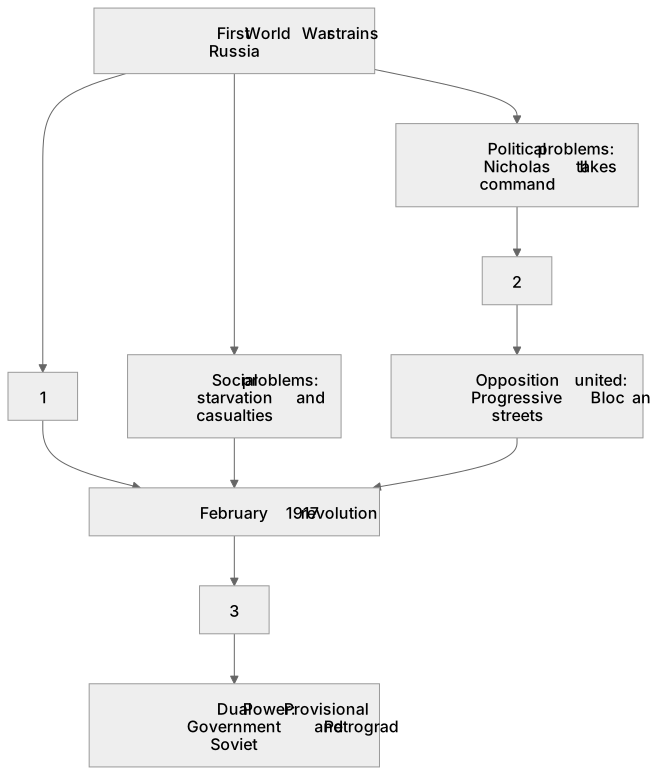
1Box 1
2Box 2
3Box 3
There is more to this lesson
The full lesson goes on to check your understanding and help you earn the marks. Create a free account to carry on, with your progress saved.
A week of Premium from your first lesson · Then the free plan continues · No card, no charge
Test your understanding of 1H Tsarist and Communist Russia, 1855–1964 – The collapse of autocracy, 1894–1917: Political authority, opposition and the state of Russia in wartime: the political, economic and social problems of wartime; opposition and the collapse of autocracy; the political developments of 1917
Active recall beats re-reading. Take an instant quiz now to test what you’ve learned and lock it into long-term memory.
A week of Premium from your first lesson · Then the free plan continues · No card, no charge