AQA · A-Level · History
Course version: 7042 · Version from Sept 2017
Economic developments: Lenin's decrees; the Stalinist economy;…
Full specification wording
1H Tsarist and Communist Russia, 1855–1964 – The emergence of Communist dictatorship, 1917–1941 (A-level only): Economic developments: Lenin's decrees; the Stalinist economy; collectivisation and the Five Year Plans
Economic transformation under Lenin and Stalin fundamentally reshaped Russia.
Checked against the AQA 7042 specification (opens in a new tab) on .
- Point 3 of 6
- 4 key terms
Study notes
From the checked teaching notes for this specification point.
The idea
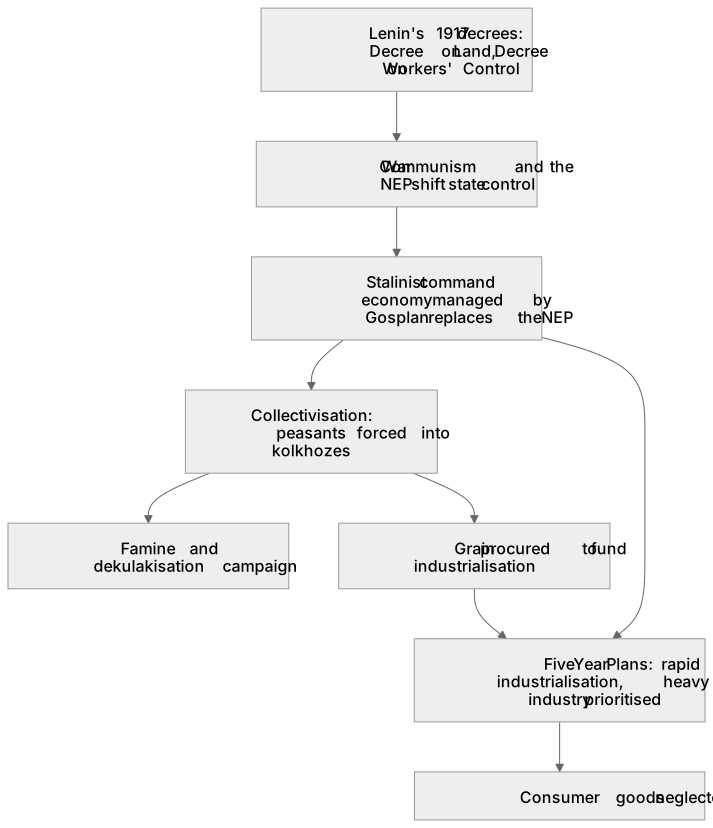
Economic transformation under Lenin and Stalin fundamentally reshaped Russia. Lenin's initial decrees, such as the 1917 Decree on Land and Decree on Workers' Control, legitimised peasant land seizures and factory takeovers, though War Communism and the NEP later shifted state control. The Stalinist economy replaced the NEP with a rigid command economy managed by Gosplan. Collectivisation forced peasants into state-run farms (kolkhozes) to fund industrialisation, triggering famine and the brutal dekulakisation campaign. Simultaneously, the Five Year Plans focused on rapid industrialisation, prioritising heavy industry like coal and steel, exemplified by massive projects such as the Magnitogorsk steelworks, at the expense of consumer goods.
What earns the marks
- Evaluate the impact of Lenin's early economic decrees, including the Decree on Land and Decree on Workers' Control, on consolidating Bolshevik power.
- Analyse the transition to the Stalinist command economy, focusing on the role of Gosplan and the abandonment of the New Economic Policy.
- Assess the economic and human costs of collectivisation, including the liquidation of the kulaks and the resulting famines of 1932-1933.
- Examine the successes and failures of the first three Five Year Plans in achieving rapid industrialisation and preparing for war.
Common mistakes and how to put them right
Confusing Lenin's initial 1917 decrees with his later policies of War Communism or the NEP.
Put it right: Ensure you distinguish between the immediate post-revolution decrees and subsequent economic shifts.
Claiming collectivisation was an economic success for agriculture.
Put it right by noting that while it allowed the state to procure grain for export and cities, agricultural production actually plummeted.
Assuming the Five Year Plans met all their targets.
Put it right: Recognise that targets were frequently manipulated or exaggerated for propaganda purposes, and consumer industries were severely neglected.
Exam tips
- Link economic policies directly to political motives, such as Stalin using collectivisation to eliminate political rivals and assert control over the countryside.
- Use specific statistics or named examples, such as the construction of Magnitogorsk or the Dnieper Dam, to substantiate arguments about the Five Year Plans.
- Compare the economic pragmatism of Lenin's NEP with the ideological rigidity of the Stalinist command economy to demonstrate synoptic understanding.
Try the lesson
The start of the 1H Tsarist and Communist Russia, 1855–1964 – The emergence of Communist dictatorship, 1917–1941 (A-level only): Economic developments: Lenin's decrees; the Stalinist economy; collectivisation and the Five Year Plans lesson, made from checked teaching notes for this specification point.
Have a go first
Which of the following best describes the primary economic impact of Lenin's Decree on Land issued in November 1917?
Listen
Economic transformation under Lenin and Stalin fundamentally reshaped Russia. Lenin's initial decrees, such as the 1917 Decree on Land and Decree on Workers' Control, legitimised peasant land seizures and factory takeovers, though War Communism and the NEP later shifted state control. The Stalinist economy replaced the NEP with a rigid command economy managed by Gosplan. Collectivisation forced peasants into state-run farms (kolkhozes) to fund industrialisation, triggering famine and the brutal dekulakisation campaign. Simultaneously, the Five Year Plans focused on rapid industrialisation, prioritising heavy industry like coal and steel, exemplified by massive projects such as the Magnitogorsk steelworks, at the expense of consumer goods. A strong answer earns marks for these points. Evaluate the impact of Lenin's early economic decrees, including the Decree on Land and Decree on Workers' Control, on consolidating Bolshevik power. Analyse the transition to the Stalinist command economy, focusing on the role of Gosplan and the abandonment of the New Economic Policy. Assess the economic and human costs of collectivisation, including the liquidation of the kulaks and the resulting famines of 1932-1933. Examine the successes and failures of the first three Five Year Plans in achieving rapid industrialisation and preparing for war. A common slip: Claiming collectivisation was an economic success for agriculture. Instead, noting that while it allowed the state to procure grain for export and cities, agricultural production actually plummeted. Exam tip: Link economic policies directly to political motives, such as Stalin using collectivisation to eliminate political rivals and assert control over the countryside.
See it
Key words
Say what each word means before you turn the card.
Command economy
Try answering aloud or in your head before turning the card.
Collectivisation
Try answering aloud or in your head before turning the card.
Industrialisation
Try answering aloud or in your head before turning the card.
State control
Try answering aloud or in your head before turning the card.
See every definition
- Command economy
- A rigid economy managed by Gosplan that replaced the NEP under Stalin.
- Collectivisation
- A policy that forced peasants into state-run farms called kolkhozes to fund industrialisation, triggering famine and the dekulakisation campaign.
- Industrialisation
- Rapid industrialisation pursued through the Five Year Plans, prioritising heavy industry such as coal and steel at the expense of consumer goods.
- State control
- Control exercised by the state, which War Communism and the NEP later shifted.
Label the diagram
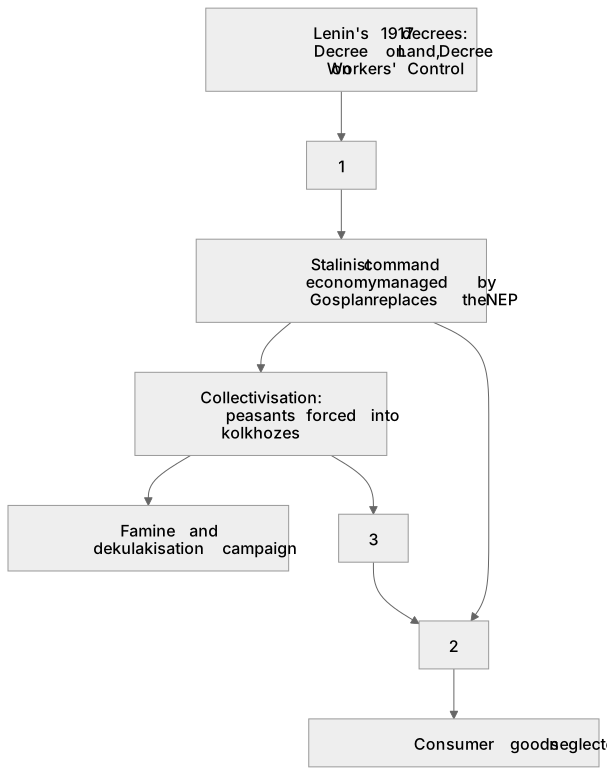
Some boxes have lost their names. Pick the right name for each number.
1Box 1
2Box 2
3Box 3
There is more to this lesson
The full lesson goes on to check your understanding and help you earn the marks. Create a free account to carry on, with your progress saved.
A week of Premium from your first lesson · Then the free plan continues · No card, no charge
Test your understanding of 1H Tsarist and Communist Russia, 1855–1964 – The emergence of Communist dictatorship, 1917–1941 (A-level only): Economic developments: Lenin's decrees; the Stalinist economy; collectivisation and the Five Year Plans
Active recall beats re-reading. Take an instant quiz now to test what you’ve learned and lock it into long-term memory.
A week of Premium from your first lesson · Then the free plan continues · No card, no charge