AQA · A-Level · History
Course version: 7042 · Version from Sept 2017
Political authority and government: the consolidation of Bolshevik…
Full specification wording
1H Tsarist and Communist Russia, 1855–1964 – The emergence of Communist dictatorship, 1917–1941 (A-level only): Political authority and government: the consolidation of Bolshevik authority and development of the Stalinist dictatorship
Following the 1917 October Revolution, the consolidation of Bolshevik authority required ruthlessly dismantling opposition.
Checked against the AQA 7042 specification (opens in a new tab) on .
- Point 2 of 6
Study notes
From the checked teaching notes for this specification point.
The idea
Following the 1917 October Revolution, the consolidation of Bolshevik authority required ruthlessly dismantling opposition. Lenin achieved this through the dissolution of the Constituent Assembly, victory in the Civil War, and the 1921 ban on factions, which centralised government control. Building upon this foundation, the development of the Stalinist dictatorship saw the state apparatus completely subordinated to one man. Stalin utilised the secret police (NKVD), extensive purges, and show trials in the 1930s to eliminate Old Bolsheviks and military leaders. This transition shifted political authority from the Communist Party's Central Committee to Stalin's personal despotism, fundamentally altering the nature of Soviet governance.
What earns the marks
- Identify the key mechanisms used to consolidate Bolshevik power, including the Cheka, the Red Army, and the suppression of rival socialist parties.
- Explain the significance of the 1921 Tenth Party Congress and the ban on factions in centralising political authority.
- Analyse the methods Stalin used to develop his dictatorship, particularly the Great Terror, show trials, and the cult of personality.
- Evaluate the extent to which the Stalinist dictatorship was a direct continuation of Lenin's methods of consolidation or a distinct departure.
Common mistakes and how to put them right
Claiming the Bolsheviks had total control immediately after October 1917.
Put it right by detailing the precarious nature of their power until the end of the Civil War.
Viewing the Stalinist purges solely as irrational paranoia.
Put it right by explaining their political function in removing potential rivals and consolidating absolute authority.
Failing to distinguish between party control and personal control.
Put it right by highlighting how Stalin bypassed the Politburo to establish a personal dictatorship.
Exam tips
- Trace the evolution of the secret police (Cheka to OGPU to NKVD) to illustrate the growing apparatus of state terror.
- When discussing the consolidation of power, ensure you address both the physical crushing of opposition (Civil War) and political centralisation (ban on factions).
- Use the 1936 Constitution as a nuanced example of how a democratic facade masked the reality of the developing Stalinist dictatorship.
Try the lesson
The start of the 1H Tsarist and Communist Russia, 1855–1964 – The emergence of Communist dictatorship, 1917–1941 (A-level only): Political authority and government: the consolidation of Bolshevik authority and development of the Stalinist dictatorship lesson, made from checked teaching notes for this specification point.
Have a go first
Which institution was established by the Bolsheviks in December 1917 specifically to consolidate their political authority by suppressing opposition?
Listen
Following the 1917 October Revolution, the consolidation of Bolshevik authority required ruthlessly dismantling opposition. Lenin achieved this through the dissolution of the Constituent Assembly, victory in the Civil War, and the 1921 ban on factions, which centralised government control. Building upon this foundation, the development of the Stalinist dictatorship saw the state apparatus completely subordinated to one man. Stalin utilised the secret police (NKVD), extensive purges, and show trials in the 1930s to eliminate Old Bolsheviks and military leaders. This transition shifted political authority from the Communist Party's Central Committee to Stalin's personal despotism, fundamentally altering the nature of Soviet governance. A strong answer earns marks for these points. Identify the key mechanisms used to consolidate Bolshevik power, including the Cheka, the Red Army, and the suppression of rival socialist parties. Explain the significance of the 1921 Tenth Party Congress and the ban on factions in centralising political authority. Analyse the methods Stalin used to develop his dictatorship, particularly the Great Terror, show trials, and the cult of personality. Evaluate the extent to which the Stalinist dictatorship was a direct continuation of Lenin's methods of consolidation or a distinct departure. A common slip: Claiming the Bolsheviks had total control immediately after October 1917. Instead, detailing the precarious nature of their power until the end of the Civil War. Exam tip: Trace the evolution of the secret police (Cheka to OGPU to NKVD) to illustrate the growing apparatus of state terror.
See it
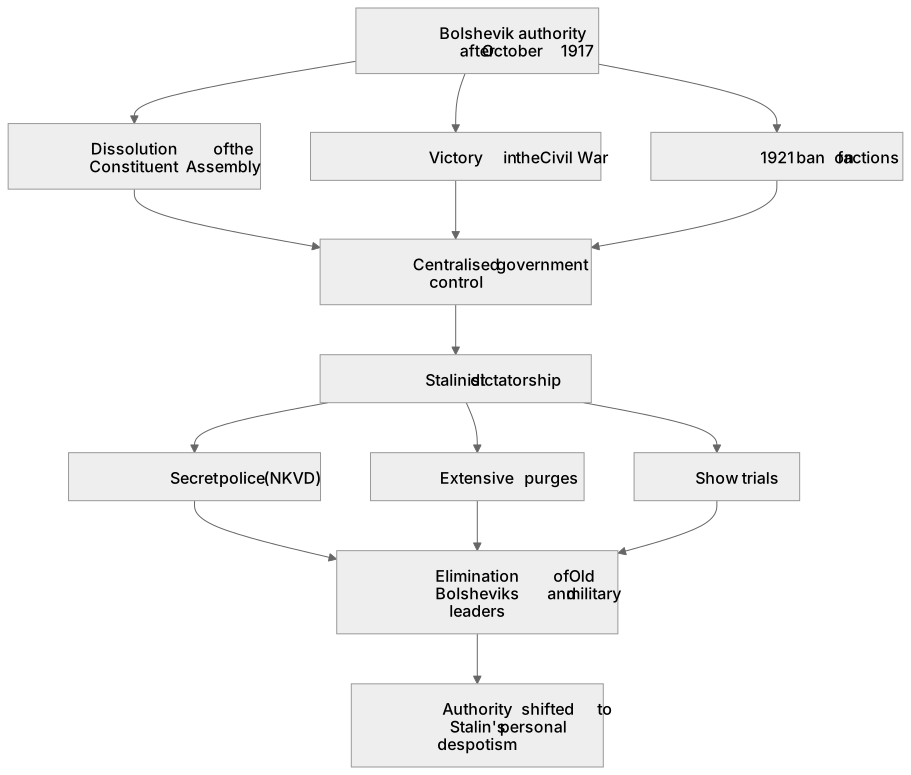
Label the diagram
Some boxes have lost their names. Pick the right name for each number.
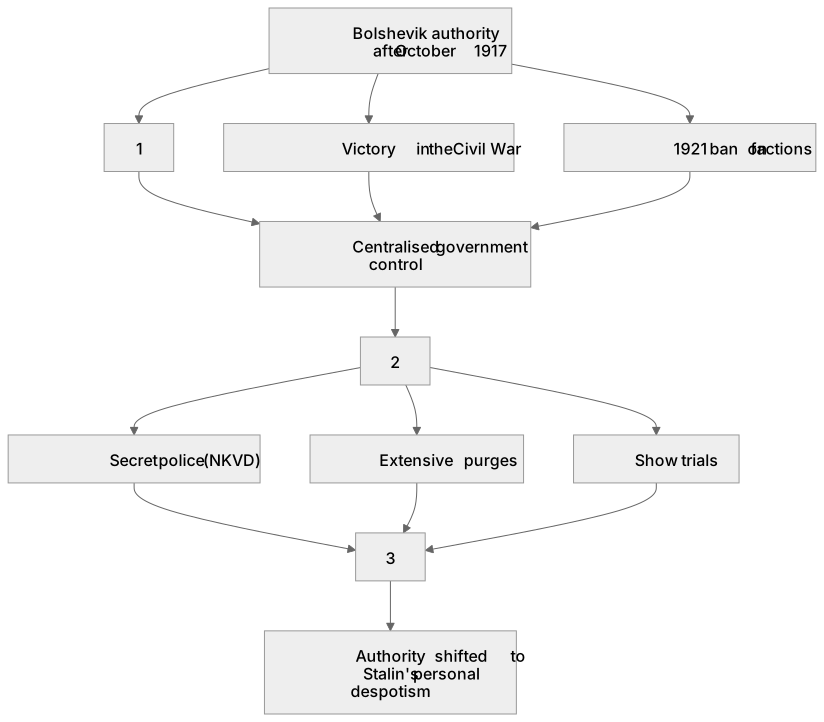
1Box 1
2Box 2
3Box 3
There is more to this lesson
The full lesson goes on to check your understanding and help you earn the marks. Create a free account to carry on, with your progress saved.
A week of Premium from your first lesson · Then the free plan continues · No card, no charge
Test your understanding of 1H Tsarist and Communist Russia, 1855–1964 – The emergence of Communist dictatorship, 1917–1941 (A-level only): Political authority and government: the consolidation of Bolshevik authority and development of the Stalinist dictatorship
Active recall beats re-reading. Take an instant quiz now to test what you’ve learned and lock it into long-term memory.
A week of Premium from your first lesson · Then the free plan continues · No card, no charge