AQA · A-Level · History
Course version: 7042 · Version from Sept 2017
Opposition: faction; the Red Terror and the purges
Full specification wording
1H Tsarist and Communist Russia, 1855–1964 – The emergence of Communist dictatorship, 1917–1941 (A-level only): Opposition: faction; the Red Terror and the purges
The Bolshevik consolidation of power faced significant opposition, which was systematically crushed through state-sponsored violence.
Checked against the AQA 7042 specification (opens in a new tab) on .
- Point 5 of 6
- 4 key terms
Study notes
From the checked teaching notes for this specification point.
The idea
The Bolshevik consolidation of power faced significant opposition, which was systematically crushed through state-sponsored violence. Internal opposition manifested as 'faction', notably the Workers' Opposition and Democratic Centralists, prompting Lenin's 1921 Ban on Factions to enforce party unity. External and ideological opposition was met with the Red Terror (1918–1922), spearheaded by the Cheka under Dzerzhinsky, targeting class enemies, SRs, and Mensheviks. Later, Stalin escalated this machinery during the Great Purges (1936–1938). Using the NKVD, Stalin eliminated Old Bolsheviks like Zinoviev and Kamenev through show trials, while the Yezhovshchina purged the military and wider society, cementing his absolute totalitarian control.
What earns the marks
- Identify the 1921 Ban on Factions as a pivotal mechanism for eliminating internal party debate and centralising power.
- Explain the role of the Cheka during the Red Terror in suppressing political opponents, such as Socialist Revolutionaries, and enforcing compliance during the Civil War.
- Analyse the progression from Lenin's targeted terror against class enemies to Stalin's widespread purges affecting loyal party members and the military.
- Evaluate the impact of the show trials in legitimising the elimination of Stalin's political rivals and creating a climate of paranoia.
Common mistakes and how to put them right
Confusing the Red Terror with the Great Purges.
Put it right: The Red Terror occurred under Lenin targeting class enemies, whereas the Great Purges occurred under Stalin targeting party members and the wider population.
Assuming the Ban on Factions eliminated all opposition immediately.
Put it right: It formally banned organised opposition groups within the party but covert dissent and power struggles continued until Stalin's purges.
Treating the Cheka, OGPU, and NKVD as identical.
Put it right: They were distinct evolutionary stages of the secret police, with the NKVD specifically executing Stalin's Great Purges.
Exam tips
- Link the 1921 Ban on Factions directly to Stalin's later ability to accuse rivals of factionalism and justify their execution.
- Use specific statistics or named targets, such as the execution of Tukhachevsky, to demonstrate the scale and impact of the military purges.
- When evaluating the motives for the purges, contrast Stalin's paranoia and desire for absolute power with the economic need for gulag labour.
Try the lesson
The start of the 1H Tsarist and Communist Russia, 1855–1964 – The emergence of Communist dictatorship, 1917–1941 (A-level only): Opposition: faction; the Red Terror and the purges lesson, made from checked teaching notes for this specification point.
Have a go first
What was the primary purpose of the Red Terror launched by the Bolsheviks in 1918?
Listen
The Bolshevik consolidation of power faced significant opposition, which was systematically crushed through state-sponsored violence. Internal opposition manifested as 'faction', notably the Workers' Opposition and Democratic Centralists, prompting Lenin's 1921 Ban on Factions to enforce party unity. External and ideological opposition was met with the Red Terror (1918–1922), spearheaded by the Cheka under Dzerzhinsky, targeting class enemies, SRs, and Mensheviks. Later, Stalin escalated this machinery during the Great Purges (1936–1938). Using the NKVD, Stalin eliminated Old Bolsheviks like Zinoviev and Kamenev through show trials, while the Yezhovshchina purged the military and wider society, cementing his absolute totalitarian control. A strong answer earns marks for these points. Identify the 1921 Ban on Factions as a pivotal mechanism for eliminating internal party debate and centralising power. Explain the role of the Cheka during the Red Terror in suppressing political opponents, such as Socialist Revolutionaries, and enforcing compliance during the Civil War. Analyse the progression from Lenin's targeted terror against class enemies to Stalin's widespread purges affecting loyal party members and the military. Evaluate the impact of the show trials in legitimising the elimination of Stalin's political rivals and creating a climate of paranoia. Exam tip: Link the 1921 Ban on Factions directly to Stalin's later ability to accuse rivals of factionalism and justify their execution.
See it
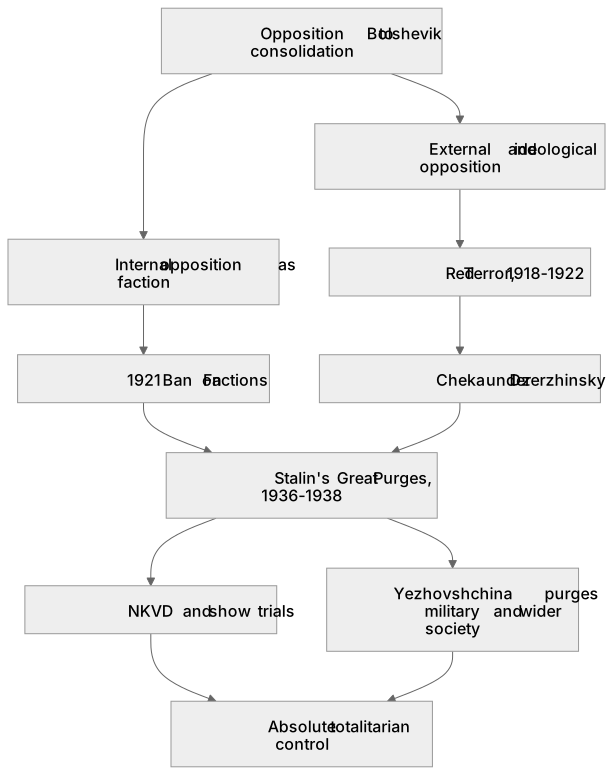
Put the events in order
Put these events in the order they happened, earliest first.
- 1. Red Terror begins, spearheaded by the Cheka under Dzerzhinsky
- 2. Great Purges begin, escalating Stalin's machinery of repression
- 3. Ban on Factions enforces party unity
Key words
Say what each word means before you turn the card.
faction
Try answering aloud or in your head before turning the card.
Red Terror
Try answering aloud or in your head before turning the card.
Great Purges
Try answering aloud or in your head before turning the card.
Cheka
Try answering aloud or in your head before turning the card.
See every definition
- faction
- Internal opposition within the party, notably the Workers' Opposition and Democratic Centralists, prompting the 1921 Ban on Factions to enforce party unity.
- Red Terror
- State-sponsored violence from 1918 to 1922, spearheaded by the Cheka under Dzerzhinsky, targeting class enemies, SRs and Mensheviks.
- Great Purges
- Stalin's escalation of the terror machinery from 1936 to 1938, eliminating Old Bolsheviks through show trials and purging the military and wider society.
- Cheka
- The secret police during the Red Terror, under Dzerzhinsky, used to suppress political opponents and enforce compliance during the Civil War.
Label the diagram
Some boxes have lost their names. Pick the right name for each number.
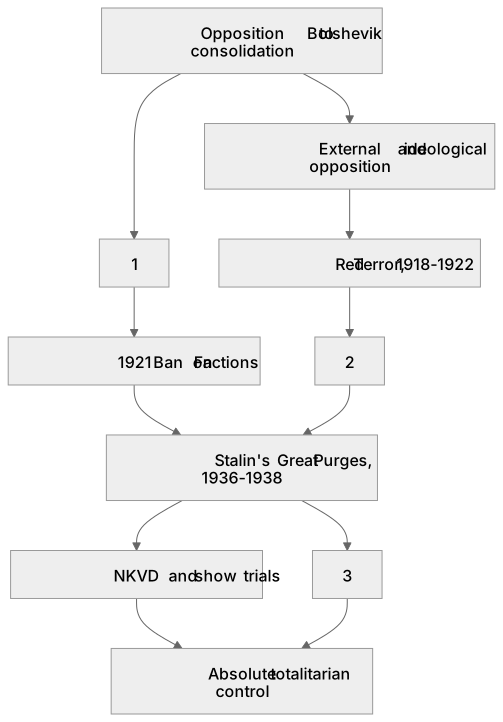
1Box 1
2Box 2
3Box 3
There is more to this lesson
The full lesson goes on to check your understanding and help you earn the marks. Create a free account to carry on, with your progress saved.
A week of Premium from your first lesson · Then the free plan continues · No card, no charge
Test your understanding of 1H Tsarist and Communist Russia, 1855–1964 – The emergence of Communist dictatorship, 1917–1941 (A-level only): Opposition: faction; the Red Terror and the purges
Active recall beats re-reading. Take an instant quiz now to test what you’ve learned and lock it into long-term memory.
A week of Premium from your first lesson · Then the free plan continues · No card, no charge