AQA · A-Level · History
Course version: 7042 · Version from Sept 2017
The political, economic and social condition of the Soviet Union by 1941
Full specification wording
1H Tsarist and Communist Russia, 1855–1964 – The emergence of Communist dictatorship, 1917–1941 (A-level only): The political, economic and social condition of the Soviet Union by 1941
By 1941, the Soviet Union had been radically transformed into a highly centralised, totalitarian state under Stalin's undisputed political control, achieved through the elimination of rivals and…
Checked against the AQA 7042 specification (opens in a new tab) on .
- Point 6 of 6
- 4 key terms
Study notes
From the checked teaching notes for this specification point.
The idea
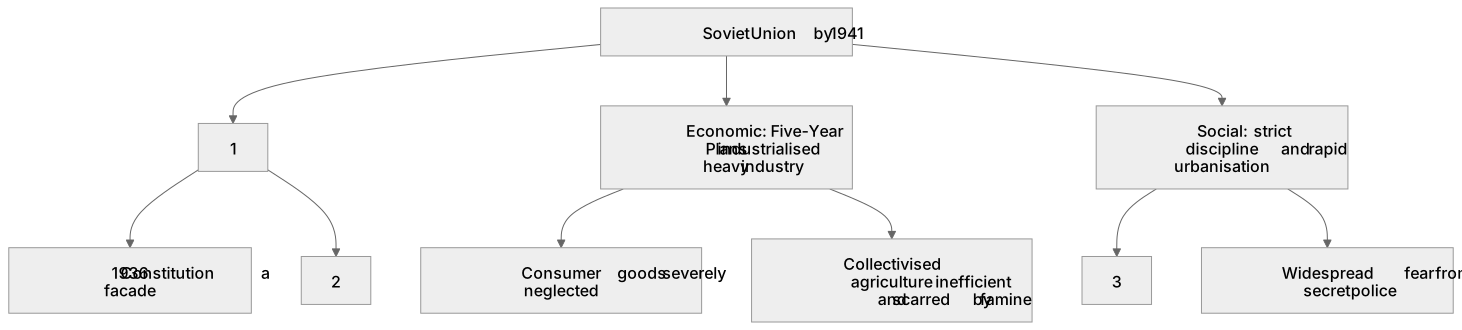
By 1941, the Soviet Union had been radically transformed into a highly centralised, totalitarian state under Stalin's undisputed political control, achieved through the elimination of rivals and the 1936 Constitution. Economically, the Five-Year Plans had rapidly industrialised the nation, creating a formidable heavy industry base crucial for the impending war, though consumer goods remained severely neglected. Agriculture was entirely collectivised, yet remained inefficient and scarred by the legacy of famine. Socially, the population experienced strict discipline, rapid urbanisation, and the 'Great Retreat' in family policies, alongside widespread fear generated by the secret police, leaving a society both modernised and deeply traumatised.
What earns the marks
- Assess the political landscape by 1941, noting Stalin's absolute dictatorship, the facade of the 1936 Constitution, and the weakened state of the purged military leadership.
- Evaluate the economic successes of the Five-Year Plans in establishing heavy industry necessary for wartime production.
- Analyse the economic shortcomings in 1941, specifically the persistent failures in collectivised agriculture and the chronic shortage of consumer goods.
- Examine the social conditions, including the impact of rapid urbanisation, strict labour discipline, and the conservative shift in social policies known as the Great Retreat.
Common mistakes and how to put them right
Claiming the Soviet economy was entirely prepared for war in 1941.
Put it right: While heavy industry was strong, agricultural output was weak and the military command had been severely damaged by the purges.
Describing the 1936 Constitution as a genuine democratic reform.
Put it right: It was a propaganda tool that promised rights on paper but masked the reality of totalitarian terror.
Ignoring the social impact of the Great Retreat; students often focus only on terror and miss the conservative reversal in policies regarding women, family, and education.
Exam tips
- Structure answers thematically by explicitly dividing paragraphs into political, economic, and social conditions to ensure comprehensive coverage of the specification point.
- Use the impending threat of Nazi Germany as context for evaluating why the Soviet economy was so heavily skewed towards military and heavy industrial production by 1941.
- Contrast the statistical successes of industrialisation with the lived reality of the Soviet workers, highlighting poor living conditions and draconian labour laws.
Try the lesson
The start of the 1H Tsarist and Communist Russia, 1855–1964 – The emergence of Communist dictatorship, 1917–1941 (A-level only): The political, economic and social condition of the Soviet Union by 1941 lesson, made from checked teaching notes for this specification point.
Have a go first
By 1941, what was the primary focus of the Soviet Union's industrial economy under the Five-Year Plans?
Listen
By 1941, the Soviet Union had been radically transformed into a highly centralised, totalitarian state under Stalin's undisputed political control, achieved through the elimination of rivals and the 1936 Constitution. Economically, the Five-Year Plans had rapidly industrialised the nation, creating a formidable heavy industry base crucial for the impending war, though consumer goods remained severely neglected. Agriculture was entirely collectivised, yet remained inefficient and scarred by the legacy of famine. Socially, the population experienced strict discipline, rapid urbanisation, and the 'Great Retreat' in family policies, alongside widespread fear generated by the secret police, leaving a society both modernised and deeply traumatised. A strong answer earns marks for these points. Assess the political landscape by 1941, noting Stalin's absolute dictatorship, the facade of the 1936 Constitution, and the weakened state of the purged military leadership. Evaluate the economic successes of the Five-Year Plans in establishing heavy industry necessary for wartime production. Analyse the economic shortcomings in 1941, specifically the persistent failures in collectivised agriculture and the chronic shortage of consumer goods. Examine the social conditions, including the impact of rapid urbanisation, strict labour discipline, and the conservative shift in social policies known as the Great Retreat. Exam tip: Structure answers thematically by explicitly dividing paragraphs into political, economic, and social conditions to ensure comprehensive coverage of the specification point.
See it

Key words
Say what each word means before you turn the card.
Totalitarianism and dictatorship
Try answering aloud or in your head before turning the card.
Command economy and industrialisation
Try answering aloud or in your head before turning the card.
Social transformation and control
Try answering aloud or in your head before turning the card.
Preparedness for war
Try answering aloud or in your head before turning the card.
See every definition
- Totalitarianism and dictatorship
- A highly centralised state under Stalin's undisputed political control, achieved through the elimination of rivals and the 1936 Constitution.
- Command economy and industrialisation
- Five-Year Plans that rapidly industrialised the nation, creating a formidable heavy industry base crucial for the impending war, though consumer goods remained severely neglected.
- Social transformation and control
- Strict discipline, rapid urbanisation, the 'Great Retreat' in family policies and widespread fear generated by the secret police, leaving a society both modernised and deeply traumatised.
- Preparedness for war
- A formidable heavy industry base crucial for the impending war, though collectivised agriculture remained inefficient and consumer goods were severely neglected.
Label the diagram
Some boxes have lost their names. Pick the right name for each number.
1Box 1
2Box 2
3Box 3
There is more to this lesson
The full lesson goes on to check your understanding and help you earn the marks. Create a free account to carry on, with your progress saved.
A week of Premium from your first lesson · Then the free plan continues · No card, no charge
Test your understanding of 1H Tsarist and Communist Russia, 1855–1964 – The emergence of Communist dictatorship, 1917–1941 (A-level only): The political, economic and social condition of the Soviet Union by 1941
Active recall beats re-reading. Take an instant quiz now to test what you’ve learned and lock it into long-term memory.
A week of Premium from your first lesson · Then the free plan continues · No card, no charge