AQA · A-Level · History
Course version: 7042 · Version from Sept 2017
Political authority and government: new leaders and ideologies; Lenin's…
Full specification wording
1H Tsarist and Communist Russia, 1855–1964 – The emergence of Communist dictatorship, 1917–1941 (A-level only): Political authority and government: new leaders and ideologies; Lenin's Russia, ideology and change; Stalin's rise, ideology and change
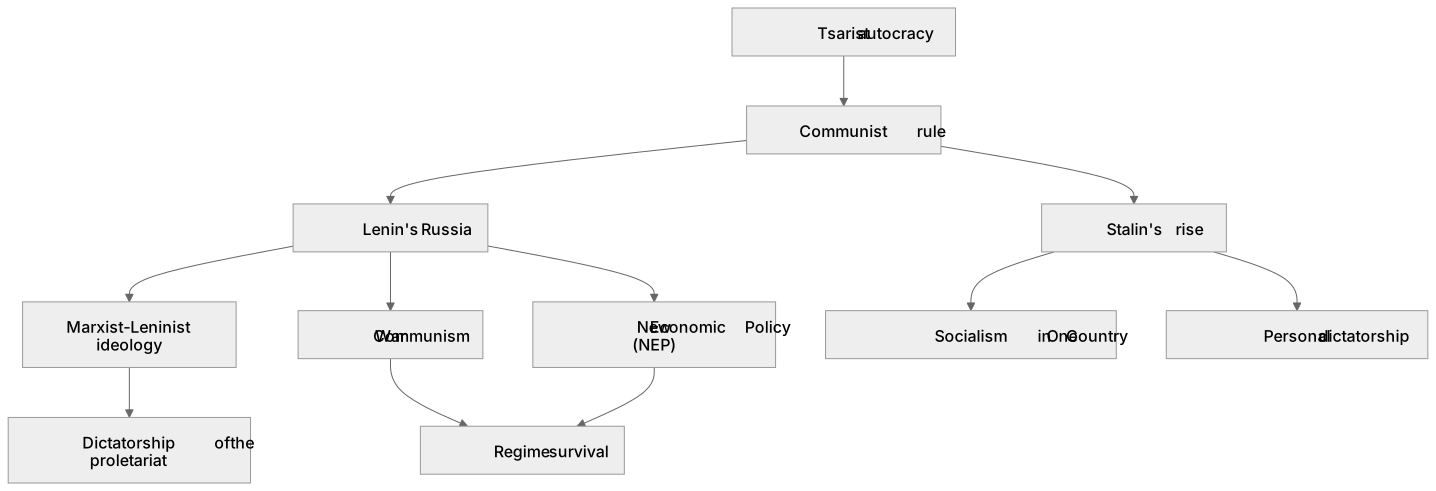
The transition from Tsarist autocracy to Communist rule introduced radically new leaders and ideologies to Russia.
Checked against the AQA 7042 specification (opens in a new tab) on .
- Point 1 of 6
- 4 key terms
Study notes
From the checked teaching notes for this specification point.
The idea
The transition from Tsarist autocracy to Communist rule introduced radically new leaders and ideologies to Russia. Lenin's Russia was driven by Marxist-Leninist ideology, aiming for a dictatorship of the proletariat. This sparked immense change, shifting from War Communism to the pragmatic New Economic Policy (NEP) to ensure regime survival. Following Lenin's death, Stalin's rise to power involved ideological manipulation, notably championing 'Socialism in One Country' against Trotsky's 'Permanent Revolution'. Stalin transformed the ideological landscape, shifting from Lenin's collective leadership model to a highly centralised, personal dictatorship, driving rapid industrialisation and forced collectivisation to secure his absolute political authority.
What earns the marks
- Explain how Lenin adapted Marxist ideology to suit Russian conditions, justifying the creation of a vanguard party.
- Assess the extent of change under Lenin, contrasting the radicalism of War Communism with the ideological compromises of the NEP.
- Analyse Stalin's tactical use of ideological debates, such as 'Socialism in One Country', to isolate rivals like Trotsky, Zinoviev, and Kamenev.
- Evaluate how Stalin's rise fundamentally changed the nature of Soviet government from a one-party state to a personal dictatorship.
Common mistakes and how to put them right
Confusing Marxist theory with Marxist-Leninism.
Put it right by emphasising Lenin's addition of the vanguard party to bypass the capitalist stage.
Assuming Stalin's rise was purely due to his position as General Secretary.
Put it right: Also evaluating his ideological flexibility and manipulation of the Lenin enrolment.
Treating Lenin's and Stalin's ideologies as identical.
Put it right by contrasting Lenin's internationalist focus with Stalin's nationalist 'Socialism in One Country'.
Exam tips
- When evaluating Stalin's rise, weigh his ideological manoeuvring against his bureaucratic power base.
- Use specific examples of ideological shifts, such as the introduction of the NEP, to demonstrate Lenin's pragmatism over pure theory.
- Link changes in government structure directly to the ideological justifications provided by the leaders at the time.
Try the lesson
The start of the 1H Tsarist and Communist Russia, 1855–1964 – The emergence of Communist dictatorship, 1917–1941 (A-level only): Political authority and government: new leaders and ideologies; Lenin's Russia, ideology and change; Stalin's rise, ideology and change lesson, made from checked teaching notes for this specification point.
Have a go first
Which ideological concept did Lenin adapt from orthodox Marxism to justify the Bolshevik seizure of power in a largely agrarian society?
Listen
The transition from Tsarist autocracy to Communist rule introduced radically new leaders and ideologies to Russia. Lenin's Russia was driven by Marxist-Leninist ideology, aiming for a dictatorship of the proletariat. This sparked immense change, shifting from War Communism to the pragmatic New Economic Policy (NEP) to ensure regime survival. Following Lenin's death, Stalin's rise to power involved ideological manipulation, notably championing 'Socialism in One Country' against Trotsky's 'Permanent Revolution'. Stalin transformed the ideological landscape, shifting from Lenin's collective leadership model to a highly centralised, personal dictatorship, driving rapid industrialisation and forced collectivisation to secure his absolute political authority. A strong answer earns marks for these points. Explain how Lenin adapted Marxist ideology to suit Russian conditions, justifying the creation of a vanguard party. Assess the extent of change under Lenin, contrasting the radicalism of War Communism with the ideological compromises of the NEP. Analyse Stalin's tactical use of ideological debates, such as 'Socialism in One Country', to isolate rivals like Trotsky, Zinoviev, and Kamenev. Evaluate how Stalin's rise fundamentally changed the nature of Soviet government from a one-party state to a personal dictatorship. A common slip: Confusing Marxist theory with Marxist-Leninism. Instead, emphasising Lenin's addition of the vanguard party to bypass the capitalist stage. Exam tip: When evaluating Stalin's rise, weigh his ideological manoeuvring against his bureaucratic power base.
See it
Key words
Say what each word means before you turn the card.
Ideological adaptation
Try answering aloud or in your head before turning the card.
Political manoeuvring
Try answering aloud or in your head before turning the card.
Continuity and change
Try answering aloud or in your head before turning the card.
Centralisation of power
Try answering aloud or in your head before turning the card.
See every definition
- Ideological adaptation
- Lenin adapted Marxist ideology to suit Russian conditions, justifying the creation of a vanguard party to bypass the capitalist stage.
- Political manoeuvring
- Stalin's rise to power involved ideological manipulation, notably championing 'Socialism in One Country' against Trotsky's 'Permanent Revolution'.
- Continuity and change
- Lenin shifted from War Communism to the pragmatic New Economic Policy to ensure regime survival, while Stalin moved from Lenin's collective leadership model to a highly centralised, personal dictatorship.
- Centralisation of power
- Stalin transformed the ideological landscape, shifting from Lenin's collective leadership model to a highly centralised, personal dictatorship to secure his absolute political authority.
Label the diagram
Some boxes have lost their names. Pick the right name for each number.
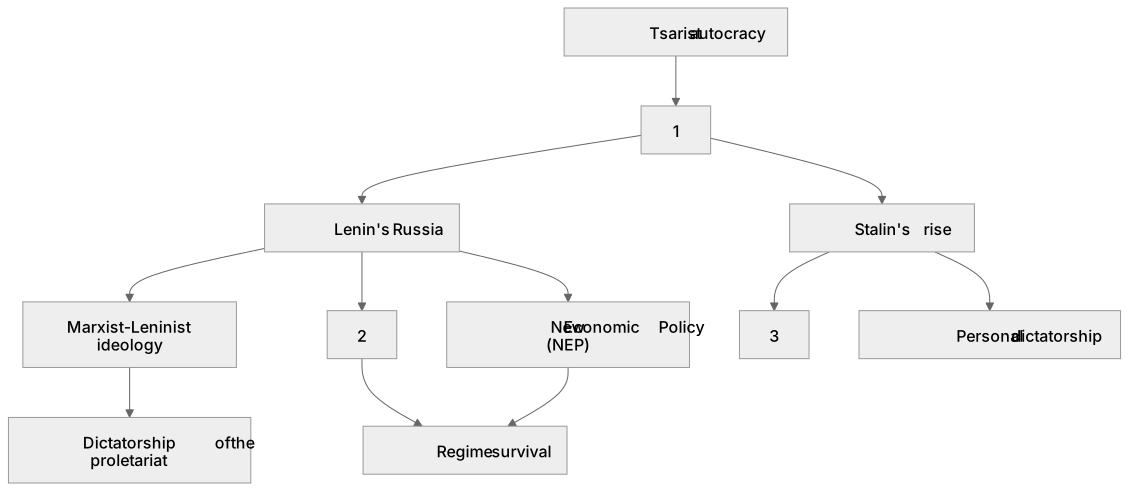
1Box 1
2Box 2
3Box 3
There is more to this lesson
The full lesson goes on to check your understanding and help you earn the marks. Create a free account to carry on, with your progress saved.
A week of Premium from your first lesson · Then the free plan continues · No card, no charge
Test your understanding of 1H Tsarist and Communist Russia, 1855–1964 – The emergence of Communist dictatorship, 1917–1941 (A-level only): Political authority and government: new leaders and ideologies; Lenin's Russia, ideology and change; Stalin's rise, ideology and change
Active recall beats re-reading. Take an instant quiz now to test what you’ve learned and lock it into long-term memory.
A week of Premium from your first lesson · Then the free plan continues · No card, no charge