AQA · A-Level · History
Course version: 7042 · Version from Sept 2017
Opposition: cultural dissidents; communist divisions; hardliners and…
Full specification wording
1H Tsarist and Communist Russia, 1855–1964 – The Stalinist dictatorship and reaction, 1941–1964 (A-level only): Opposition: cultural dissidents; communist divisions; hardliners and reformers; opponents of Khrushchev and his fall from power
Khrushchev’s era witnessed varied opposition.
Checked against the AQA 7042 specification (opens in a new tab) on .
- Point 5 of 6
- 4 key terms
Study notes
From the checked teaching notes for this specification point.
The idea
Khrushchev’s era witnessed varied opposition. Cultural dissidents, emboldened by the 'Thaws', circulated illegal samizdat literature; writers like Boris Pasternak faced severe state persecution, while Solzhenitsyn's sanctioned works still sparked subversive thought. Within the Communist Party, deep divisions emerged between reformers supporting de-Stalinisation and hardliners fearing a loss of control. Opponents of Khrushchev included the Anti-Party Group (1957), who attempted to oust him over his economic and foreign policies. Ultimately, his erratic leadership, the Cuban Missile Crisis humiliation, and agricultural failures (Virgin Lands scheme) alienated the military, KGB, and party elite, leading to his orchestrated fall from power in October 1964 by figures like Brezhnev.
What earns the marks
- Identify specific cultural dissidents and the methods used to suppress them, such as the expulsion of Pasternak from the Soviet Writers' Union.
- Analyse the ideological split between party hardliners who opposed de-Stalinisation and reformers who supported Khrushchev's initial thaw.
- Evaluate the role of the 1957 Anti-Party Group crisis in demonstrating early high-level political opposition to Khrushchev's leadership.
- Assess the cumulative factors leading to Khrushchev's 1964 fall, including agricultural failures, administrative restructuring, and foreign policy embarrassments.
Common mistakes and how to put them right
Confusing the 1957 Anti-Party Group attempt to oust Khrushchev with his actual removal in 1964.
Put it right: The 1957 attempt failed because Khrushchev appealed to the Central Committee, whereas the 1964 plot succeeded.
Assuming cultural dissidents had widespread public support.
Put it right: Dissident activity was largely confined to the intelligentsia and urban centres, not the broader peasantry or working class.
Claiming Khrushchev was executed upon his fall from power.
Put it right: Unlike his predecessors' rivals, Khrushchev was forced into peaceful retirement, demonstrating a shift in Soviet political culture.
Exam tips
- Link Khrushchev's erratic policy shifts directly to the growing dissatisfaction among the party bureaucracy.
- Use specific examples of cultural dissent, such as the samizdat movement or the poetry readings at Mayakovsky Square, to illustrate the limits of the cultural thaw.
- When evaluating his fall, weigh domestic failures against foreign policy crises to build a balanced argument regarding the primary cause of his removal.
Try the lesson
The start of the 1H Tsarist and Communist Russia, 1855–1964 – The Stalinist dictatorship and reaction, 1941–1964 (A-level only): Opposition: cultural dissidents; communist divisions; hardliners and reformers; opponents of Khrushchev and his fall from power lesson, made from checked teaching notes for this specification point.
Have a go first
Which group within the Communist Party leadership attempted to oust Nikita Khrushchev from power in 1957?
Listen
Khrushchev’s era witnessed varied opposition. Cultural dissidents, emboldened by the 'Thaws', circulated illegal samizdat literature; writers like Boris Pasternak faced severe state persecution, while Solzhenitsyn's sanctioned works still sparked subversive thought. Within the Communist Party, deep divisions emerged between reformers supporting de-Stalinisation and hardliners fearing a loss of control. Opponents of Khrushchev included the Anti-Party Group (1957), who attempted to oust him over his economic and foreign policies. Ultimately, his erratic leadership, the Cuban Missile Crisis humiliation, and agricultural failures (Virgin Lands scheme) alienated the military, KGB, and party elite, leading to his orchestrated fall from power in October 1964 by figures like Brezhnev. A strong answer earns marks for these points. Identify specific cultural dissidents and the methods used to suppress them, such as the expulsion of Pasternak from the Soviet Writers' Union. Analyse the ideological split between party hardliners who opposed de-Stalinisation and reformers who supported Khrushchev's initial thaw. Evaluate the role of the 1957 Anti-Party Group crisis in demonstrating early high-level political opposition to Khrushchev's leadership. Assess the cumulative factors leading to Khrushchev's 1964 fall, including agricultural failures, administrative restructuring, and foreign policy embarrassments. Exam tip: Link Khrushchev's erratic policy shifts directly to the growing dissatisfaction among the party bureaucracy.
See it
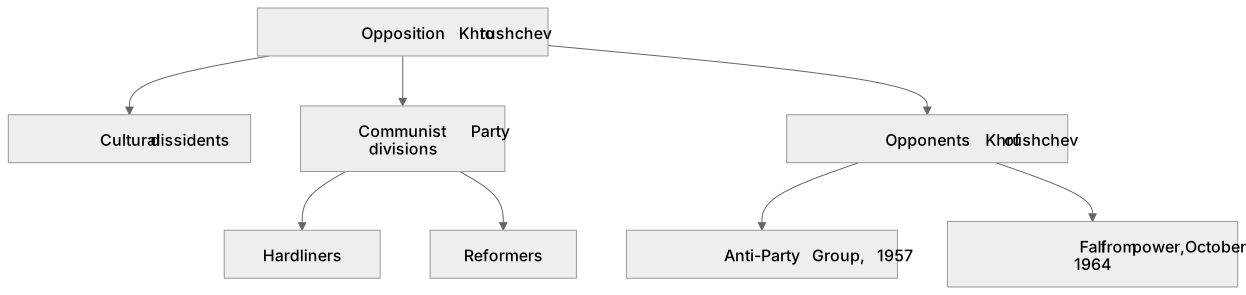
Key words
Say what each word means before you turn the card.
Cultural dissidents
Try answering aloud or in your head before turning the card.
De-Stalinisation
Try answering aloud or in your head before turning the card.
Hardliners
Try answering aloud or in your head before turning the card.
Anti-Party Group
Try answering aloud or in your head before turning the card.
See every definition
- Cultural dissidents
- Writers and others emboldened by the 'Thaws' who circulated illegal samizdat literature and faced severe state persecution.
- De-Stalinisation
- The cause supported by reformers within the Communist Party, which hardliners opposed out of fear of losing control.
- Hardliners
- Party figures who feared a loss of control and opposed de-Stalinisation, standing against the reformers.
- Anti-Party Group
- Opponents of Khrushchev who in 1957 attempted to oust him over his economic and foreign policies.
Label the diagram
Some boxes have lost their names. Pick the right name for each number.
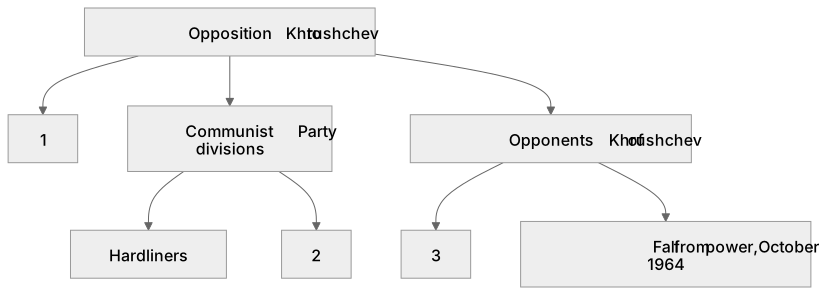
1Box 1
2Box 2
3Box 3
There is more to this lesson
The full lesson goes on to check your understanding and help you earn the marks. Create a free account to carry on, with your progress saved.
A week of Premium from your first lesson · Then the free plan continues · No card, no charge
Test your understanding of 1H Tsarist and Communist Russia, 1855–1964 – The Stalinist dictatorship and reaction, 1941–1964 (A-level only): Opposition: cultural dissidents; communist divisions; hardliners and reformers; opponents of Khrushchev and his fall from power
Active recall beats re-reading. Take an instant quiz now to test what you’ve learned and lock it into long-term memory.
A week of Premium from your first lesson · Then the free plan continues · No card, no charge