AQA · A-Level · History
Course version: 7042 · Version from Sept 2017
Economic and social developments: changes in industrial organisation from…
Full specification wording
1H Tsarist and Communist Russia, 1855–1964 – The Stalinist dictatorship and reaction, 1941–1964 (A-level only): Economic and social developments: changes in industrial organisation from Stalin to Khrushchev; agriculture and the Virgin Lands scheme; social and cultural change from Stalin to Khrushchev
Khrushchev shifted Soviet economic priorities from Stalin's heavy industry focus towards consumer goods and light industry.
Checked against the AQA 7042 specification (opens in a new tab) on .
- Point 4 of 6
- 4 key terms
Study notes
From the checked teaching notes for this specification point.
The idea
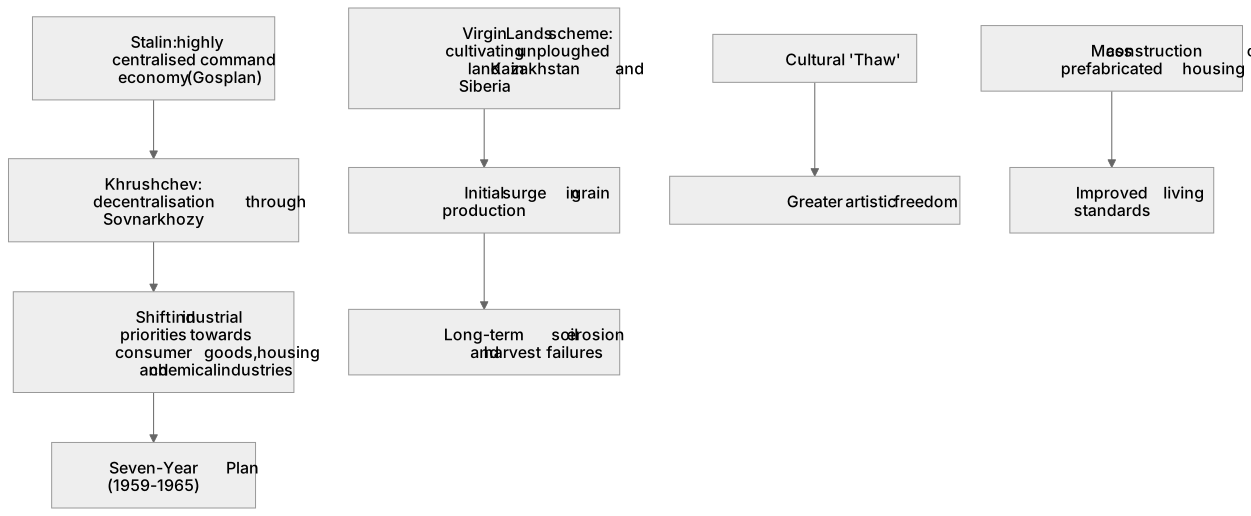
Khrushchev shifted Soviet economic priorities from Stalin's heavy industry focus towards consumer goods and light industry. He decentralised industrial organisation by creating 105 regional economic councils (Sovnarkhozy) to reduce bureaucratic inefficiency. In agriculture, he championed the Virgin Lands scheme, cultivating vast tracts of unploughed land in Kazakhstan and Siberia to boost grain production, though initial successes were followed by ecological degradation and falling yields. Socially and culturally, the era witnessed the 'Thaw', allowing greater artistic freedom (like publishing Solzhenitsyn), alongside massive housing programmes (Khrushchyovka) that significantly improved living standards compared to the Stalinist era.
What earns the marks
- Compare Stalin's highly centralised command economy (Gosplan) with Khrushchev's attempt at decentralisation through the Sovnarkhozy.
- Evaluate the aims and outcomes of the Virgin Lands scheme, noting the initial surge in grain production followed by long-term soil erosion and harvest failures.
- Analyse the shift in industrial priorities towards consumer goods, housing, and chemical industries under the Seven-Year Plan (1959-1965).
- Assess social and cultural changes, including the cultural 'Thaw', improved minimum wages, and the mass construction of prefabricated housing.
Common mistakes and how to put them right
Arguing that Khrushchev completely abandoned heavy industry.
Put it right: Emphasise that while consumer goods increased, heavy industry and military-industrial spending remained a massive part of the Soviet economy.
Describing the Virgin Lands scheme as a total failure from the start.
Put it right: Acknowledge the significant short-term successes in the mid-1950s before the long-term ecological and structural problems emerged.
Claiming the cultural 'Thaw' meant total freedom of expression.
Put it right: Specify that censorship remained, and artistic freedom was only permitted if it did not directly challenge the Communist system.
Exam tips
- Use the contrast between Stalin's monumental architecture and Khrushchev's utilitarian housing blocks to illustrate the shift in social priorities.
- When evaluating economic policies, distinguish between Khrushchev's ambitious targets and the actual, often flawed, implementation.
- Connect the failure of the Virgin Lands scheme in the early 1960s to the growing dissatisfaction that led to Khrushchev's removal.
Try the lesson
The start of the 1H Tsarist and Communist Russia, 1855–1964 – The Stalinist dictatorship and reaction, 1941–1964 (A-level only): Economic and social developments: changes in industrial organisation from Stalin to Khrushchev; agriculture and the Virgin Lands scheme; social and cultural change from Stalin to Khrushchev lesson, made from checked teaching notes for this specification point.
Have a go first
What was the primary objective of Nikita Khrushchev's Virgin Lands scheme introduced in 1954?
Listen
Khrushchev shifted Soviet economic priorities from Stalin's heavy industry focus towards consumer goods and light industry. He decentralised industrial organisation by creating 105 regional economic councils (Sovnarkhozy) to reduce bureaucratic inefficiency. In agriculture, he championed the Virgin Lands scheme, cultivating vast tracts of unploughed land in Kazakhstan and Siberia to boost grain production, though initial successes were followed by ecological degradation and falling yields. Socially and culturally, the era witnessed the 'Thaw', allowing greater artistic freedom (like publishing Solzhenitsyn), alongside massive housing programmes (Khrushchyovka) that significantly improved living standards compared to the Stalinist era. A strong answer earns marks for these points. Compare Stalin's highly centralised command economy (Gosplan) with Khrushchev's attempt at decentralisation through the Sovnarkhozy. Evaluate the aims and outcomes of the Virgin Lands scheme, noting the initial surge in grain production followed by long-term soil erosion and harvest failures. Analyse the shift in industrial priorities towards consumer goods, housing, and chemical industries under the Seven-Year Plan (1959-1965). Assess social and cultural changes, including the cultural 'Thaw', improved minimum wages, and the mass construction of prefabricated housing. A common slip: Arguing that Khrushchev completely abandoned heavy industry. Instead, Emphasise that while consumer goods increased, heavy industry and military-industrial spending remained a massive part of the Soviet economy. Exam tip: Use the contrast between Stalin's monumental architecture and Khrushchev's utilitarian housing blocks to illustrate the shift in social priorities.
See it
Key words
Say what each word means before you turn the card.
Economic centralisation versus decentralisation
Try answering aloud or in your head before turning the card.
Agricultural policy and food security
Try answering aloud or in your head before turning the card.
Living standards and social welfare
Try answering aloud or in your head before turning the card.
Cultural control and the 'Thaw'
Try answering aloud or in your head before turning the card.
See every definition
- Economic centralisation versus decentralisation
- Stalin's highly centralised command economy under Gosplan contrasted with Khrushchev's attempt at decentralisation through the Sovnarkhozy, created to reduce bureaucratic inefficiency.
- Agricultural policy and food security
- The Virgin Lands scheme cultivated vast tracts of unploughed land in Kazakhstan and Siberia to boost grain production, though initial successes were followed by ecological degradation and falling yields.
- Living standards and social welfare
- Massive housing programmes, including the Khrushchyovka, significantly improved living standards compared to the Stalinist era, alongside improved minimum wages.
- Cultural control and the 'Thaw'
- The era witnessed the 'Thaw', allowing greater artistic freedom, such as publishing Solzhenitsyn, though censorship remained and freedom was only permitted if it did not directly challenge the Communist system.
Label the diagram
Some boxes have lost their names. Pick the right name for each number.
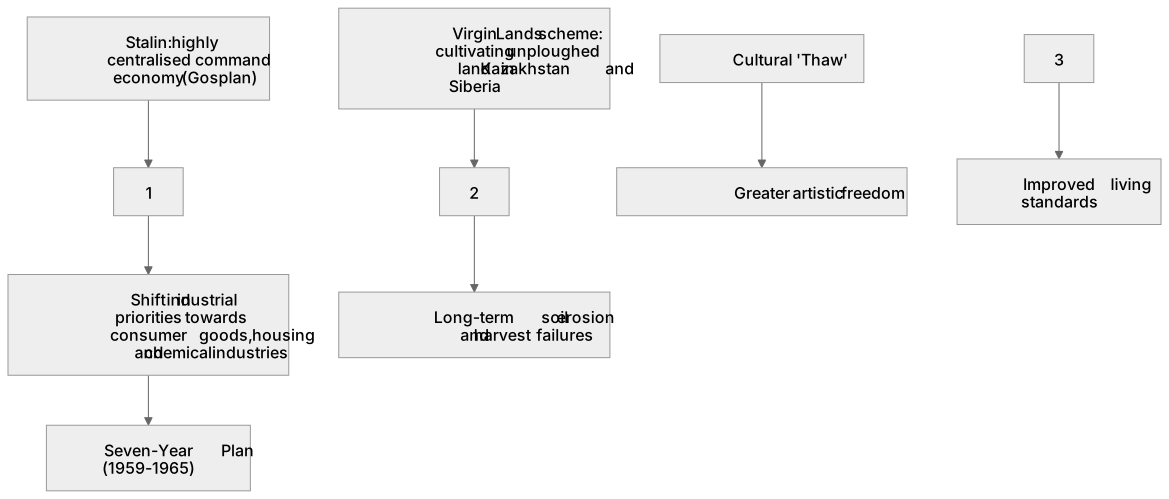
1Box 1
2Box 2
3Box 3
There is more to this lesson
The full lesson goes on to check your understanding and help you earn the marks. Create a free account to carry on, with your progress saved.
A week of Premium from your first lesson · Then the free plan continues · No card, no charge
Test your understanding of 1H Tsarist and Communist Russia, 1855–1964 – The Stalinist dictatorship and reaction, 1941–1964 (A-level only): Economic and social developments: changes in industrial organisation from Stalin to Khrushchev; agriculture and the Virgin Lands scheme; social and cultural change from Stalin to Khrushchev
Active recall beats re-reading. Take an instant quiz now to test what you’ve learned and lock it into long-term memory.
A week of Premium from your first lesson · Then the free plan continues · No card, no charge