AQA · A-Level · History
Course version: 7042 · Version from Sept 2017
Political authority and government: Khrushchev’s rise to power; policies…
Full specification wording
1H Tsarist and Communist Russia, 1855–1964 – The Stalinist dictatorship and reaction, 1941–1964 (A-level only): Political authority and government: Khrushchev’s rise to power; policies and ideology; de- Stalinisation; political and party change
Following Stalin's death in 1953, Khrushchev secured power by outmanoeuvring rivals like Beria and Malenkov, culminating in his position as First Secretary.
Checked against the AQA 7042 specification (opens in a new tab) on .
- Point 3 of 6
- 3 key terms
Study notes
From the checked teaching notes for this specification point.
The idea
Following Stalin's death in 1953, Khrushchev secured power by outmanoeuvring rivals like Beria and Malenkov, culminating in his position as First Secretary. His ideology sought a return to Leninism, moving away from Stalin's terror. This was defined by 'de-Stalinisation', famously launched in his 1956 Secret Speech, which denounced Stalin's cult of personality and purges. Consequently, political and party changes occurred, including the release of millions from the Gulag, decentralisation of party control, and the introduction of fixed terms for party officials. However, his authority remained constrained by conservative opposition, leading to his eventual removal in 1964.
What earns the marks
- Explain the power struggle (1953-1957), noting how Khrushchev used his position as Party Secretary to build a patronage network against Malenkov and the 'Anti-Party Group'.
- Analyse the ideological shift towards 'reform communism' and the desire to revitalise the party without dismantling the one-party state.
- Evaluate the impact of the 1956 Secret Speech at the 20th Party Congress as the catalyst for de-Stalinisation.
- Assess political and party changes, such as the division of the party into industrial and agricultural wings and the introduction of term limits for officials.
Common mistakes and how to put them right
Claiming de-Stalinisation meant introducing democracy.
Put it right: Clarify that Khrushchev maintained a strict one-party communist state and only sought to remove the extremes of Stalin's terror.
Stating Khrushchev took absolute power immediately in 1953.
Put it right: Explain that there was a period of collective leadership and a protracted power struggle until 1957.
Assuming the Secret Speech was broadcast to the general public.
Put it right: Note that it was delivered to a closed session of the 20th Party Congress, though its contents quickly leaked.
Exam tips
- Link Khrushchev's political reforms directly to his eventual downfall in 1964, as his restructuring alienated the party bureaucracy.
- Use the term 'democratisation' carefully; in Khrushchev's context, it meant increasing party membership among workers, not Western-style elections.
- Contrast Khrushchev's reliance on party machinery to defeat the Anti-Party Group with Stalin's use of the secret police.
Try the lesson
The start of the 1H Tsarist and Communist Russia, 1855–1964 – The Stalinist dictatorship and reaction, 1941–1964 (A-level only): Political authority and government: Khrushchev’s rise to power; policies and ideology; de- Stalinisation; political and party change lesson, made from checked teaching notes for this specification point.
Have a go first
In which year did Nikita Khrushchev deliver his 'Secret Speech' denouncing the crimes of Joseph Stalin to the Twentieth Party Congress?
Listen
Following Stalin's death in 1953, Khrushchev secured power by outmanoeuvring rivals like Beria and Malenkov, culminating in his position as First Secretary. His ideology sought a return to Leninism, moving away from Stalin's terror. This was defined by 'de-Stalinisation', famously launched in his 1956 Secret Speech, which denounced Stalin's cult of personality and purges. Consequently, political and party changes occurred, including the release of millions from the Gulag, decentralisation of party control, and the introduction of fixed terms for party officials. However, his authority remained constrained by conservative opposition, leading to his eventual removal in 1964. A strong answer earns marks for these points. Explain the power struggle (1953-1957), noting how Khrushchev used his position as Party Secretary to build a patronage network against Malenkov and the 'Anti-Party Group'. Analyse the ideological shift towards 'reform communism' and the desire to revitalise the party without dismantling the one-party state. Evaluate the impact of the 1956 Secret Speech at the 20th Party Congress as the catalyst for de-Stalinisation. Assess political and party changes, such as the division of the party into industrial and agricultural wings and the introduction of term limits for officials. A common slip: Claiming de-Stalinisation meant introducing democracy. Instead, Clarify that Khrushchev maintained a strict one-party communist state and only sought to remove the extremes of Stalin's terror. Exam tip: Link Khrushchev's political reforms directly to his eventual downfall in 1964, as his restructuring alienated the party bureaucracy.
See it
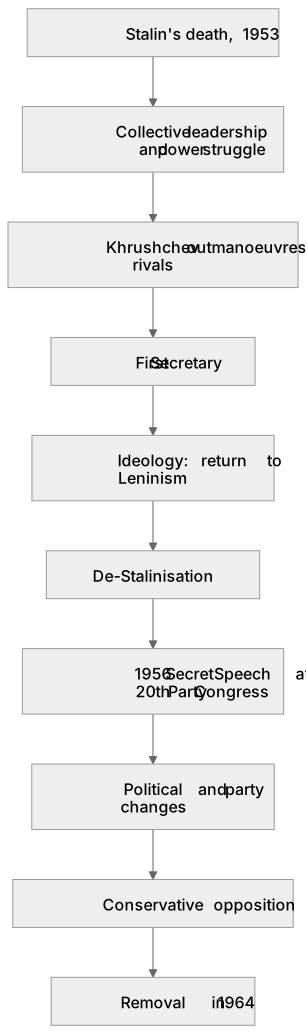
Put the events in order
Put these events in the order they happened, earliest first.
- 1. Stalin's death, followed by a period of collective leadership
- 2. Khrushchev's eventual removal from power
- 3. Khrushchev defeats the Anti-Party Group, ending the power struggle
Key words
Say what each word means before you turn the card.
de-Stalinisation
Try answering aloud or in your head before turning the card.
Secret Speech
Try answering aloud or in your head before turning the card.
reform communism
Try answering aloud or in your head before turning the card.
See every definition
- de-Stalinisation
- A move away from Stalin's terror, launched in the 1956 Secret Speech, which denounced his cult of personality and purges.
- Secret Speech
- Delivered to a closed session of the 20th Party Congress in 1956, it denounced Stalin's cult of personality and purges and launched de-Stalinisation.
- reform communism
- An ideological shift seeking to revitalise the party without dismantling the one-party state.
Label the diagram
Some boxes have lost their names. Pick the right name for each number.
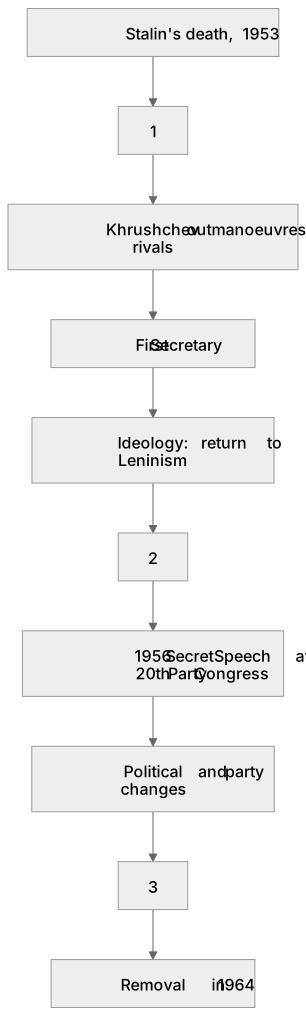
1Box 1
2Box 2
3Box 3
There is more to this lesson
The full lesson goes on to check your understanding and help you earn the marks. Create a free account to carry on, with your progress saved.
A week of Premium from your first lesson · Then the free plan continues · No card, no charge
Test your understanding of 1H Tsarist and Communist Russia, 1855–1964 – The Stalinist dictatorship and reaction, 1941–1964 (A-level only): Political authority and government: Khrushchev’s rise to power; policies and ideology; de- Stalinisation; political and party change
Active recall beats re-reading. Take an instant quiz now to test what you’ve learned and lock it into long-term memory.
A week of Premium from your first lesson · Then the free plan continues · No card, no charge