AQA · A-Level · History
Course version: 7042 · Version from Sept 2017
Economic and social developments: industrial developments and the land…
Full specification wording
1H Tsarist and Communist Russia, 1855–1964 – Trying to preserve autocracy, 1855–1894: Economic and social developments: industrial developments and the land issue; social divisions; nobles, landowners and position of the peasantry; the cultural influence of the Church
Russia saw profound economic and social developments between 1855 and 1894.
Checked against the AQA 7042 specification (opens in a new tab) on .
- Point 6 of 6
- 4 key terms
Study notes
From the checked teaching notes for this specification point.
The idea
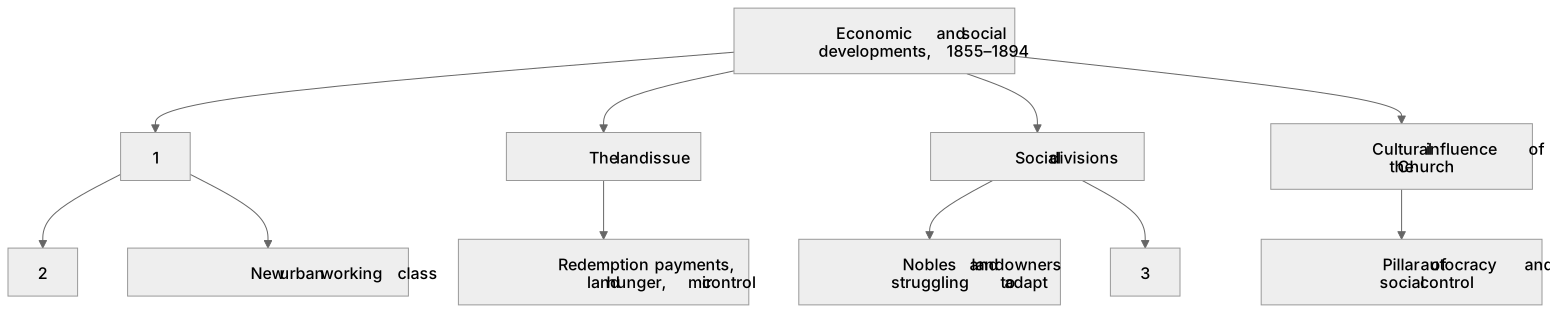
Russia saw profound economic and social developments between 1855 and 1894. Industrial developments accelerated through state-sponsored railways and foreign investment, fostering a new urban working class. The land issue remained acute; despite Emancipation, the peasantry suffered from redemption payments, land hunger, and restrictive mir control. Social divisions widened. Many nobles and landowners struggled to adapt to commercial farming, often selling estates, while a small class of wealthier peasants emerged. Meanwhile, the Russian Orthodox Church maintained immense cultural influence, acting as a vital pillar of autocracy and social control, heavily promoted by Pobedonostsev to enforce traditional values and loyalty to the Tsar.
What earns the marks
- Assess the extent and impact of industrial developments, including the roles of Reutern, Vyshnegradsky, and Witte.
- Evaluate the ongoing land issue, focusing on the limitations of the Emancipation Edict and the persistence of rural poverty.
- Analyse the changing social divisions, particularly the decline of the nobility's economic power and the stratification within the peasantry.
- Explain the cultural influence of the Russian Orthodox Church and its role in maintaining autocratic authority and social cohesion.
Common mistakes and how to put them right
Overstating the extent of industrialisation.
Put it right: Recognise that while industrial developments began, Russia remained overwhelmingly agrarian by 1894.
Assuming the nobility lost all power.
Put it right: Note that while many nobles lost land and wealth, they retained significant political and social dominance.
Ignoring the role of the Church.
Put it right: Explicitly discuss how the Orthodox Church was used as an instrument of state control and Russification.
Exam tips
- Link economic policies directly to their social consequences, such as how the drive for grain exports under Vyshnegradsky exacerbated the 1891-92 famine.
- Use the concept of the 'mir' to explain why agricultural modernisation was stifled and how it affected the position of the peasantry.
- When discussing social divisions, contrast the emerging urban proletariat with the traditional rural peasantry to highlight the uneven nature of development.
Try the lesson
The start of the 1H Tsarist and Communist Russia, 1855–1964 – Trying to preserve autocracy, 1855–1894: Economic and social developments: industrial developments and the land issue; social divisions; nobles, landowners and position of the peasantry; the cultural influence of the Church lesson, made from checked teaching notes for this specification point.
Have a go first
Following the 1861 Emancipation Edict, what financial obligation was imposed on the Russian peasantry in exchange for their land allotments?
Listen
Russia saw profound economic and social developments between 1855 and 1894. Industrial developments accelerated through state-sponsored railways and foreign investment, fostering a new urban working class. The land issue remained acute; despite Emancipation, the peasantry suffered from redemption payments, land hunger, and restrictive mir control. Social divisions widened. Many nobles and landowners struggled to adapt to commercial farming, often selling estates, while a small class of wealthier peasants emerged. Meanwhile, the Russian Orthodox Church maintained immense cultural influence, acting as a vital pillar of autocracy and social control, heavily promoted by Pobedonostsev to enforce traditional values and loyalty to the Tsar. A strong answer earns marks for these points. Assess the extent and impact of industrial developments, including the roles of Reutern, Vyshnegradsky, and Witte. Evaluate the ongoing land issue, focusing on the limitations of the Emancipation Edict and the persistence of rural poverty. Analyse the changing social divisions, particularly the decline of the nobility's economic power and the stratification within the peasantry. Explain the cultural influence of the Russian Orthodox Church and its role in maintaining autocratic authority and social cohesion. A common slip: Overstating the extent of industrialisation. Instead, recognise that while industrial developments began, Russia remained overwhelmingly agrarian by 1894. Exam tip: Link economic policies directly to their social consequences, such as how the drive for grain exports under Vyshnegradsky exacerbated the 1891-92 famine.
See it

Key words
Say what each word means before you turn the card.
Economic modernisation vs backwardness
Try answering aloud or in your head before turning the card.
Social stratification and mobility
Try answering aloud or in your head before turning the card.
State control and religion
Try answering aloud or in your head before turning the card.
The legacy of Emancipation
Try answering aloud or in your head before turning the card.
See every definition
- Economic modernisation vs backwardness
- Industrial developments accelerated through state-sponsored railways and foreign investment, yet Russia remained overwhelmingly agrarian by 1894.
- Social stratification and mobility
- Social divisions widened, with many nobles and landowners struggling to adapt to commercial farming while a small class of wealthier peasants emerged.
- State control and religion
- The Russian Orthodox Church acted as a vital pillar of autocracy and social control, heavily promoted by Pobedonostsev to enforce traditional values and loyalty to the Tsar.
- The legacy of Emancipation
- Despite Emancipation, the peasantry suffered from redemption payments, land hunger, and restrictive mir control, leaving the land issue acute.
Label the diagram
Some boxes have lost their names. Pick the right name for each number.
1Box 1
2Box 2
3Box 3
There is more to this lesson
The full lesson goes on to check your understanding and help you earn the marks. Create a free account to carry on, with your progress saved.
A week of Premium from your first lesson · Then the free plan continues · No card, no charge
Test your understanding of 1H Tsarist and Communist Russia, 1855–1964 – Trying to preserve autocracy, 1855–1894: Economic and social developments: industrial developments and the land issue; social divisions; nobles, landowners and position of the peasantry; the cultural influence of the Church
Active recall beats re-reading. Take an instant quiz now to test what you’ve learned and lock it into long-term memory.
A week of Premium from your first lesson · Then the free plan continues · No card, no charge