AQA · A-Level · History
Course version: 7042 · Version from Sept 2017
Opposition: ideas and ideologies; individuals; liberals and radical groups…
Full specification wording
1H Tsarist and Communist Russia, 1855–1964 – Trying to preserve autocracy, 1855–1894: Opposition: ideas and ideologies; individuals; liberals and radical groups and the Tsarist reaction
Between 1855 and 1894, opposition to the Tsarist regime evolved, driven by diverse ideas and ideologies.
Checked against the AQA 7042 specification (opens in a new tab) on .
- Point 5 of 6
- 4 key terms
Study notes
From the checked teaching notes for this specification point.
The idea
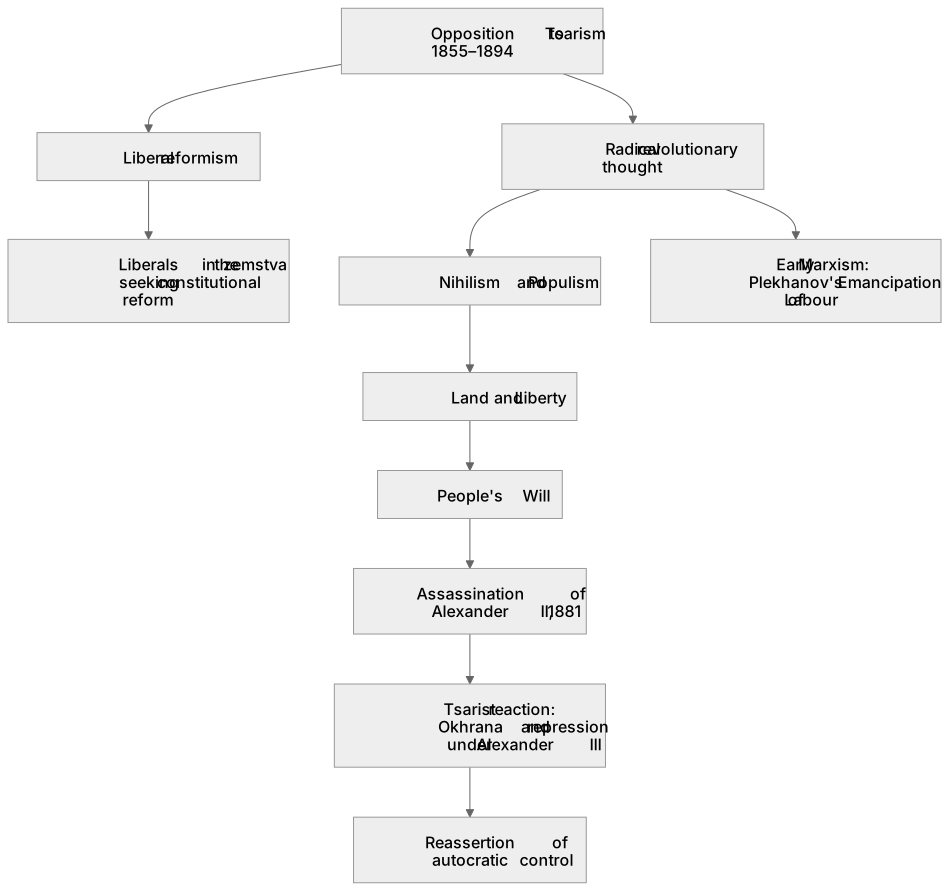
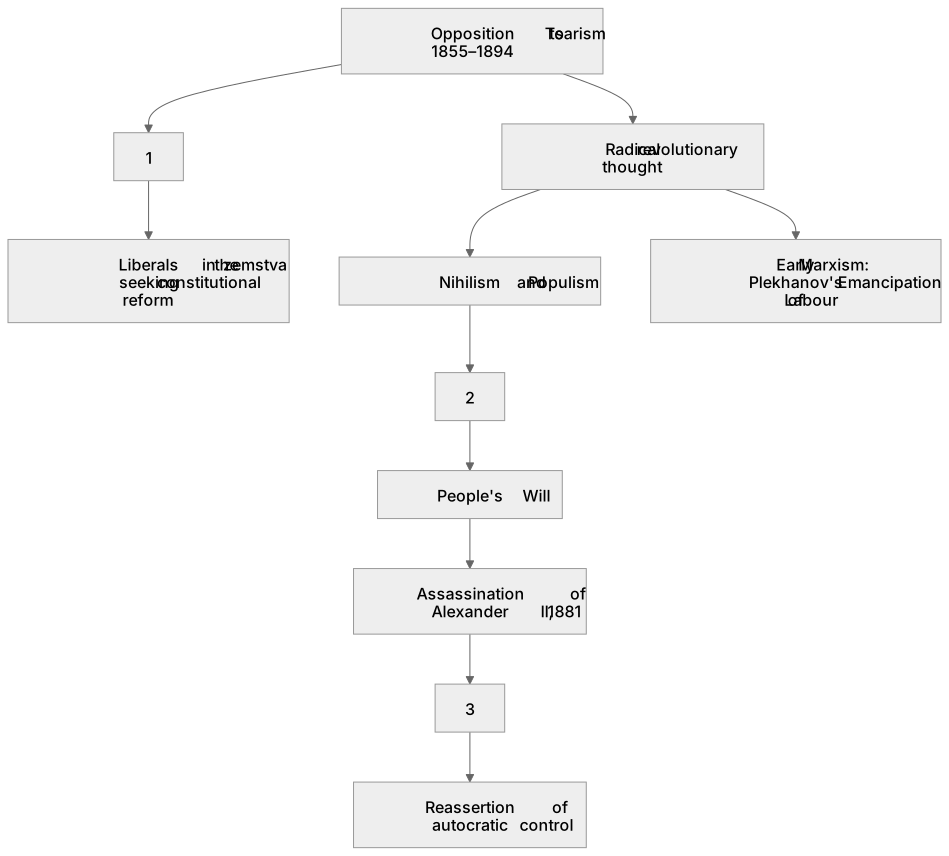
Between 1855 and 1894, opposition to the Tsarist regime evolved, driven by diverse ideas and ideologies. Liberalism grew among the intelligentsia and within the zemstva, seeking constitutional reform. Radical ideologies like Nihilism and Populism inspired groups such as Land and Liberty. Following its split, the radical People's Will emerged, assassinating Alexander II in 1881. Early Marxism developed separately through Plekhanov's Emancipation of Labour. Key individuals such as Herzen, Chernyshevsky and Plekhanov shaped these movements. The Tsarist reaction was severe; Alexander II's later reign saw increased police powers, and Alexander III implemented harsh repression, using the Okhrana to crush radicals and reassert autocratic control.
What earns the marks
- Identify and explain the core ideologies of opposition, distinguishing between liberal reformism and radical revolutionary thought.
- Evaluate the role of key individuals, such as Herzen, Chernyshevsky, or Plekhanov, in formulating and spreading opposition ideas.
- Analyse the methods and impact of radical groups, particularly the Populists, Land and Liberty, and the People's Will.
- Assess the effectiveness of the Tsarist reaction, including the use of the Okhrana, censorship, and counter-reforms under Alexander III.
Common mistakes and how to put them right
Confusing the aims of different radical groups.
Put it right: Ensure clear distinction between the peaceful propaganda of Black Partition and the terrorism of the People's Will.
Assuming all opposition was violent.
Put it right: Acknowledge that liberals, particularly in the zemstva, sought peaceful, constitutional reform rather than violent revolution.
Treating the Tsarist reaction as uniform across the period.
Put it right: Contrast the initial reformist phase of Alexander II with his later reactionary stance and the systematic repression of Alexander III.
Conflating early Marxism with Populism.
Put it right: Recognise that Land and Liberty was a Populist group, whereas early Marxism in Russia was pioneered separately by Plekhanov's Emancipation of Labour.
Exam tips
- When discussing opposition, always link the ideology to the specific actions of the groups or individuals involved.
- Evaluate the extent to which the Tsarist reaction successfully neutralised opposition by 1894, noting the temporary suppression of groups like the People's Will.
- Use specific examples of individuals, such as Chernyshevsky's 'What is to be Done?', to demonstrate the influence of radical literature.
Try the lesson
The start of the 1H Tsarist and Communist Russia, 1855–1964 – Trying to preserve autocracy, 1855–1894: Opposition: ideas and ideologies; individuals; liberals and radical groups and the Tsarist reaction lesson, made from checked teaching notes for this specification point.
Have a go first
Which radical opposition group was responsible for the assassination of Tsar Alexander II in 1881?
Listen
Between 1855 and 1894, opposition to the Tsarist regime evolved, driven by diverse ideas and ideologies. Liberalism grew among the intelligentsia and within the zemstva, seeking constitutional reform. Radical ideologies like Nihilism and Populism inspired groups such as Land and Liberty. Following its split, the radical People's Will emerged, assassinating Alexander II in 1881. Early Marxism developed separately through Plekhanov's Emancipation of Labour. Key individuals such as Herzen, Chernyshevsky and Plekhanov shaped these movements. The Tsarist reaction was severe; Alexander II's later reign saw increased police powers, and Alexander III implemented harsh repression, using the Okhrana to crush radicals and reassert autocratic control. A strong answer earns marks for these points. Identify and explain the core ideologies of opposition, distinguishing between liberal reformism and radical revolutionary thought. Evaluate the role of key individuals, such as Herzen, Chernyshevsky, or Plekhanov, in formulating and spreading opposition ideas. Analyse the methods and impact of radical groups, particularly the Populists, Land and Liberty, and the People's Will. Assess the effectiveness of the Tsarist reaction, including the use of the Okhrana, censorship, and counter-reforms under Alexander III. A common slip: Confusing the aims of different radical groups. Instead, ensure clear distinction between the peaceful propaganda of Black Partition and the terrorism of the People's Will. Exam tip: When discussing opposition, always link the ideology to the specific actions of the groups or individuals involved.
See it
Key words
Say what each word means before you turn the card.
Ideology and revolution
Try answering aloud or in your head before turning the card.
Autocracy and repression
Try answering aloud or in your head before turning the card.
The role of the intelligentsia
Try answering aloud or in your head before turning the card.
Reform versus reaction
Try answering aloud or in your head before turning the card.
See every definition
- Ideology and revolution
- Diverse ideas and ideologies drove opposition to the Tsarist regime, with radical revolutionary thought inspiring groups such as Land and Liberty and the People's Will.
- Autocracy and repression
- The Tsarist reaction was severe, with increased police powers and harsh repression under Alexander III, using the Okhrana to crush radicals and reassert autocratic control.
- The role of the intelligentsia
- Liberalism grew among the intelligentsia and within the zemstva, seeking constitutional reform, while key individuals such as Herzen, Chernyshevsky and Plekhanov shaped these movements.
- Reform versus reaction
- Liberals sought peaceful, constitutional reform rather than violent revolution, while the Tsarist reaction used censorship and counter-reforms under Alexander III.
Label the diagram
Some boxes have lost their names. Pick the right name for each number.
1Box 1
2Box 2
3Box 3
There is more to this lesson
The full lesson goes on to check your understanding and help you earn the marks. Create a free account to carry on, with your progress saved.
A week of Premium from your first lesson · Then the free plan continues · No card, no charge
Test your understanding of 1H Tsarist and Communist Russia, 1855–1964 – Trying to preserve autocracy, 1855–1894: Opposition: ideas and ideologies; individuals; liberals and radical groups and the Tsarist reaction
Active recall beats re-reading. Take an instant quiz now to test what you’ve learned and lock it into long-term memory.
A week of Premium from your first lesson · Then the free plan continues · No card, no charge