AQA · A-Level · History
Course version: 7042 · Version from Sept 2017
Government and Tsars: Alexander II and Alexander III as rulers; attitudes…
Full specification wording
1H Tsarist and Communist Russia, 1855–1964 – Trying to preserve autocracy, 1855–1894: Government and Tsars: Alexander II and Alexander III as rulers; attitudes to and imposition of autocracy; key developments
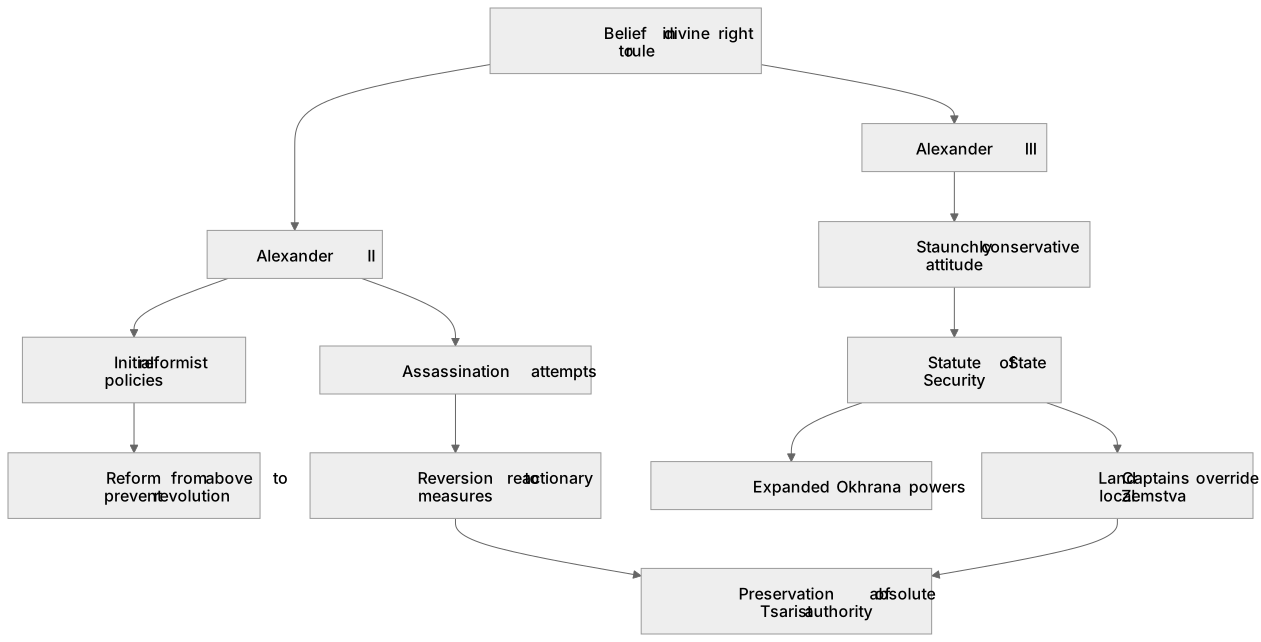
Alexander II and Alexander III both fundamentally believed in their divine right to rule, yet their methods of imposing autocracy differed.
Checked against the AQA 7042 specification (opens in a new tab) on .
- Point 3 of 6
- 4 key terms
Study notes
From the checked teaching notes for this specification point.
The idea
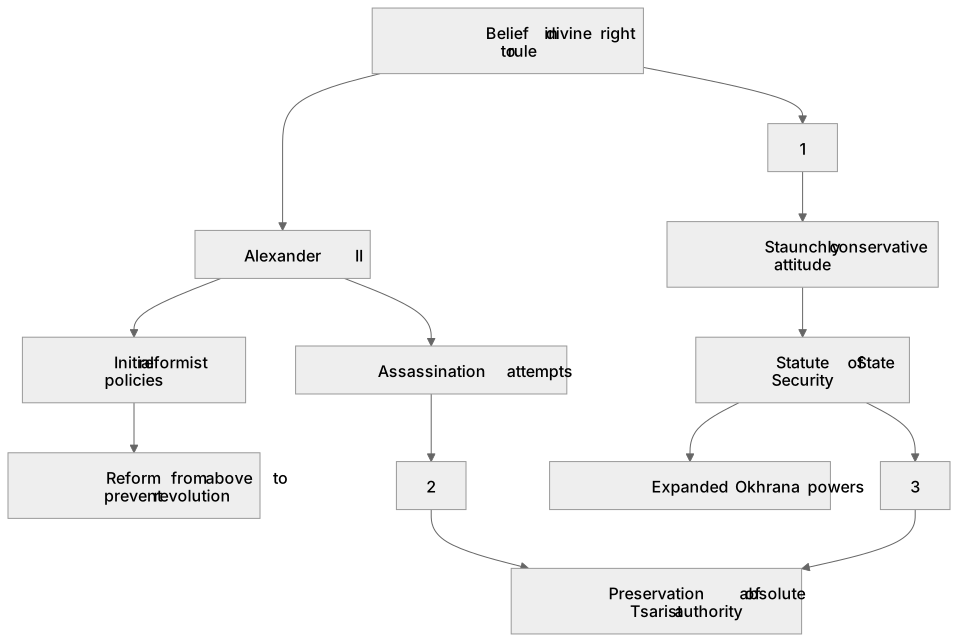
Alexander II and Alexander III both fundamentally believed in their divine right to rule, yet their methods of imposing autocracy differed. Alexander II initially adopted reformist policies, such as the 1861 Emancipation Edict and creating the Zemstva, believing reform from above would prevent revolution. However, following assassination attempts, he reverted to reactionary measures. Conversely, Alexander III's attitude was staunchly conservative. Following his father's 1881 assassination, he imposed autocracy through the Statute of State Security, expanding the Okhrana's powers and introducing Land Captains to override local Zemstva. Key developments include this shift from reform to reaction under Alexander II and the systematic repression under Alexander III, both aiming to preserve absolute Tsarist authority.
What earns the marks
- Assess Alexander II's initial reforms, such as the Emancipation of the Serfs and the creation of the Zemstva, as methods intended to strengthen rather than dismantle autocracy.
- Evaluate the turning point in Alexander II's reign, noting how assassination attempts prompted reactionary appointments and a tightening of state control.
- Analyse Alexander III's 1881 Manifesto of Unshakable Autocracy and the Statute of State Security as direct, uncompromising impositions of absolute rule.
- Examine the role of the Okhrana and the 1889 introduction of Land Captains in centralising control and suppressing local opposition under Alexander III.
Common mistakes and how to put them right
Claiming Alexander II wanted to establish a democracy.
Put it right: He reformed solely to preserve autocracy and prevent a bottom-up revolution.
Viewing Alexander II's reign as entirely reformist.
Put it right: He became highly reactionary in his later years following multiple assassination attempts.
Assuming Alexander III reversed all of his father's economic policies.
Put it right: While politically reactionary, he allowed economic modernisation under ministers like Bunge and Vyshnegradsky.
Exam tips
- Contrast the differing methods used by both Tsars to achieve the same ultimate goal: the preservation of autocratic power.
- Use specific legislation, such as the 1881 Statute of State Security, to demonstrate how Alexander III practically imposed his autocratic will.
- When evaluating 'key developments', structure your argument around the shift from reform to reaction across the period 1855 to 1894.
Try the lesson
The start of the 1H Tsarist and Communist Russia, 1855–1964 – Trying to preserve autocracy, 1855–1894: Government and Tsars: Alexander II and Alexander III as rulers; attitudes to and imposition of autocracy; key developments lesson, made from checked teaching notes for this specification point.
Have a go first
Which of the following documents, issued in 1881, clearly demonstrated Alexander III's rejection of political reform and his commitment to absolute rule?
Listen
Alexander II and Alexander III both fundamentally believed in their divine right to rule, yet their methods of imposing autocracy differed. Alexander II initially adopted reformist policies, such as the 1861 Emancipation Edict and creating the Zemstva, believing reform from above would prevent revolution. However, following assassination attempts, he reverted to reactionary measures. Conversely, Alexander III's attitude was staunchly conservative. Following his father's 1881 assassination, he imposed autocracy through the Statute of State Security, expanding the Okhrana's powers and introducing Land Captains to override local Zemstva. Key developments include this shift from reform to reaction under Alexander II and the systematic repression under Alexander III, both aiming to preserve absolute Tsarist authority. A strong answer earns marks for these points. Assess Alexander II's initial reforms, such as the Emancipation of the Serfs and the creation of the Zemstva, as methods intended to strengthen rather than dismantle autocracy. Evaluate the turning point in Alexander II's reign, noting how assassination attempts prompted reactionary appointments and a tightening of state control. Analyse Alexander III's 1881 Manifesto of Unshakable Autocracy and the Statute of State Security as direct, uncompromising impositions of absolute rule. Examine the role of the Okhrana and the 1889 introduction of Land Captains in centralising control and suppressing local opposition under Alexander III. Exam tip: Contrast the differing methods used by both Tsars to achieve the same ultimate goal: the preservation of autocratic power.
See it
Key words
Say what each word means before you turn the card.
Autocracy and Dictatorship
Try answering aloud or in your head before turning the card.
Reform vs Reaction
Try answering aloud or in your head before turning the card.
State Control and Repression
Try answering aloud or in your head before turning the card.
Continuity and Change
Try answering aloud or in your head before turning the card.
See every definition
- Autocracy and Dictatorship
- Both Tsars fundamentally believed in their divine right to rule and aimed to preserve absolute Tsarist authority.
- Reform vs Reaction
- Alexander II initially adopted reformist policies, believing reform from above would prevent revolution, but reverted to reactionary measures following assassination attempts.
- State Control and Repression
- Alexander III imposed autocracy through the Statute of State Security, expanding the Okhrana's powers and introducing Land Captains to override local Zemstva.
- Continuity and Change
- Key developments include the shift from reform to reaction under Alexander II and the systematic repression under Alexander III, both aiming to preserve autocracy.
Label the diagram
Some boxes have lost their names. Pick the right name for each number.
1Box 1
2Box 2
3Box 3
There is more to this lesson
The full lesson goes on to check your understanding and help you earn the marks. Create a free account to carry on, with your progress saved.
A week of Premium from your first lesson · Then the free plan continues · No card, no charge
Test your understanding of 1H Tsarist and Communist Russia, 1855–1964 – Trying to preserve autocracy, 1855–1894: Government and Tsars: Alexander II and Alexander III as rulers; attitudes to and imposition of autocracy; key developments
Active recall beats re-reading. Take an instant quiz now to test what you’ve learned and lock it into long-term memory.
A week of Premium from your first lesson · Then the free plan continues · No card, no charge