AQA · A-Level · History
Course version: 7042 · Version from Sept 2017
Political authority in action: Russification; treatment of ethnic…
Full specification wording
1H Tsarist and Communist Russia, 1855–1964 – Trying to preserve autocracy, 1855–1894: Political authority in action: Russification; treatment of ethnic minorities and Jews
Russification was Alexander III's policy to enforce Russian language, culture, and Orthodoxy across the Empire to strengthen political authority.
Checked against the AQA 7042 specification (opens in a new tab) on .
- Point 4 of 6
Study notes
From the checked teaching notes for this specification point.
The idea
Russification was Alexander III's policy to enforce Russian language, culture, and Orthodoxy across the Empire to strengthen political authority. This aggressive assimilation targeted ethnic minorities like Poles, Finns, and Ukrainians. For example, the Polish National Bank was closed, and Russian became the mandatory language in schools. The treatment of Jews was exceptionally severe, characterised by state-sponsored anti-Semitism. The 1882 May Laws banned new Jewish settlement in rural areas within the pre-existing Pale of Settlement. Other discriminatory policies introduced quotas on their education and banned them from government office. Furthermore, authorities frequently ignored or encouraged violent pogroms against Jewish communities. These policies ultimately alienated minorities, driving many into revolutionary groups and weakening the autocracy.
What earns the marks
- Define Russification as a deliberate political strategy to unify the multi-ethnic empire under Russian Orthodoxy and culture to consolidate autocratic power.
- Detail specific measures against ethnic minorities, such as the suppression of the Ukrainian language and the integration of Poland into the Russian administration.
- Analyse the impact of the 1882 May Laws, which restricted rural settlement within the pre-existing Pale of Settlement, alongside other discriminatory quotas.
- Evaluate the political consequences of these policies, specifically how state-sponsored anti-Semitism and cultural repression fuelled revolutionary movements like the Jewish Bund.
Common mistakes and how to put them right
Confusing Russification with general foreign policy.
Put it right: It was strictly an internal policy aimed at domestic ethnic minorities.
Stating that all ethnic minorities experienced identical treatment.
Put it right: The severity varied, with Jews and Poles facing much harsher restrictions than loyal Finns initially.
Assuming Russification successfully unified the empire.
Put it right: It actually bred deep resentment and increased support for revolutionary opposition.
Exam tips
- Use the 1882 May Laws as a primary example of how political authority was weaponised against the Jewish population.
- Link the policy of Russification to the broader theme of preserving autocracy, arguing whether it strengthened or undermined Tsarist control.
- Differentiate between the cultural repression of groups like the Ukrainians and the violent, physical persecution of the Jews through pogroms.
Try the lesson
The start of the 1H Tsarist and Communist Russia, 1855–1964 – Trying to preserve autocracy, 1855–1894: Political authority in action: Russification; treatment of ethnic minorities and Jews lesson, made from checked teaching notes for this specification point.
Have a go first
Which of the following was a central feature of the policy of Russification pursued by Alexander III across the Russian Empire?
Listen
Russification was Alexander III's policy to enforce Russian language, culture, and Orthodoxy across the Empire to strengthen political authority. This aggressive assimilation targeted ethnic minorities like Poles, Finns, and Ukrainians. For example, the Polish National Bank was closed, and Russian became the mandatory language in schools. The treatment of Jews was exceptionally severe, characterised by state-sponsored anti-Semitism. The 1882 May Laws banned new Jewish settlement in rural areas within the pre-existing Pale of Settlement. Other discriminatory policies introduced quotas on their education and banned them from government office. Furthermore, authorities frequently ignored or encouraged violent pogroms against Jewish communities. These policies ultimately alienated minorities, driving many into revolutionary groups and weakening the autocracy. A strong answer earns marks for these points. Define Russification as a deliberate political strategy to unify the multi-ethnic empire under Russian Orthodoxy and culture to consolidate autocratic power. Detail specific measures against ethnic minorities, such as the suppression of the Ukrainian language and the integration of Poland into the Russian administration. Analyse the impact of the 1882 May Laws, which restricted rural settlement within the pre-existing Pale of Settlement, alongside other discriminatory quotas. Evaluate the political consequences of these policies, specifically how state-sponsored anti-Semitism and cultural repression fuelled revolutionary movements like the Jewish Bund. Exam tip: Use the 1882 May Laws as a primary example of how political authority was weaponised against the Jewish population.
See it
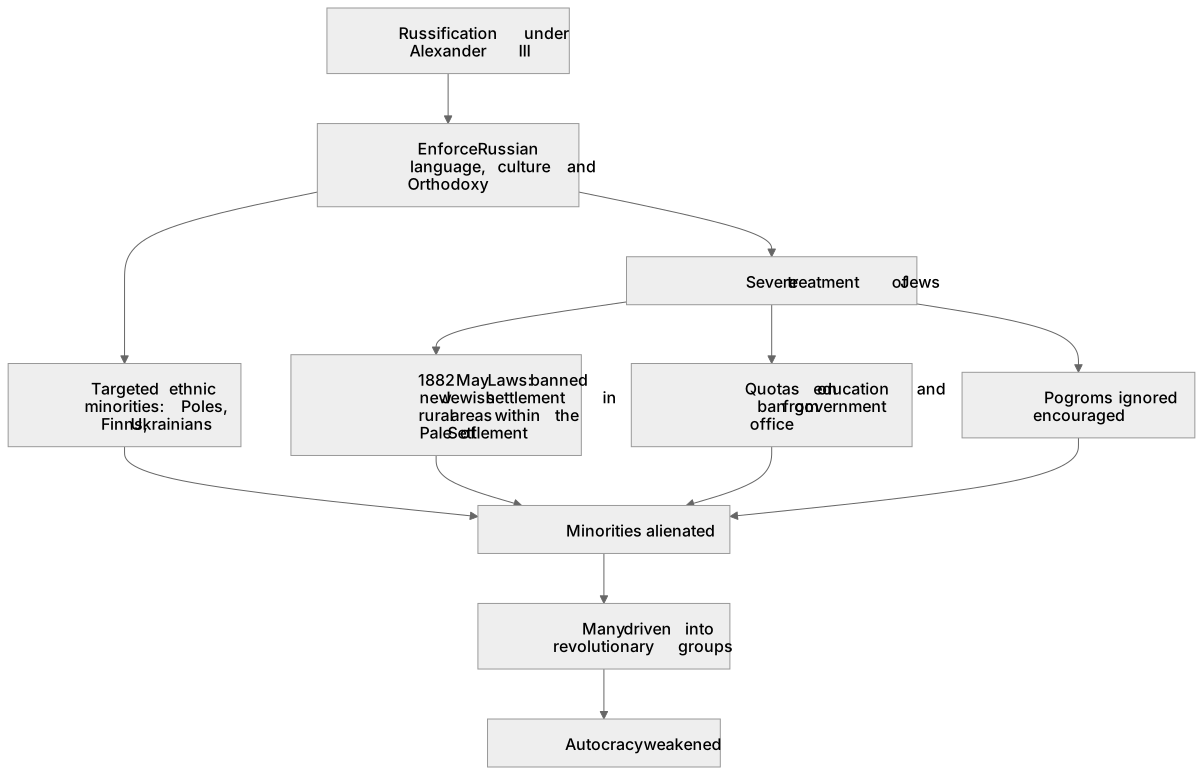
Label the diagram
Some boxes have lost their names. Pick the right name for each number.
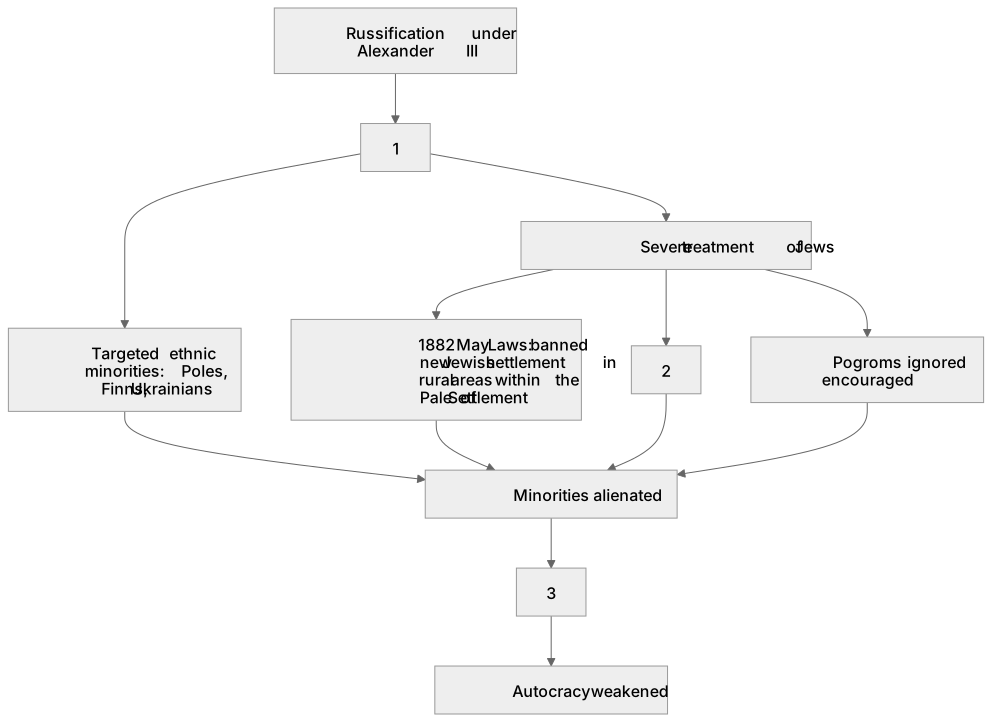
1Box 1
2Box 2
3Box 3
There is more to this lesson
The full lesson goes on to check your understanding and help you earn the marks. Create a free account to carry on, with your progress saved.
A week of Premium from your first lesson · Then the free plan continues · No card, no charge
Test your understanding of 1H Tsarist and Communist Russia, 1855–1964 – Trying to preserve autocracy, 1855–1894: Political authority in action: Russification; treatment of ethnic minorities and Jews
Active recall beats re-reading. Take an instant quiz now to test what you’ve learned and lock it into long-term memory.
A week of Premium from your first lesson · Then the free plan continues · No card, no charge