AQA · A-Level · History
Course version: 7042 · Version from Sept 2017
How important was the role of key individuals and groups and how were they…
Full specification wording
1J The British Empire, c1857–1967 – consequence in this period through the following key questions:: How important was the role of key individuals and groups and how were they affected by developments?
Evaluating the British Empire requires analysing the influence of key individuals and groups, and how broader developments affected them.
Checked against the AQA 7042 specification (opens in a new tab) on .
- Point 6 of 6
- 2 key terms
Study notes
From the checked teaching notes for this specification point.
The idea
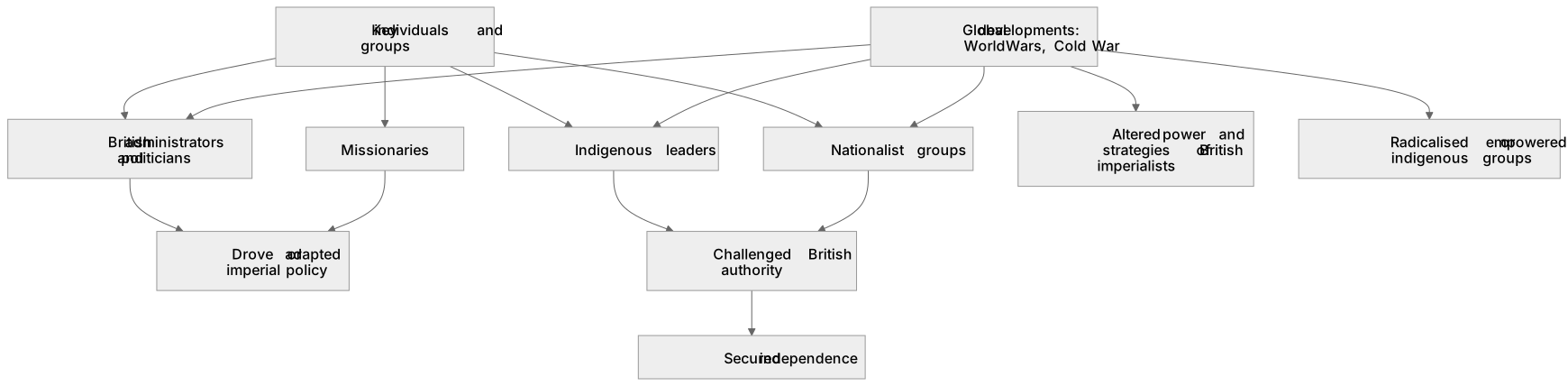
Evaluating the British Empire requires analysing the influence of key individuals and groups, and how broader developments affected them. British administrators like Curzon and Chamberlain, alongside groups such as missionaries, actively drove imperial policy. Conversely, indigenous leaders like Gandhi and Nkrumah, and nationalist groups, were pivotal in dismantling the empire. Crucially, these figures were profoundly affected by global developments. The economic strain of two World Wars and shifting geopolitical power forced British officials to adapt their strategies, while simultaneously accelerating the momentum and popular support of nationalist groups demanding independence, altering their roles from reformers to revolutionaries.
What earns the marks
- Assess the impact of key British individuals, such as administrators and politicians, in driving or adapting imperial policy.
- Evaluate the role of indigenous leaders and nationalist groups in challenging British authority and securing independence.
- Analyse how global developments, such as the World Wars and the Cold War, altered the power and strategies of British imperialists.
- Examine how changing economic and political landscapes radicalised or empowered indigenous groups and their leaders.
Common mistakes and how to put them right
Focusing solely on the actions of individuals without addressing how they were affected by broader developments.
Put it right: Explicitly link the changing strategies of leaders to external events like the World Wars.
Limiting 'key individuals' to British administrators.
Put it right: Ensure a balanced analysis that includes indigenous leaders and anti-colonial figures.
Treating groups as static entities.
Put it right: Demonstrate how groups like the Indian National Congress evolved in response to changing imperial policies and global contexts.
Exam tips
- Always pair the actions of an individual or group with the specific historical development that influenced or constrained them.
- Contrast the roles of different groups, such as the differing priorities of Christian missionaries versus colonial administrators.
- Use the World Wars as a primary turning point to explain how the influence and circumstances of both British and indigenous leaders shifted.
Try the lesson
The start of the 1J The British Empire, c1857–1967 – consequence in this period through the following key questions:: How important was the role of key individuals and groups and how were they affected by developments? lesson, made from checked teaching notes for this specification point.
Have a go first
What was the primary role of Cecil Rhodes in the expansion of the British Empire in southern Africa during the late 19th century?
Listen
Evaluating the British Empire requires analysing the influence of key individuals and groups, and how broader developments affected them. British administrators like Curzon and Chamberlain, alongside groups such as missionaries, actively drove imperial policy. Conversely, indigenous leaders like Gandhi and Nkrumah, and nationalist groups, were pivotal in dismantling the empire. Crucially, these figures were profoundly affected by global developments. The economic strain of two World Wars and shifting geopolitical power forced British officials to adapt their strategies, while simultaneously accelerating the momentum and popular support of nationalist groups demanding independence, altering their roles from reformers to revolutionaries. A strong answer earns marks for these points. Assess the impact of key British individuals, such as administrators and politicians, in driving or adapting imperial policy. Evaluate the role of indigenous leaders and nationalist groups in challenging British authority and securing independence. Analyse how global developments, such as the World Wars and the Cold War, altered the power and strategies of British imperialists. Examine how changing economic and political landscapes radicalised or empowered indigenous groups and their leaders. A common slip: Focusing solely on the actions of individuals without addressing how they were affected by broader developments. Instead, explicitly link the changing strategies of leaders to external events like the World Wars. Exam tip: Always pair the actions of an individual or group with the specific historical development that influenced or constrained them.
See it
Key words
Say what each word means before you turn the card.
Leadership
Try answering aloud or in your head before turning the card.
Imperial Policy
Try answering aloud or in your head before turning the card.
See every definition
- Leadership
- The influence of key individuals and groups, both British administrators and indigenous figures, in driving or challenging imperial policy.
- Imperial Policy
- The course driven by British administrators and politicians, which key individuals adapted in response to broader developments.
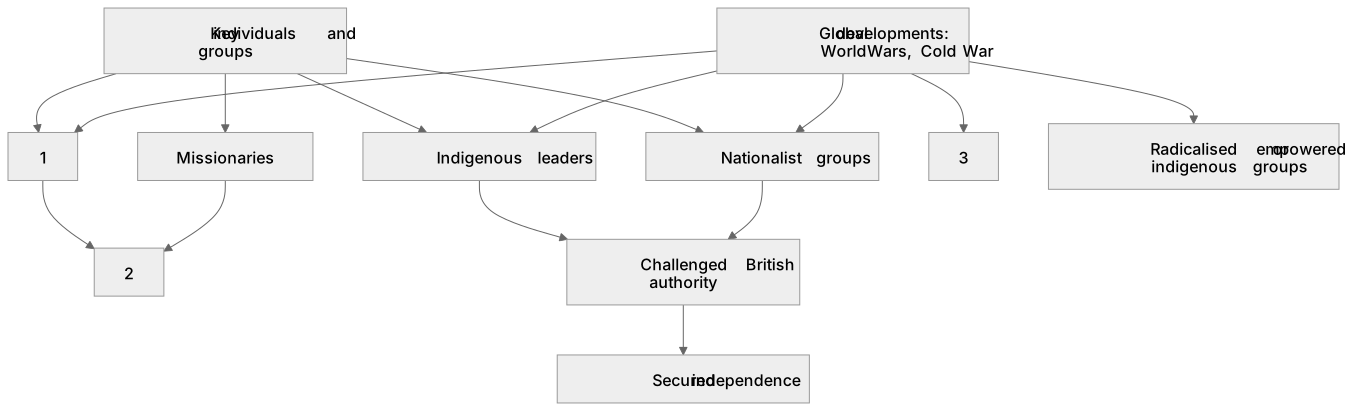
Label the diagram
Some boxes have lost their names. Pick the right name for each number.
1Box 1
2Box 2
3Box 3
There is more to this lesson
The full lesson goes on to check your understanding and help you earn the marks. Create a free account to carry on, with your progress saved.
A week of Premium from your first lesson · Then the free plan continues · No card, no charge
Test your understanding of 1J The British Empire, c1857–1967 – consequence in this period through the following key questions:: How important was the role of key individuals and groups and how were they affected by developments?
Active recall beats re-reading. Take an instant quiz now to test what you’ve learned and lock it into long-term memory.
A week of Premium from your first lesson · Then the free plan continues · No card, no charge