AQA · A-Level · History
Course version: 7042 · Version from Sept 2017
How did the indigenous peoples respond to British rule?
Full specification wording
1J The British Empire, c1857–1967 – consequence in this period through the following key questions:: How did the indigenous peoples respond to British rule?
Indigenous responses to British rule between 1857 and 1967 spanned a complex spectrum from active collaboration to armed rebellion.
Checked against the AQA 7042 specification (opens in a new tab) on .
- Point 5 of 6
- 4 key terms
Study notes
From the checked teaching notes for this specification point.
The idea
Indigenous responses to British rule between 1857 and 1967 spanned a complex spectrum from active collaboration to armed rebellion. Initially, many indigenous elites accommodated British administrators to preserve their own status, while others formed political organisations, such as the Indian National Congress, to seek constitutional reform within the imperial framework. Conversely, direct resistance frequently erupted, ranging from the 1857 Indian Mutiny and the Mahdist War in Sudan to the later Mau Mau Uprising in Kenya. Over time, responses evolved from localised, traditionalist revolts into sophisticated, mass nationalist movements demanding complete independence, demonstrating that indigenous peoples were active agents rather than passive subjects of empire.
What earns the marks
- Identify and evaluate the spectrum of indigenous responses, including collaboration, passive resistance, and armed rebellion.
- Analyse the evolution of resistance from early traditionalist uprisings to modern, organised nationalist movements.
- Assess the motivations behind collaboration, such as economic gain, preservation of local authority, or protection against rival indigenous groups.
- Evaluate the impact of British policies and administrative styles on shaping the nature and intensity of indigenous responses across different colonies.
Common mistakes and how to put them right
Treating indigenous peoples as a homogenous group.
Put it right: Acknowledge the diverse and often conflicting responses within the same colony, such as collaborators versus resistors.
Assuming all resistance was violent.
Put it right: Include examples of constitutional, economic, and passive resistance, such as boycotts or the formation of political parties.
Viewing indigenous populations merely as passive victims.
Put it right: Frame indigenous peoples as active agents who strategically navigated, manipulated, or challenged British rule.
Exam tips
- Use specific case studies from different continents, such as India and Africa, to demonstrate the variety of indigenous responses.
- Track how the nature of resistance changed over the period, particularly the shift towards organised mass nationalism in the twentieth century.
- When evaluating responses, consider the socio-economic status of the indigenous groups, as elites often responded differently to the peasantry.
Try the lesson
The start of the 1J The British Empire, c1857–1967 – consequence in this period through the following key questions:: How did the indigenous peoples respond to British rule? lesson, made from checked teaching notes for this specification point.
Have a go first
When the Indian National Congress was founded in 1885, what was its primary initial objective regarding British rule?
Listen
Indigenous responses to British rule between 1857 and 1967 spanned a complex spectrum from active collaboration to armed rebellion. Initially, many indigenous elites accommodated British administrators to preserve their own status, while others formed political organisations, such as the Indian National Congress, to seek constitutional reform within the imperial framework. Conversely, direct resistance frequently erupted, ranging from the 1857 Indian Mutiny and the Mahdist War in Sudan to the later Mau Mau Uprising in Kenya. Over time, responses evolved from localised, traditionalist revolts into sophisticated, mass nationalist movements demanding complete independence, demonstrating that indigenous peoples were active agents rather than passive subjects of empire. A strong answer earns marks for these points. Identify and evaluate the spectrum of indigenous responses, including collaboration, passive resistance, and armed rebellion. Analyse the evolution of resistance from early traditionalist uprisings to modern, organised nationalist movements. Assess the motivations behind collaboration, such as economic gain, preservation of local authority, or protection against rival indigenous groups. Evaluate the impact of British policies and administrative styles on shaping the nature and intensity of indigenous responses across different colonies. A common slip: Treating indigenous peoples as a homogenous group. Instead, acknowledge the diverse and often conflicting responses within the same colony, such as collaborators versus resistors. Exam tip: Use specific case studies from different continents, such as India and Africa, to demonstrate the variety of indigenous responses.
See it
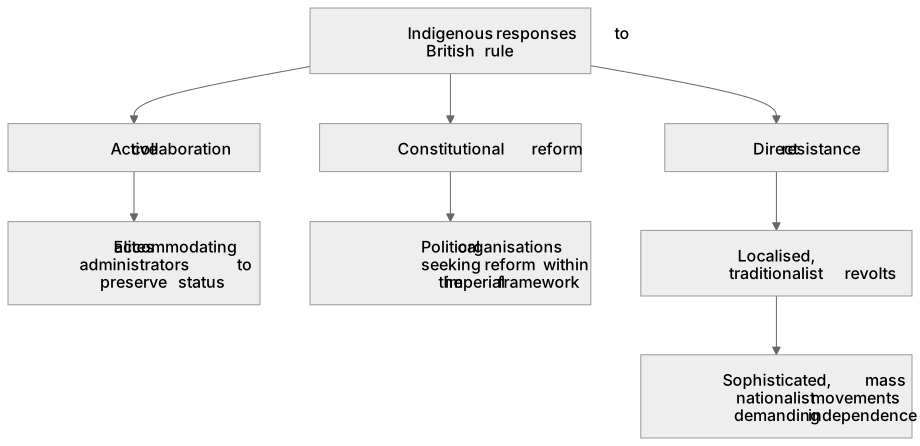
Key words
Say what each word means before you turn the card.
Nationalism
Try answering aloud or in your head before turning the card.
Resistance and Rebellion
Try answering aloud or in your head before turning the card.
Collaboration and Accommodation
Try answering aloud or in your head before turning the card.
Imperial Administration
Try answering aloud or in your head before turning the card.
See every definition
- Nationalism
- Sophisticated, mass movements demanding complete independence, into which responses evolved over time from localised, traditionalist revolts.
- Resistance and Rebellion
- Direct resistance that frequently erupted, ranging from the 1857 Indian Mutiny and the Mahdist War in Sudan to the later Mau Mau Uprising in Kenya.
- Collaboration and Accommodation
- Indigenous elites accommodating British administrators to preserve their own status, part of a spectrum of responses that also included armed rebellion.
- Imperial Administration
- British policies and administrative styles that shaped the nature and intensity of indigenous responses across different colonies.
Label the diagram
Some boxes have lost their names. Pick the right name for each number.
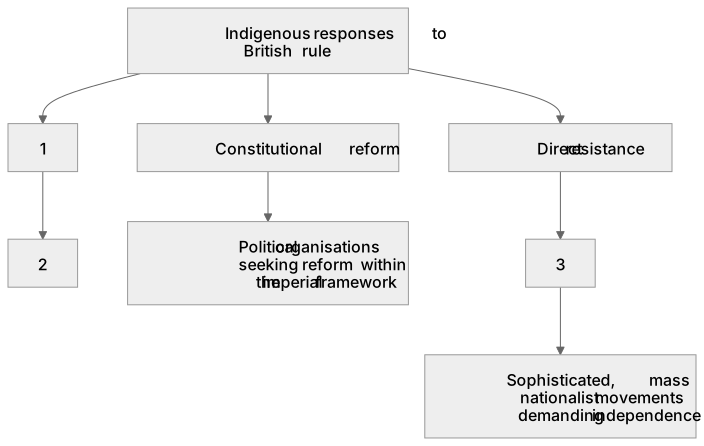
1Box 1
2Box 2
3Box 3
There is more to this lesson
The full lesson goes on to check your understanding and help you earn the marks. Create a free account to carry on, with your progress saved.
A week of Premium from your first lesson · Then the free plan continues · No card, no charge
Test your understanding of 1J The British Empire, c1857–1967 – consequence in this period through the following key questions:: How did the indigenous peoples respond to British rule?
Active recall beats re-reading. Take an instant quiz now to test what you’ve learned and lock it into long-term memory.
A week of Premium from your first lesson · Then the free plan continues · No card, no charge