AQA · A-Level · History
Course version: 7042 · Version from Sept 2017
What part did economic factors play in the development of the British…
Full specification wording
1J The British Empire, c1857–1967 – consequence in this period through the following key questions:: What part did economic factors play in the development of the British Empire?
Economic factors were central to the expansion, consolidation, and decline of the British Empire.
Checked against the AQA 7042 specification (opens in a new tab) on .
- Point 3 of 6
- 4 key terms
Study notes
From the checked teaching notes for this specification point.
The idea
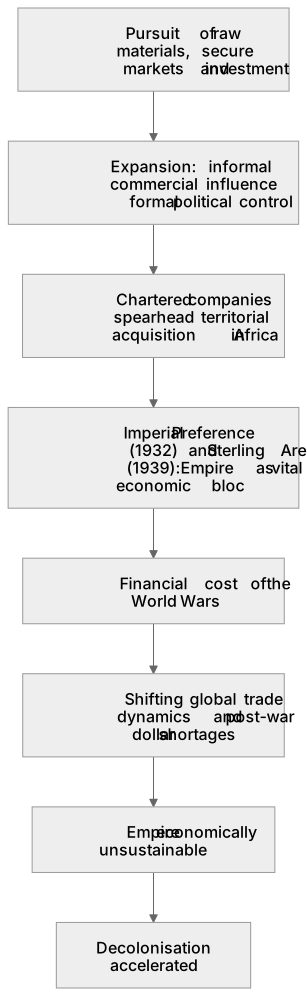
Economic factors were central to the expansion, consolidation, and decline of the British Empire. Initially, the pursuit of raw materials, secure markets, and investment drove expansion, transitioning from informal commercial influence to formal political control. For example, chartered companies like the Royal Niger Company spearheaded territorial acquisition in Africa to secure palm oil. During the 1930s and the Second World War, the Empire became a vital economic bloc through Imperial Preference (1932) and the Sterling Area (1939). However, the crippling financial cost of the World Wars, alongside shifting global trade dynamics and post-war dollar shortages, made the Empire economically unsustainable, accelerating the process of decolonisation.
What earns the marks
- Evaluate the role of chartered companies in driving late nineteenth-century territorial expansion for commercial gain.
- Analyse the impact of Imperial Preference (1932) and the Sterling Area (1939) on consolidating imperial economic ties during the 1930s and the Second World War.
- Assess how the economic burden of the First and Second World Wars weakened Britain's capacity to maintain its imperial commitments.
- Compare the relative importance of economic motives against strategic, political, or ideological factors in specific case studies, such as Egypt or India.
Common mistakes and how to put them right
Treating economic factors as the sole driver of imperial expansion.
Put it right: Weigh economic motives against strategic concerns (like the Suez Canal) and ideological factors (like the 'civilising mission').
Assuming the Empire was always highly profitable for the British state.
Put it right: Distinguish between private wealth generated by investors and the significant administrative and military costs borne by the British taxpayer.
Ignoring the economic causes of decolonisation.
Put it right: Explicitly link Britain's post-1945 financial exhaustion and reliance on American loans to the rapid dismantling of the Empire.
Stating that Imperial Preference and the Sterling Area supported Britain through both World Wars.
Put it right: Note that Imperial Preference was introduced in 1932 and the Sterling Area formalised in 1939, so they did not operate during the First World War.
Exam tips
- Use specific statistics or examples of commodities (e.g., Indian cotton, Rand gold) to substantiate claims about economic motivations.
- When assessing 'what part' economic factors played, structure your essay to directly compare them with strategic and political drivers.
- Track change over time by contrasting the aggressive economic expansionism of the 1880s with the defensive economic consolidation of the 1930s.
Try the lesson
The start of the 1J The British Empire, c1857–1967 – consequence in this period through the following key questions:: What part did economic factors play in the development of the British Empire? lesson, made from checked teaching notes for this specification point.
Have a go first
How did the 'Long Depression' of the late 19th century economically influence British imperial expansion in Africa?
Listen
Economic factors were central to the expansion, consolidation, and decline of the British Empire. Initially, the pursuit of raw materials, secure markets, and investment drove expansion, transitioning from informal commercial influence to formal political control. For example, chartered companies like the Royal Niger Company spearheaded territorial acquisition in Africa to secure palm oil. During the 1930s and the Second World War, the Empire became a vital economic bloc through Imperial Preference (1932) and the Sterling Area (1939). However, the crippling financial cost of the World Wars, alongside shifting global trade dynamics and post-war dollar shortages, made the Empire economically unsustainable, accelerating the process of decolonisation. A strong answer earns marks for these points. Evaluate the role of chartered companies in driving late nineteenth-century territorial expansion for commercial gain. Analyse the impact of Imperial Preference (1932) and the Sterling Area (1939) on consolidating imperial economic ties during the 1930s and the Second World War. Assess how the economic burden of the First and Second World Wars weakened Britain's capacity to maintain its imperial commitments. Compare the relative importance of economic motives against strategic, political, or ideological factors in specific case studies, such as Egypt or India. A common slip: Treating economic factors as the sole driver of imperial expansion. Instead, weigh economic motives against strategic concerns (like the Suez Canal) and ideological factors (like the 'civilising mission'). Exam tip: Use specific statistics or examples of commodities (e.g., Indian cotton, Rand gold) to substantiate claims about economic motivations.
See it
Put it in order
Put these steps in the order they happen.
- 1. Financial cost of the World Wars
- 2. Decolonisation accelerated
- 3. Shifting global trade dynamics and post-war dollar shortages
- 4. Pursuit of raw materials, secure markets and investment
- 5. Expansion: informal commercial influence to formal political control
- 6. Empire economically unsustainable
- 7. Chartered companies spearhead territorial acquisition in Africa
- 8. Imperial Preference (1932) and Sterling Area (1939): Empire as vital economic bloc
Key words
Say what each word means before you turn the card.
Trade and commerce
Try answering aloud or in your head before turning the card.
Imperial policy and administration
Try answering aloud or in your head before turning the card.
Decolonisation and decline
Try answering aloud or in your head before turning the card.
Strategic versus economic motives
Try answering aloud or in your head before turning the card.
See every definition
- Trade and commerce
- The pursuit of raw materials, secure markets and investment that drove expansion from informal commercial influence to formal political control.
- Imperial policy and administration
- Formal political control that expansion transitioned to, alongside the administrative and military costs borne by the British taxpayer.
- Decolonisation and decline
- A process accelerated by the crippling financial cost of the World Wars, shifting global trade dynamics and post-war dollar shortages, which made the Empire economically unsustainable.
- Strategic versus economic motives
- Economic motives weighed against strategic concerns and ideological factors, rather than treating economic factors as the sole driver of imperial expansion.
Label the diagram
Some boxes have lost their names. Pick the right name for each number.
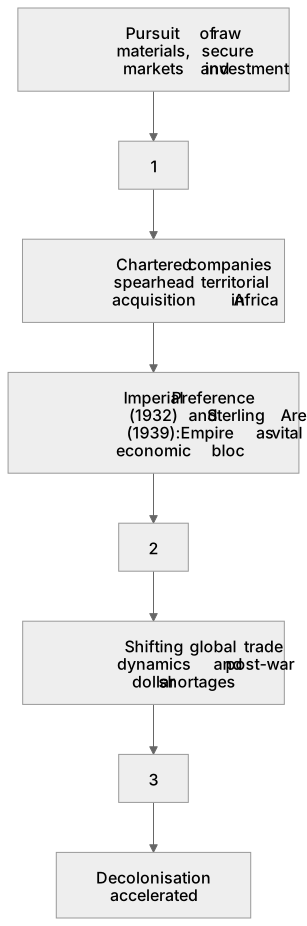
1Box 1
2Box 2
3Box 3
There is more to this lesson
The full lesson goes on to check your understanding and help you earn the marks. Create a free account to carry on, with your progress saved.
A week of Premium from your first lesson · Then the free plan continues · No card, no charge
Test your understanding of 1J The British Empire, c1857–1967 – consequence in this period through the following key questions:: What part did economic factors play in the development of the British Empire?
Active recall beats re-reading. Take an instant quiz now to test what you’ve learned and lock it into long-term memory.
A week of Premium from your first lesson · Then the free plan continues · No card, no charge