AQA · A-Level · History
Course version: 7042 · Version from Sept 2017
How did the Empire influence British attitudes and culture?
Full specification wording
1J The British Empire, c1857–1967 – consequence in this period through the following key questions:: How did the Empire influence British attitudes and culture?
The British Empire profoundly shaped domestic attitudes and culture from 1857 to 1967, embedding imperial consciousness into everyday life.
Checked against the AQA 7042 specification (opens in a new tab) on .
- Point 4 of 6
- 4 key terms
Study notes
From the checked teaching notes for this specification point.
The idea
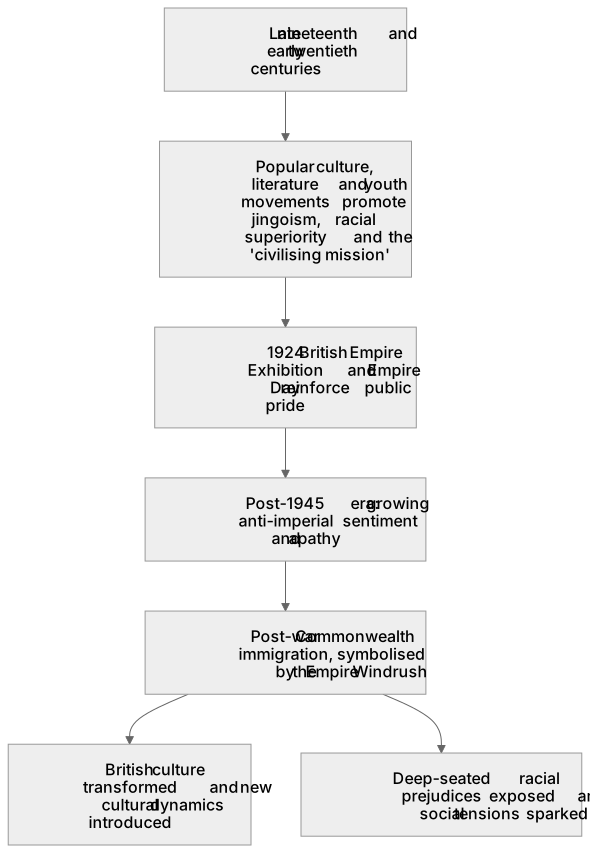
The British Empire profoundly shaped domestic attitudes and culture from 1857 to 1967, embedding imperial consciousness into everyday life. In the late nineteenth and early twentieth centuries, popular culture, literature, and youth movements like the Boy Scouts actively promoted jingoism, racial superiority, and the paternalistic 'civilising mission'. Events such as the 1924 British Empire Exhibition and the celebration of Empire Day reinforced public pride in imperial achievements. However, attitudes shifted over time; the post-1945 era saw growing anti-imperial sentiment and apathy. Furthermore, post-war Commonwealth immigration, symbolised by the Empire Windrush, fundamentally transformed British culture, introducing new cultural dynamics while also exposing deep-seated racial prejudices and sparking significant social tensions.
What earns the marks
- Analyse the methods used to promote imperial ideology to the British public, including youth movements, exhibitions, and education.
- Evaluate the reflection of imperial attitudes in popular culture, such as music hall entertainment, advertising, and the literature of authors like Rudyard Kipling.
- Assess the extent of genuine working-class support for the Empire compared to middle-class and elite jingoism.
- Examine the cultural and social impact of post-1945 Commonwealth immigration on British society and the resulting shifts in racial attitudes.
Common mistakes and how to put them right
Assuming that all British people enthusiastically supported the Empire throughout the entire period.
Put it right: Acknowledge the existence of anti-imperialist critics (like J.A. Hobson) and widespread working-class apathy or ignorance regarding imperial affairs.
Treating British culture as static between 1857 and 1967.
Put it right: Contrast the aggressive jingoism of the Boer War era with the growing public indifference and focus on domestic welfare after the Second World War.
Discussing imperial culture without mentioning post-war immigration.
Put it right: Include the demographic and cultural transformations brought about by Commonwealth migrants in the 1950s and 1960s when discussing the Empire's legacy in Britain.
Exam tips
- Cite specific cultural artefacts, such as Pears' Soap advertisements or Empire Day celebrations, to provide concrete evidence of imperial propaganda.
- Differentiate between the attitudes of different social classes and political affiliations towards the Empire.
- When discussing the later period, explicitly link the arrival of Commonwealth immigrants to changing domestic attitudes regarding race and national identity.
Try the lesson
The start of the 1J The British Empire, c1857–1967 – consequence in this period through the following key questions:: How did the Empire influence British attitudes and culture? lesson, made from checked teaching notes for this specification point.
Have a go first
How was the British public's awareness of and pride in the Empire most commonly reinforced in the late 19th and early 20th centuries?
Listen
The British Empire profoundly shaped domestic attitudes and culture from 1857 to 1967, embedding imperial consciousness into everyday life. In the late nineteenth and early twentieth centuries, popular culture, literature, and youth movements like the Boy Scouts actively promoted jingoism, racial superiority, and the paternalistic 'civilising mission'. Events such as the 1924 British Empire Exhibition and the celebration of Empire Day reinforced public pride in imperial achievements. However, attitudes shifted over time; the post-1945 era saw growing anti-imperial sentiment and apathy. Furthermore, post-war Commonwealth immigration, symbolised by the Empire Windrush, fundamentally transformed British culture, introducing new cultural dynamics while also exposing deep-seated racial prejudices and sparking significant social tensions. A strong answer earns marks for these points. Analyse the methods used to promote imperial ideology to the British public, including youth movements, exhibitions, and education. Evaluate the reflection of imperial attitudes in popular culture, such as music hall entertainment, advertising, and the literature of authors like Rudyard Kipling. Assess the extent of genuine working-class support for the Empire compared to middle-class and elite jingoism. Examine the cultural and social impact of post-1945 Commonwealth immigration on British society and the resulting shifts in racial attitudes. A common slip: Assuming that all British people enthusiastically supported the Empire throughout the entire period. Instead, Acknowledge the existence of anti-imperialist critics (like J.A. Hobson) and widespread working-class apathy or ignorance regarding imperial affairs. Exam tip: Cite specific cultural artefacts, such as Pears' Soap advertisements or Empire Day celebrations, to provide concrete evidence of imperial propaganda.
See it
Key words
Say what each word means before you turn the card.
Social class and popular culture
Try answering aloud or in your head before turning the card.
Race and immigration
Try answering aloud or in your head before turning the card.
Propaganda and education
Try answering aloud or in your head before turning the card.
National identity
Try answering aloud or in your head before turning the card.
See every definition
- Social class and popular culture
- Popular culture, literature and youth movements promoted jingoism, racial superiority and the paternalistic 'civilising mission', while working-class support for the Empire is assessed against middle-class and elite jingoism.
- Race and immigration
- Post-war Commonwealth immigration, symbolised by the Empire Windrush, transformed British culture while exposing deep-seated racial prejudices and sparking significant social tensions.
- Propaganda and education
- Imperial ideology was promoted to the British public through methods including youth movements, exhibitions and education.
- National identity
- The arrival of Commonwealth immigrants is linked to changing domestic attitudes regarding race and national identity.
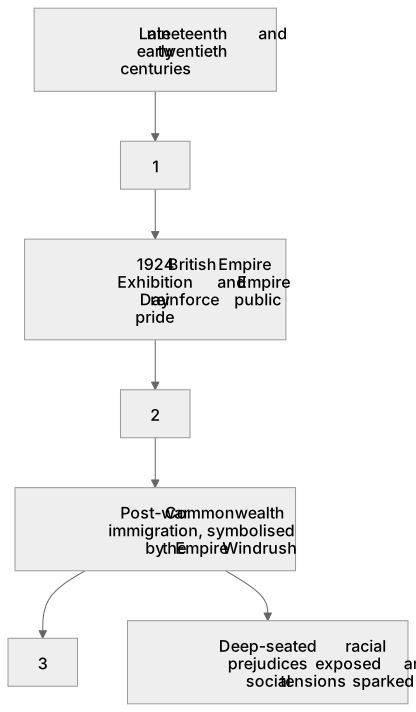
Label the diagram
Some boxes have lost their names. Pick the right name for each number.
1Box 1
2Box 2
3Box 3
There is more to this lesson
The full lesson goes on to check your understanding and help you earn the marks. Create a free account to carry on, with your progress saved.
A week of Premium from your first lesson · Then the free plan continues · No card, no charge
Test your understanding of 1J The British Empire, c1857–1967 – consequence in this period through the following key questions:: How did the Empire influence British attitudes and culture?
Active recall beats re-reading. Take an instant quiz now to test what you’ve learned and lock it into long-term memory.
A week of Premium from your first lesson · Then the free plan continues · No card, no charge