AQA · A-Level · History
Course version: 7042 · Version from Sept 2017
Relations with indigenous peoples; challenges to British rule; the Sudan;…
Full specification wording
1J The British Empire, c1857–1967 – Imperial consolidation and Liberal rule, c1890–1914: Relations with indigenous peoples; challenges to British rule; the Sudan; the causes and consequences of the Boer War
British relations with indigenous peoples during this era were often defined by exploitation and violent suppression of resistance.
Checked against the AQA 7042 specification (opens in a new tab) on .
- Point 6 of 6
- 3 key terms
Study notes
From the checked teaching notes for this specification point.
The idea
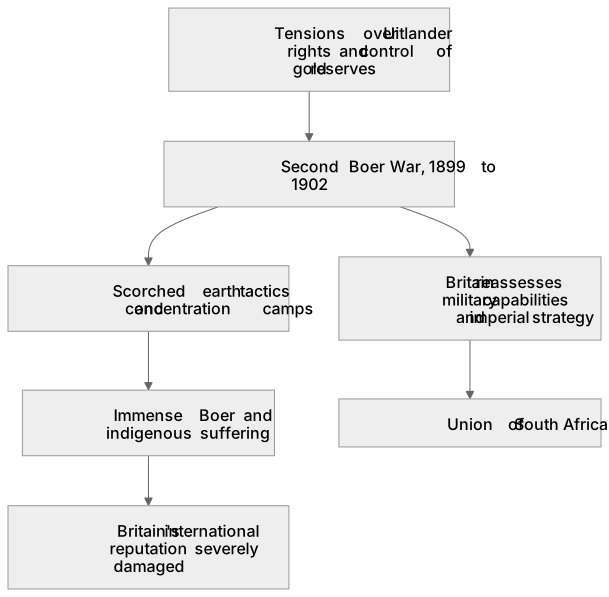
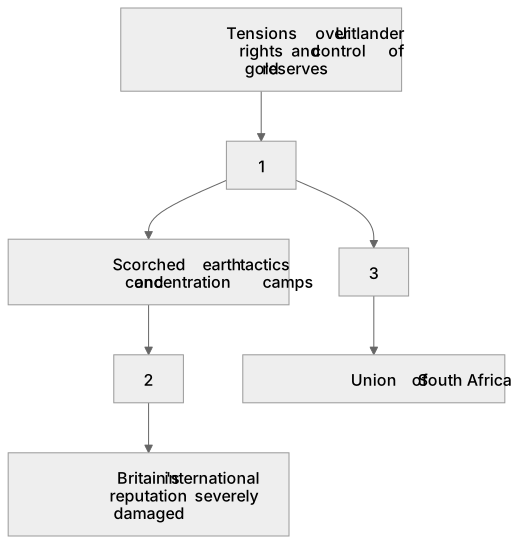
British relations with indigenous peoples during this era were often defined by exploitation and violent suppression of resistance. Challenges to British rule emerged across the empire, notably in the Sudan, where the Mahdist uprising was brutally crushed at the Battle of Omdurman in 1898, restoring British control to secure the Nile. In South Africa, tensions over Uitlander rights and control of gold reserves caused the Second Boer War (1899 to 1902). The conflict had profound consequences: the British use of scorched earth tactics and concentration camps caused immense Boer and indigenous suffering, severely damaging Britain's international reputation. Ultimately, the war forced Britain to reassess its military capabilities and imperial strategy, leading to the Union of South Africa.
What earns the marks
- Analyse the nature of British relations with indigenous peoples, focusing on land dispossession, taxation, and cultural imposition.
- Evaluate specific challenges to British rule, including the motivations and methods of indigenous resistance movements.
- Explain the strategic and political reasons for the British reconquest of the Sudan, highlighting the significance of the Battle of Omdurman.
- Assess the long-term and short-term causes of the Second Boer War, including the role of Cecil Rhodes, Paul Kruger, and the discovery of gold.
- Examine the consequences of the Boer War, such as the impact of concentration camps, the Treaty of Vereeniging, and shifts in British domestic and foreign policy.
Common mistakes and how to put them right
Stating the Boer War was fought solely over the rights of Uitlanders.
Put it right: Explain that while Uitlander grievances were the immediate pretext, the underlying cause was the struggle for economic and strategic control of a gold-rich region.
Ignoring the impact of the Boer War on black Africans.
Put it right: Include the experiences of black Africans who were also interned in concentration camps and suffered heavily during the conflict.
Viewing the reconquest of the Sudan purely as revenge for General Gordon.
Put it right: Emphasise the broader strategic imperatives, such as securing the headwaters of the Nile and countering French expansion during the Fashoda Incident.
Exam tips
- Differentiate clearly between the causes of the First and Second Boer Wars to avoid confusing the timelines and key figures.
- Use the Battle of Omdurman as a concrete example of how technological superiority, such as the Maxim gun, dictated relations with indigenous peoples.
- When evaluating the consequences of the Boer War, connect the military failings directly to the subsequent National Efficiency movement in Britain.
Try the lesson
The start of the 1J The British Empire, c1857–1967 – Imperial consolidation and Liberal rule, c1890–1914: Relations with indigenous peoples; challenges to British rule; the Sudan; the causes and consequences of the Boer War lesson, made from checked teaching notes for this specification point.
Have a go first
Which group of people in the Transvaal were at the centre of the political dispute that served as a primary catalyst for the Second Boer War?
Listen
British relations with indigenous peoples during this era were often defined by exploitation and violent suppression of resistance. Challenges to British rule emerged across the empire, notably in the Sudan, where the Mahdist uprising was brutally crushed at the Battle of Omdurman in 1898, restoring British control to secure the Nile. In South Africa, tensions over Uitlander rights and control of gold reserves caused the Second Boer War (1899 to 1902). The conflict had profound consequences: the British use of scorched earth tactics and concentration camps caused immense Boer and indigenous suffering, severely damaging Britain's international reputation. Ultimately, the war forced Britain to reassess its military capabilities and imperial strategy, leading to the Union of South Africa. A strong answer earns marks for these points. Analyse the nature of British relations with indigenous peoples, focusing on land dispossession, taxation, and cultural imposition. Evaluate specific challenges to British rule, including the motivations and methods of indigenous resistance movements. Explain the strategic and political reasons for the British reconquest of the Sudan, highlighting the significance of the Battle of Omdurman. Assess the long-term and short-term causes of the Second Boer War, including the role of Cecil Rhodes, Paul Kruger, and the discovery of gold. A common slip: Stating the Boer War was fought solely over the rights of Uitlanders. Instead, Explain that while Uitlander grievances were the immediate pretext, the underlying cause was the struggle for economic and strategic control of a gold-rich region. Exam tip: Differentiate clearly between the causes of the First and Second Boer Wars to avoid confusing the timelines and key figures.
See it
Put the events in order
Put these events in the order they happened, earliest first.
- 1. Battle of Omdurman restores British control of the Sudan
- 2. Second Boer War ends
- 3. Second Boer War begins over Uitlander rights and gold
Key words
Say what each word means before you turn the card.
Indigenous resistance and suppression
Try answering aloud or in your head before turning the card.
Military technology and warfare
Try answering aloud or in your head before turning the card.
Imperial overstretch and vulnerability
Try answering aloud or in your head before turning the card.
See every definition
- Indigenous resistance and suppression
- Relations with indigenous peoples were often defined by exploitation and violent suppression of resistance to British rule.
- Military technology and warfare
- Technological superiority dictated relations with indigenous peoples, as shown by the Maxim gun at the Battle of Omdurman.
- Imperial overstretch and vulnerability
- The Boer War forced Britain to reassess its military capabilities and imperial strategy after the conflict damaged its international reputation.
Label the diagram
Some boxes have lost their names. Pick the right name for each number.
1Box 1
2Box 2
3Box 3
There is more to this lesson
The full lesson goes on to check your understanding and help you earn the marks. Create a free account to carry on, with your progress saved.
A week of Premium from your first lesson · Then the free plan continues · No card, no charge
Test your understanding of 1J The British Empire, c1857–1967 – Imperial consolidation and Liberal rule, c1890–1914: Relations with indigenous peoples; challenges to British rule; the Sudan; the causes and consequences of the Boer War
Active recall beats re-reading. Take an instant quiz now to test what you’ve learned and lock it into long-term memory.
A week of Premium from your first lesson · Then the free plan continues · No card, no charge