AQA · A-Level · History
Course version: 7042 · Version from Sept 2017
Imperialism: supporters and critics; National Efficiency; the British…
Full specification wording
1J The British Empire, c1857–1967 – Imperial consolidation and Liberal rule, c1890–1914: Imperialism: supporters and critics; National Efficiency; the British Empire and popular culture; representations of empire
Between 1890 and 1914, British imperialism sparked intense debate.
Checked against the AQA 7042 specification (opens in a new tab) on .
- Point 5 of 6
- 4 key terms
Study notes
From the checked teaching notes for this specification point.
The idea
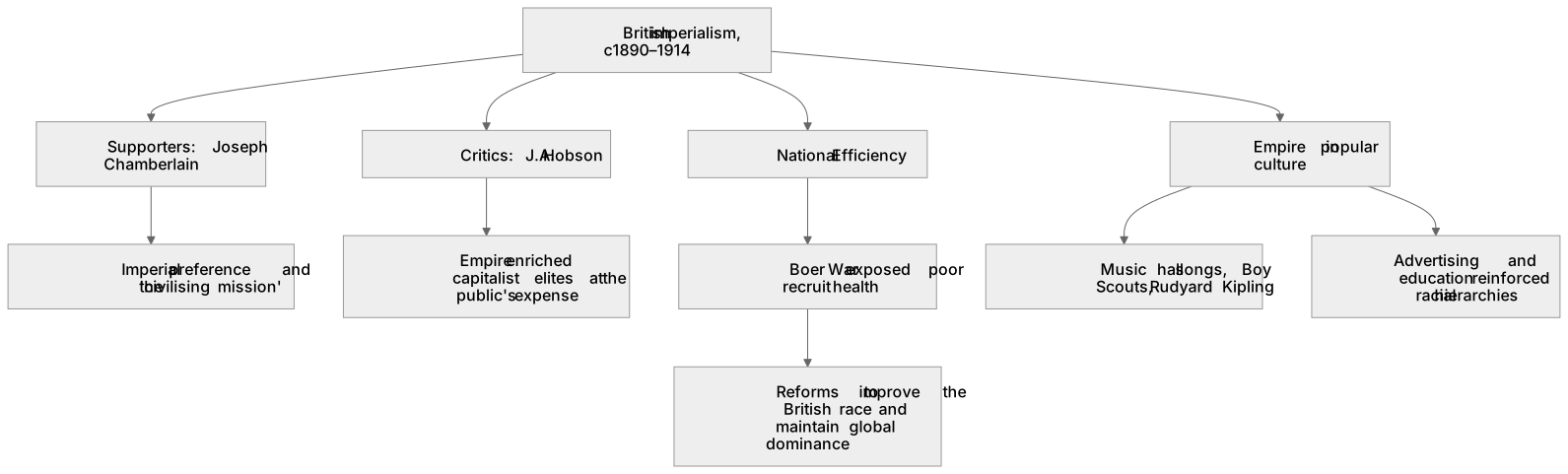
Between 1890 and 1914, British imperialism sparked intense debate. Supporters like Joseph Chamberlain championed imperial preference and the 'civilising mission', while critics like J.A. Hobson argued empire merely enriched capitalist elites at the public's expense. The Boer War's exposure of poor recruit health triggered the 'National Efficiency' movement, driving reforms to improve the British race and maintain global dominance. Simultaneously, the empire permeated popular culture through jingoistic music hall songs, youth movements like the Boy Scouts, and literature by Rudyard Kipling. Representations of empire in advertising and education consistently reinforced racial hierarchies and celebrated imperial heroes, embedding imperial ideology into everyday British life.
What earns the marks
- Identify key supporters of imperialism, such as Joseph Chamberlain, and explain their ideological, strategic, or economic motivations.
- Evaluate the arguments of imperial critics, particularly J.A. Hobson's economic critique and radical Liberal opposition.
- Explain the concept of 'National Efficiency' as a reaction to the Boer War, linking it to social reforms and fears of national decline.
- Analyse how popular culture, including music halls, literature, and youth movements, promoted imperial values to the British public.
- Assess how representations of empire in advertising, such as Pears' Soap, and education reinforced racial superiority and the 'civilising mission'.
Common mistakes and how to put them right
Assuming all British people enthusiastically supported the empire.
Put it right: Acknowledge the vocal minority of critics, such as J.A. Hobson and radical Liberals, who actively opposed imperial expansion.
Treating 'National Efficiency' solely as a military reform movement.
Put it right: Explain that it encompassed social, educational, and public health reforms designed to improve the physical condition of the British workforce and army.
Viewing popular culture as passively reflecting empire.
Put it right: Recognise that popular culture actively shaped public opinion and manufactured consent for imperial policies through targeted propaganda and consumer goods.
Exam tips
- Use specific examples of popular culture, such as the Boy Scouts or Pears' Soap advertisements, to illustrate how imperial ideology reached the working classes.
- When discussing critics of empire, explicitly mention J.A. Hobson's thesis on capitalist manipulation to demonstrate depth of historiographical knowledge.
- Link the drive for National Efficiency directly to the shock of the Boer War and the subsequent Liberal social reforms of 1906 to 1914.
Try the lesson
The start of the 1J The British Empire, c1857–1967 – Imperial consolidation and Liberal rule, c1890–1914: Imperialism: supporters and critics; National Efficiency; the British Empire and popular culture; representations of empire lesson, made from checked teaching notes for this specification point.
Have a go first
Which organisation, founded in 1908 by Robert Baden-Powell, was designed to promote imperial values and physical fitness among young people?
Listen
Between 1890 and 1914, British imperialism sparked intense debate. Supporters like Joseph Chamberlain championed imperial preference and the 'civilising mission', while critics like J.A. Hobson argued empire merely enriched capitalist elites at the public's expense. The Boer War's exposure of poor recruit health triggered the 'National Efficiency' movement, driving reforms to improve the British race and maintain global dominance. Simultaneously, the empire permeated popular culture through jingoistic music hall songs, youth movements like the Boy Scouts, and literature by Rudyard Kipling. Representations of empire in advertising and education consistently reinforced racial hierarchies and celebrated imperial heroes, embedding imperial ideology into everyday British life. A strong answer earns marks for these points. Identify key supporters of imperialism, such as Joseph Chamberlain, and explain their ideological, strategic, or economic motivations. Evaluate the arguments of imperial critics, particularly J.A. Hobson's economic critique and radical Liberal opposition. Explain the concept of 'National Efficiency' as a reaction to the Boer War, linking it to social reforms and fears of national decline. Analyse how popular culture, including music halls, literature, and youth movements, promoted imperial values to the British public. A common slip: Assuming all British people enthusiastically supported the empire. Instead, Acknowledge the vocal minority of critics, such as J.A. Hobson and radical Liberals, who actively opposed imperial expansion. Exam tip: Use specific examples of popular culture, such as the Boy Scouts or Pears' Soap advertisements, to illustrate how imperial ideology reached the working classes.
See it
Key words
Say what each word means before you turn the card.
National Efficiency
Try answering aloud or in your head before turning the card.
Economic critiques of empire
Try answering aloud or in your head before turning the card.
Ideology and propaganda
Try answering aloud or in your head before turning the card.
Social class and imperialism
Try answering aloud or in your head before turning the card.
See every definition
- National Efficiency
- A movement triggered by the Boer War's exposure of poor recruit health, driving reforms to improve the British race and maintain global dominance.
- Economic critiques of empire
- Arguments such as J.A. Hobson's that empire merely enriched capitalist elites at the public's expense.
- Ideology and propaganda
- Imperial ideology embedded into everyday British life through popular culture, advertising and education that reinforced racial hierarchies and celebrated imperial heroes.
- Social class and imperialism
- The claim of critics that empire enriched capitalist elites at the public's expense, while popular culture reached the working classes.
Label the diagram
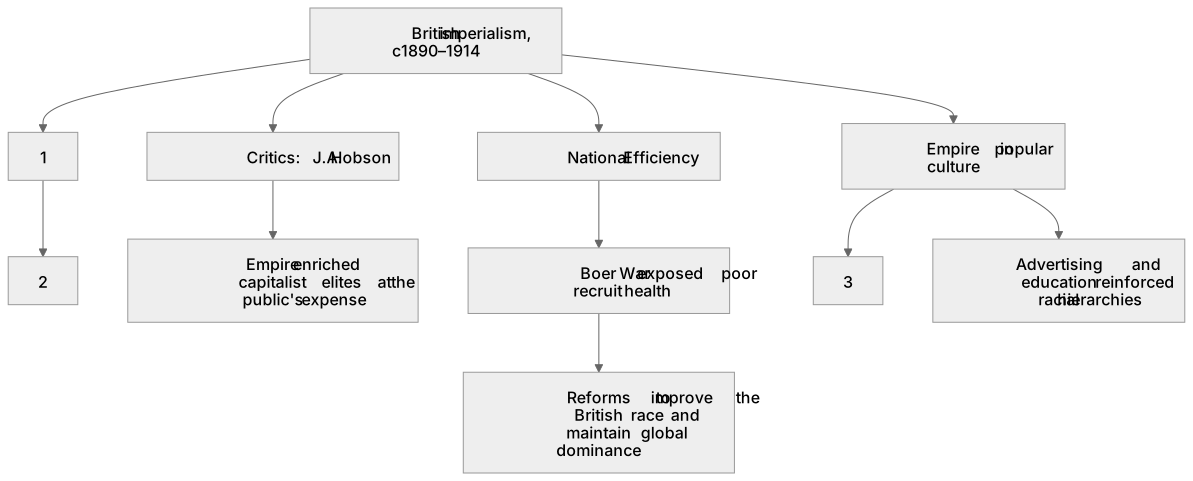
Some boxes have lost their names. Pick the right name for each number.
1Box 1
2Box 2
3Box 3
There is more to this lesson
The full lesson goes on to check your understanding and help you earn the marks. Create a free account to carry on, with your progress saved.
A week of Premium from your first lesson · Then the free plan continues · No card, no charge
Test your understanding of 1J The British Empire, c1857–1967 – Imperial consolidation and Liberal rule, c1890–1914: Imperialism: supporters and critics; National Efficiency; the British Empire and popular culture; representations of empire
Active recall beats re-reading. Take an instant quiz now to test what you’ve learned and lock it into long-term memory.
A week of Premium from your first lesson · Then the free plan continues · No card, no charge