AQA · A-Level · History
Course version: 7042 · Version from Sept 2017
Trade and commerce
Full specification wording
1J The British Empire, c1857–1967 – Imperial consolidation and Liberal rule, c1890–1914: Trade and commerce
Between 1890 and 1914, trade and commerce were central to imperial consolidation, though the economic value of the Empire was increasingly debated.
Checked against the AQA 7042 specification (opens in a new tab) on .
- Point 3 of 6
- 4 key terms
Study notes
From the checked teaching notes for this specification point.
The idea
Between 1890 and 1914, trade and commerce were central to imperial consolidation, though the economic value of the Empire was increasingly debated. Britain relied on colonies for vital raw materials, such as Indian cotton and South African gold, while using them as markets for manufactured exports. However, non-imperial trade with nations like the USA and Germany often outpaced imperial commerce. The City of London dominated global finance, directing massive investments overseas, yet much flowed to the 'informal empire' like Latin America. This period also witnessed fierce political battles over trade policy, notably the clash between traditional free trade and the campaign for Imperial Preference.
What earns the marks
- Identify the reliance on the Empire for raw materials and foodstuffs, contrasting this with the export of British manufactured goods.
- Evaluate the significance of the 'informal empire' and non-imperial trade, noting that Britain traded more with the USA and Europe than its own colonies.
- Analyse the role of the City of London in global finance, specifically the scale of overseas investment and invisible earnings.
- Assess the political and economic debate between maintaining traditional free trade and adopting Imperial Preference.
Common mistakes and how to put them right
Assuming the majority of British trade was conducted exclusively within the formal Empire.
Put it right: In reality, trade with non-imperial nations like the USA was often larger.
Confusing free trade with Imperial Preference.
Put it right: Free trade allowed tariff-free imports from anywhere, whereas Imperial Preference sought to impose tariffs on non-imperial goods.
Overlooking the role of invisible exports; students often focus solely on physical goods and ignore the massive financial returns from shipping, insurance, and overseas investments.
Exam tips
- Use specific statistical examples, such as the percentage of British exports going to India, to substantiate arguments about the Empire's economic value.
- Link economic policies to political shifts, particularly how the debate over tariff reform divided the Conservative Party and contributed to the 1906 Liberal landslide.
- Contrast the economic utility of different types of colonies, such as the self-governing dominions versus the tropical dependencies.
Try the lesson
The start of the 1J The British Empire, c1857–1967 – Imperial consolidation and Liberal rule, c1890–1914: Trade and commerce lesson, made from checked teaching notes for this specification point.
Have a go first
Which policy did Joseph Chamberlain advocate to strengthen trade and commerce within the British Empire in the early 20th century?
Listen
Between 1890 and 1914, trade and commerce were central to imperial consolidation, though the economic value of the Empire was increasingly debated. Britain relied on colonies for vital raw materials, such as Indian cotton and South African gold, while using them as markets for manufactured exports. However, non-imperial trade with nations like the USA and Germany often outpaced imperial commerce. The City of London dominated global finance, directing massive investments overseas, yet much flowed to the 'informal empire' like Latin America. This period also witnessed fierce political battles over trade policy, notably the clash between traditional free trade and the campaign for Imperial Preference. A strong answer earns marks for these points. Identify the reliance on the Empire for raw materials and foodstuffs, contrasting this with the export of British manufactured goods. Evaluate the significance of the 'informal empire' and non-imperial trade, noting that Britain traded more with the USA and Europe than its own colonies. Analyse the role of the City of London in global finance, specifically the scale of overseas investment and invisible earnings. Assess the political and economic debate between maintaining traditional free trade and adopting Imperial Preference. Exam tip: Use specific statistical examples, such as the percentage of British exports going to India, to substantiate arguments about the Empire's economic value.
See it

Key words
Say what each word means before you turn the card.
Free trade
Try answering aloud or in your head before turning the card.
Imperial Preference
Try answering aloud or in your head before turning the card.
Informal empire
Try answering aloud or in your head before turning the card.
Invisible earnings
Try answering aloud or in your head before turning the card.
See every definition
- Free trade
- A policy allowing tariff-free imports from anywhere, as opposed to imposing tariffs on non-imperial goods.
- Imperial Preference
- A campaign that sought to impose tariffs on non-imperial goods, in contrast to traditional free trade.
- Informal empire
- Regions such as Latin America that received much of the massive overseas investment directed by the City of London.
- Invisible earnings
- Massive financial returns from shipping, insurance, and overseas investments, often overlooked when focusing solely on physical goods.
Label the diagram
Some boxes have lost their names. Pick the right name for each number.
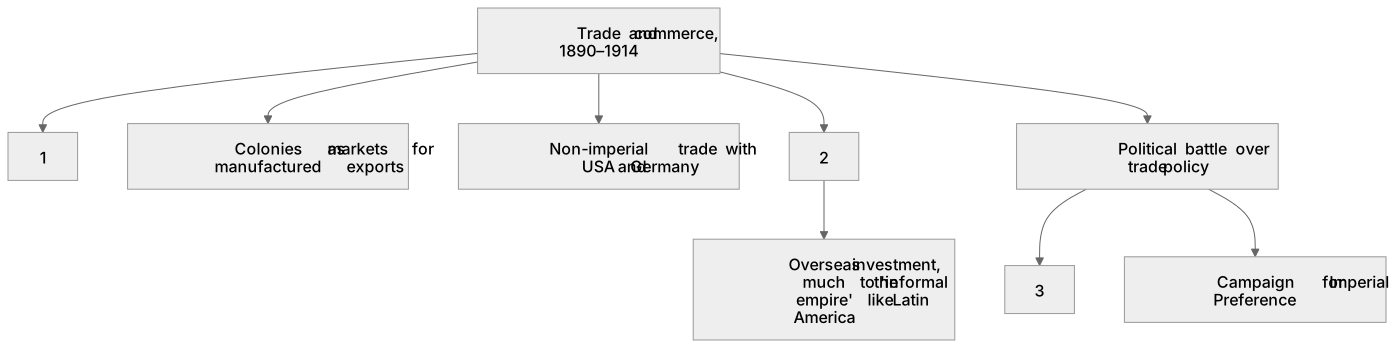
1Box 1
2Box 2
3Box 3
There is more to this lesson
The full lesson goes on to check your understanding and help you earn the marks. Create a free account to carry on, with your progress saved.
A week of Premium from your first lesson · Then the free plan continues · No card, no charge
Test your understanding of 1J The British Empire, c1857–1967 – Imperial consolidation and Liberal rule, c1890–1914: Trade and commerce
Active recall beats re-reading. Take an instant quiz now to test what you’ve learned and lock it into long-term memory.
A week of Premium from your first lesson · Then the free plan continues · No card, no charge