AQA · A-Level · History
Course version: 7042 · Version from Sept 2017
The role and influence on attitudes to empire of: Joseph Chamberlain;…
Full specification wording
1J The British Empire, c1857–1967 – Imperial consolidation and Liberal rule, c1890–1914: The role and influence on attitudes to empire of: Joseph Chamberlain; Cecil Rhodes; colonial administration
Between 1890 and 1914, key figures profoundly shaped domestic attitudes towards the British Empire.
Checked against the AQA 7042 specification (opens in a new tab) on .
- Point 4 of 6
- 3 key terms
Study notes
From the checked teaching notes for this specification point.
The idea
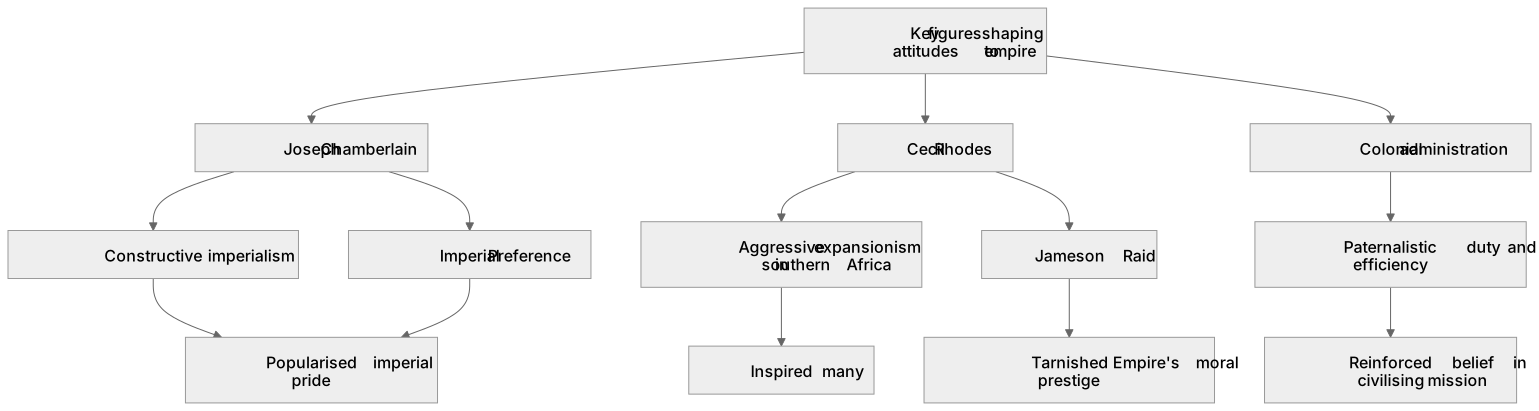
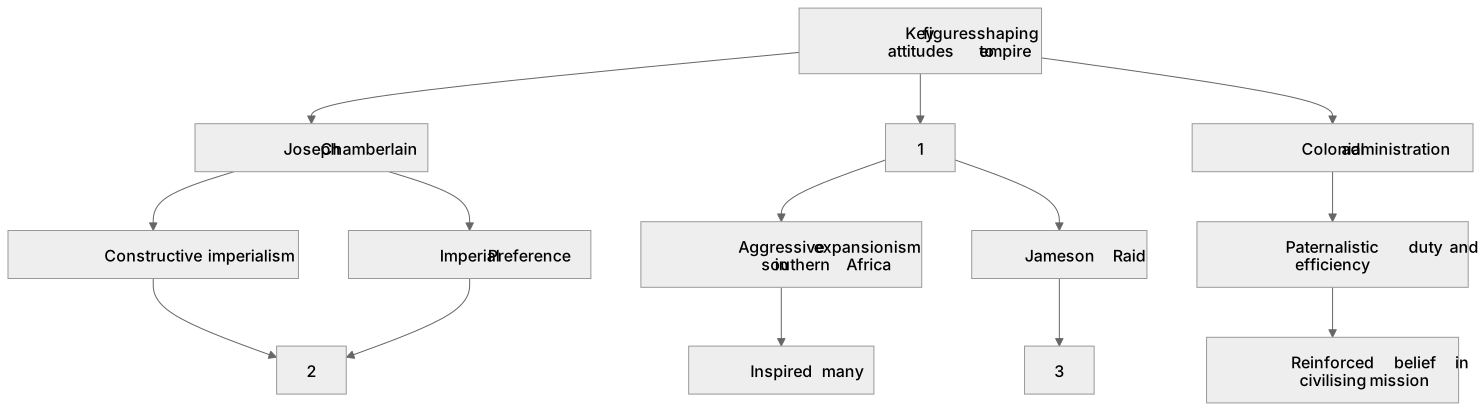
Between 1890 and 1914, key figures profoundly shaped domestic attitudes towards the British Empire. As Colonial Secretary, Joseph Chamberlain championed 'constructive imperialism', attempting to unite the Empire through Imperial Preference, thereby popularising imperial pride among the British public. Cecil Rhodes embodied aggressive expansionism in southern Africa; his imperial vision inspired many, though controversies like the Jameson Raid tarnished the Empire's moral prestige. Meanwhile, colonial administration, led by figures such as Curzon and Milner, projected an image of paternalistic duty and efficiency. This reinforced domestic beliefs in a 'civilising mission' and British administrative superiority.
What earns the marks
- Evaluate Joseph Chamberlain's tenure as Colonial Secretary and his efforts to foster imperial unity through tariff reform and colonial development.
- Analyse Cecil Rhodes' role in driving territorial expansion in Africa and how his actions, including the Jameson Raid, polarised public opinion on imperialism.
- Assess how colonial administrators like Lord Curzon and Alfred Milner influenced British attitudes by promoting the concept of the 'civilising mission' and imperial duty.
- Examine the extent to which these individuals succeeded in generating genuine popular imperialism or 'jingoism' among the British working classes.
Common mistakes and how to put them right
Treating Chamberlain and Rhodes as having identical imperial visions.
Put it right: Chamberlain focused on political and economic consolidation, while Rhodes was primarily driven by territorial expansion and personal wealth.
Assuming colonial administrators were universally admired in Britain.
Put it right: Figures like Milner faced severe domestic criticism for their handling of the Boer War and Chinese labour.
Ignoring the role of colonial administration in shaping attitudes; students often focus only on individuals and neglect how the bureaucratic machinery projected an image of paternalistic order.
Exam tips
- Contrast Chamberlain's official government influence with Rhodes' power as a private capitalist and colonial politician.
- Use the Jameson Raid or the Boer War as key turning points to demonstrate how aggressive imperialism began to face domestic backlash.
- Link the actions of colonial administrators to the broader ideological concept of the 'White Man's Burden' when discussing domestic attitudes.
Try the lesson
The start of the 1J The British Empire, c1857–1967 – Imperial consolidation and Liberal rule, c1890–1914: The role and influence on attitudes to empire of: Joseph Chamberlain; Cecil Rhodes; colonial administration lesson, made from checked teaching notes for this specification point.
Have a go first
Which ambition was central to Cecil Rhodes's vision for the expansion of the British Empire in Africa?
Listen
Between 1890 and 1914, key figures profoundly shaped domestic attitudes towards the British Empire. As Colonial Secretary, Joseph Chamberlain championed 'constructive imperialism', attempting to unite the Empire through Imperial Preference, thereby popularising imperial pride among the British public. Cecil Rhodes embodied aggressive expansionism in southern Africa; his imperial vision inspired many, though controversies like the Jameson Raid tarnished the Empire's moral prestige. Meanwhile, colonial administration, led by figures such as Curzon and Milner, projected an image of paternalistic duty and efficiency. This reinforced domestic beliefs in a 'civilising mission' and British administrative superiority. A strong answer earns marks for these points. Evaluate Joseph Chamberlain's tenure as Colonial Secretary and his efforts to foster imperial unity through tariff reform and colonial development. Analyse Cecil Rhodes' role in driving territorial expansion in Africa and how his actions, including the Jameson Raid, polarised public opinion on imperialism. Assess how colonial administrators like Lord Curzon and Alfred Milner influenced British attitudes by promoting the concept of the 'civilising mission' and imperial duty. Examine the extent to which these individuals succeeded in generating genuine popular imperialism or 'jingoism' among the British working classes. Exam tip: Contrast Chamberlain's official government influence with Rhodes' power as a private capitalist and colonial politician.
See it
Key words
Say what each word means before you turn the card.
Popular imperialism
Try answering aloud or in your head before turning the card.
The civilising mission
Try answering aloud or in your head before turning the card.
Imperial consolidation
Try answering aloud or in your head before turning the card.
See every definition
- Popular imperialism
- Imperial pride among the British public, which Joseph Chamberlain popularised by championing 'constructive imperialism' and attempting to unite the Empire through Imperial Preference.
- The civilising mission
- A belief reinforced by colonial administration, which projected an image of paternalistic duty and efficiency and British administrative superiority.
- Imperial consolidation
- The political and economic unification of the Empire, which Chamberlain pursued through Imperial Preference and colonial development.
Label the diagram
Some boxes have lost their names. Pick the right name for each number.
1Box 1
2Box 2
3Box 3
There is more to this lesson
The full lesson goes on to check your understanding and help you earn the marks. Create a free account to carry on, with your progress saved.
A week of Premium from your first lesson · Then the free plan continues · No card, no charge
Test your understanding of 1J The British Empire, c1857–1967 – Imperial consolidation and Liberal rule, c1890–1914: The role and influence on attitudes to empire of: Joseph Chamberlain; Cecil Rhodes; colonial administration
Active recall beats re-reading. Take an instant quiz now to test what you’ve learned and lock it into long-term memory.
A week of Premium from your first lesson · Then the free plan continues · No card, no charge