AQA · A-Level · History
Course version: 7042 · Version from Sept 2017
The development of trade and commerce; the economic impact of war
Full specification wording
1J The British Empire, c1857–1967 – Imperialism challenged, 1914–1947 (A-level only): The development of trade and commerce; the economic impact of war
Between 1914 and 1947, the British Empire's trade and commerce underwent significant shifts, driven by the economic impact of two World Wars.
Checked against the AQA 7042 specification (opens in a new tab) on .
- Point 3 of 6
- 4 key terms
Study notes
From the checked teaching notes for this specification point.
The idea
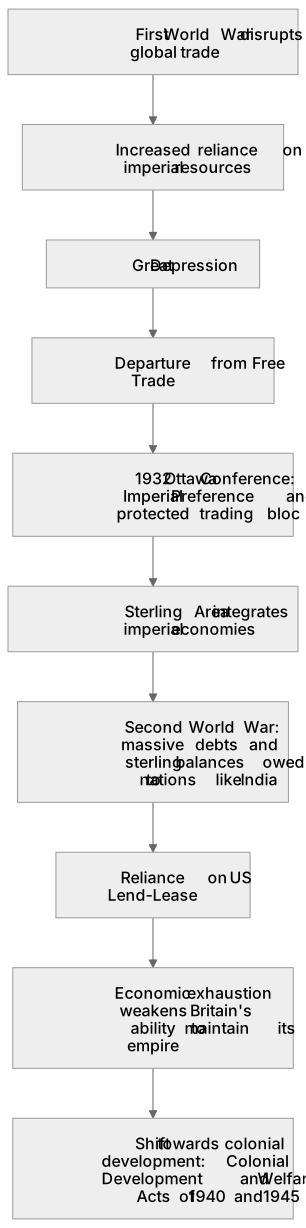
Between 1914 and 1947, the British Empire's trade and commerce underwent significant shifts, driven by the economic impact of two World Wars. The First World War disrupted global trade, increasing reliance on imperial resources. The Great Depression prompted a departure from Free Trade, culminating in the 1932 Ottawa Conference which established 'Imperial Preference' and a protected trading bloc. The Sterling Area further integrated imperial economies. However, the Second World War had a devastating economic impact. Britain accumulated massive debts, notably £3 billion in sterling balances owed to nations like India, and relied heavily on US Lend-Lease. This economic exhaustion weakened Britain's ability to maintain its empire, shifting policy towards colonial development, as seen in the Colonial Development and Welfare Acts of 1940 and 1945.
What earns the marks
- Analyse the development of trade and commerce, focusing on the shift to Imperial Preference at the 1932 Ottawa Conference.
- Evaluate the economic impact of the First World War, including the disruption of traditional markets and increased reliance on imperial trade.
- Assess the financial devastation of the Second World War, noting the accumulation of massive sterling balances and reliance on US loans.
- Explain how economic exhaustion post-1945 influenced imperial policy, such as the implementation of the Colonial Development and Welfare Acts.
Common mistakes and how to put them right
Claiming Britain maintained Free Trade throughout this period.
Put it right: Britain abandoned Free Trade in the 1930s, adopting Imperial Preference at the 1932 Ottawa Conference.
Ignoring the economic impact of the First World War.
Put it right: Acknowledge how WWI disrupted global markets and increased Britain's economic reliance on the Empire.
Assuming the Empire remained a source of immense wealth after 1945.
Put it right: Recognise that by 1945, the Empire was a significant financial burden, with Britain owing massive sterling balances to colonies like India.
Exam tips
- Use specific examples like the 1932 Ottawa Conference to demonstrate the shift towards protectionism and Imperial Preference.
- Link the economic impact of the Second World War directly to the acceleration of decolonisation, citing the burden of sterling balances.
- Contrast the economic strategies of the inter-war years with the post-1945 reality of British near-bankruptcy.
Try the lesson
The start of the 1J The British Empire, c1857–1967 – Imperialism challenged, 1914–1947 (A-level only): The development of trade and commerce; the economic impact of war lesson, made from checked teaching notes for this specification point.
Have a go first
How did the British government significantly alter its imperial trade policy at the Ottawa Conference in 1932?
Listen
Between 1914 and 1947, the British Empire's trade and commerce underwent significant shifts, driven by the economic impact of two World Wars. The First World War disrupted global trade, increasing reliance on imperial resources. The Great Depression prompted a departure from Free Trade, culminating in the 1932 Ottawa Conference which established 'Imperial Preference' and a protected trading bloc. The Sterling Area further integrated imperial economies. However, the Second World War had a devastating economic impact. Britain accumulated massive debts, notably £3 billion in sterling balances owed to nations like India, and relied heavily on US Lend-Lease. This economic exhaustion weakened Britain's ability to maintain its empire, shifting policy towards colonial development, as seen in the Colonial Development and Welfare Acts of 1940 and 1945. A strong answer earns marks for these points. Analyse the development of trade and commerce, focusing on the shift to Imperial Preference at the 1932 Ottawa Conference. Evaluate the economic impact of the First World War, including the disruption of traditional markets and increased reliance on imperial trade. Assess the financial devastation of the Second World War, noting the accumulation of massive sterling balances and reliance on US loans. Explain how economic exhaustion post-1945 influenced imperial policy, such as the implementation of the Colonial Development and Welfare Acts. A common slip: Claiming Britain maintained Free Trade throughout this period. Instead, Britain abandoned Free Trade in the 1930s, adopting Imperial Preference at the 1932 Ottawa Conference. Exam tip: Use specific examples like the 1932 Ottawa Conference to demonstrate the shift towards protectionism and Imperial Preference.
See it
Key words
Say what each word means before you turn the card.
Imperial Preference and protectionism
Try answering aloud or in your head before turning the card.
The Sterling Area
Try answering aloud or in your head before turning the card.
The economic cost of total war
Try answering aloud or in your head before turning the card.
Colonial development and welfare
Try answering aloud or in your head before turning the card.
See every definition
- Imperial Preference and protectionism
- A protected trading bloc established at the 1932 Ottawa Conference, marking a departure from Free Trade.
- The Sterling Area
- A development that further integrated imperial economies.
- The economic cost of total war
- The Second World War had a devastating economic impact, with Britain accumulating massive debts and relying heavily on US Lend-Lease.
- Colonial development and welfare
- A shift in policy towards colonial development, as seen in the Colonial Development and Welfare Acts of 1940 and 1945.
Label the diagram
Some boxes have lost their names. Pick the right name for each number.
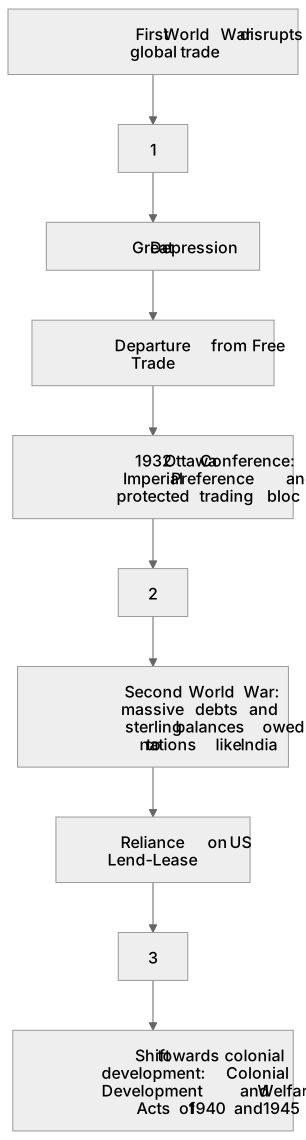
1Box 1
2Box 2
3Box 3
There is more to this lesson
The full lesson goes on to check your understanding and help you earn the marks. Create a free account to carry on, with your progress saved.
A week of Premium from your first lesson · Then the free plan continues · No card, no charge
Test your understanding of 1J The British Empire, c1857–1967 – Imperialism challenged, 1914–1947 (A-level only): The development of trade and commerce; the economic impact of war
Active recall beats re-reading. Take an instant quiz now to test what you’ve learned and lock it into long-term memory.
A week of Premium from your first lesson · Then the free plan continues · No card, no charge