AQA · A-Level · History
Course version: 7042 · Version from Sept 2017
Relations with indigenous peoples; the Indian Mutiny and its impact;…
Full specification wording
1J The British Empire, c1857–1967 – The development of Imperialism, c1857–c1890: Relations with indigenous peoples; the Indian Mutiny and its impact; relations with Boers and Bantu peoples in southern Africa
British relations with indigenous peoples from 1857 to 1890 were defined by exploitation and violent conflict.
Checked against the AQA 7042 specification (opens in a new tab) on .
- Point 6 of 6
Study notes
From the checked teaching notes for this specification point.
The idea
British relations with indigenous peoples from 1857 to 1890 were defined by exploitation and violent conflict. The 1857 Indian Mutiny was a watershed moment, triggered by cultural insensitivity and the annexation of princely states. Its impact was profound: the East India Company was abolished, direct Crown rule was established, and the British adopted a more segregated approach to Indian traditions. In southern Africa, relations with Boers and Bantu peoples were equally turbulent. British attempts to confederate the region led to the 1877 annexation of the Transvaal, sparking the First Boer War and a British defeat at Majuba Hill. Simultaneously, the British engaged in brutal conflicts with Bantu peoples, notably the 1879 Anglo-Zulu War, to dismantle indigenous power structures.
What earns the marks
- Analyse the causes of the Indian Mutiny, including the Doctrine of Lapse and the greased cartridge controversy.
- Evaluate the political and social impact of the Indian Mutiny, specifically the shift from East India Company rule to the British Raj.
- Assess the causes and consequences of the First Boer War, focusing on British attempts at confederation and Boer resistance.
- Examine British policies towards Bantu peoples, including the strategic motivations behind the Anglo-Zulu War of 1879.
Common mistakes and how to put them right
Referring to the Boers as indigenous peoples.
Put it right: Clearly distinguish between the European-descended Boers and the indigenous Bantu peoples (such as the Zulu and Xhosa) when discussing southern Africa.
Assuming the Indian Mutiny was a unified national uprising.
Put it right: Explain that the rebellion was largely confined to the Bengal army and northern and central India, with many regions and princes remaining loyal to the British.
Overlooking the economic motives in southern Africa.
Put it right: Integrate the discovery of diamonds in 1867 as a crucial catalyst for British expansionism and subsequent conflicts with both Boers and Bantu peoples.
Exam tips
- Use the Government of India Act 1858 as specific evidence of the administrative impact of the Indian Mutiny.
- When discussing southern Africa, explicitly link the policy of confederation (promoted by Lord Carnarvon) to the outbreak of both the Anglo-Zulu War and the First Boer War.
- Compare the different methods of British control used in India (collaboration with princes post-Mutiny) versus southern Africa (military subjugation of the Zulu).
Try the lesson
The start of the 1J The British Empire, c1857–1967 – The development of Imperialism, c1857–c1890: Relations with indigenous peoples; the Indian Mutiny and its impact; relations with Boers and Bantu peoples in southern Africa lesson, made from checked teaching notes for this specification point.
Have a go first
Following the suppression of the Indian Mutiny in 1858, what major change was made to the administration of India?
Listen
British relations with indigenous peoples from 1857 to 1890 were defined by exploitation and violent conflict. The 1857 Indian Mutiny was a watershed moment, triggered by cultural insensitivity and the annexation of princely states. Its impact was profound: the East India Company was abolished, direct Crown rule was established, and the British adopted a more segregated approach to Indian traditions. In southern Africa, relations with Boers and Bantu peoples were equally turbulent. British attempts to confederate the region led to the 1877 annexation of the Transvaal, sparking the First Boer War and a British defeat at Majuba Hill. Simultaneously, the British engaged in brutal conflicts with Bantu peoples, notably the 1879 Anglo-Zulu War, to dismantle indigenous power structures. A strong answer earns marks for these points. Analyse the causes of the Indian Mutiny, including the Doctrine of Lapse and the greased cartridge controversy. Evaluate the political and social impact of the Indian Mutiny, specifically the shift from East India Company rule to the British Raj. Assess the causes and consequences of the First Boer War, focusing on British attempts at confederation and Boer resistance. Examine British policies towards Bantu peoples, including the strategic motivations behind the Anglo-Zulu War of 1879. A common slip: Referring to the Boers as indigenous peoples. Instead, clearly distinguish between the European-descended Boers and the indigenous Bantu peoples (such as the Zulu and Xhosa) when discussing southern Africa. Exam tip: Use the Government of India Act 1858 as specific evidence of the administrative impact of the Indian Mutiny.
See it
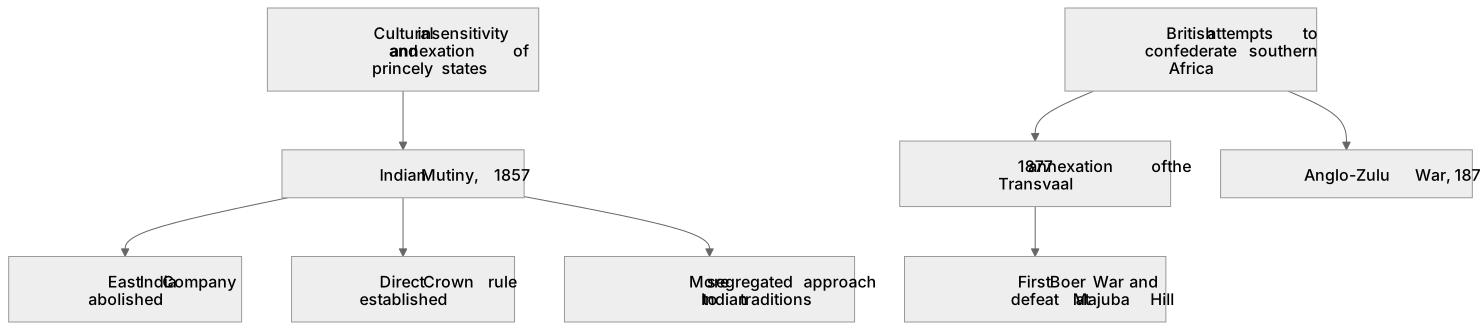
Put the events in order
Put these events in the order they happened, earliest first.
- 1. Anglo-Zulu War to dismantle indigenous power structures
- 2. Indian Mutiny triggered by cultural insensitivity and annexation of princely states
- 3. Annexation of the Transvaal sparking the First Boer War
- 4. Discovery of diamonds acting as catalyst for British expansionism
Label the diagram
Some boxes have lost their names. Pick the right name for each number.
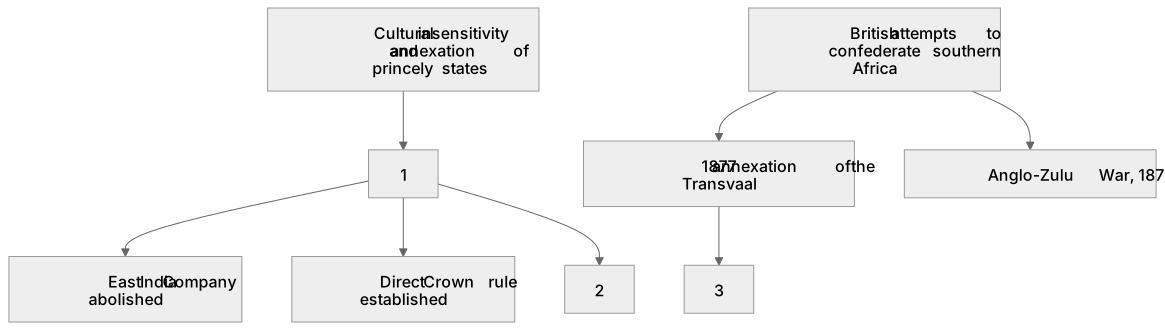
1Box 1
2Box 2
3Box 3
There is more to this lesson
The full lesson goes on to check your understanding and help you earn the marks. Create a free account to carry on, with your progress saved.
A week of Premium from your first lesson · Then the free plan continues · No card, no charge
Test your understanding of 1J The British Empire, c1857–1967 – The development of Imperialism, c1857–c1890: Relations with indigenous peoples; the Indian Mutiny and its impact; relations with Boers and Bantu peoples in southern Africa
Active recall beats re-reading. Take an instant quiz now to test what you’ve learned and lock it into long-term memory.
A week of Premium from your first lesson · Then the free plan continues · No card, no charge