AQA · A-Level · History
Course version: 7042 · Version from Sept 2017
Attitudes towards imperialism in Britain; the development of party…
Full specification wording
1J The British Empire, c1857–1967 – The development of Imperialism, c1857–c1890: Attitudes towards imperialism in Britain; the development of party political conflicts
Between 1857 and 1890, British attitudes towards imperialism shifted from mid-Victorian indifference to a conscious, popular imperialism.
Checked against the AQA 7042 specification (opens in a new tab) on .
- Point 5 of 6
- 4 key terms
Study notes
From the checked teaching notes for this specification point.
The idea
Between 1857 and 1890, British attitudes towards imperialism shifted from mid-Victorian indifference to a conscious, popular imperialism. Initially, empire was viewed primarily through the lens of free trade. However, as international competition grew, imperialism became a defining feature of British identity and party politics. The development of party political conflicts centred on the ideological divide between Benjamin Disraeli’s Conservatives, who championed imperial expansion (such as the 1876 Royal Titles Act), and William Gladstone’s Liberals. Gladstone frequently criticised imperial adventurism on moral and financial grounds, though he was still forced into interventions like the 1882 occupation of Egypt. This cemented the Empire as a major electoral issue.
What earns the marks
- Identify the shift in public attitudes from mid-Victorian 'informal empire' to late-Victorian 'New Imperialism'.
- Analyse Disraeli's use of imperialism to broaden the Conservative Party's electoral appeal, notably through the Crystal Palace speech of 1872.
- Evaluate Gladstone's anti-imperialist rhetoric, such as the Midlothian Campaign, contrasting it with his actual foreign policy decisions.
- Assess the role of the press, literature, and exhibitions in fostering popular imperialism among the British public.
Common mistakes and how to put them right
Assuming Gladstone was entirely anti-empire.
Put it right: Recognise that while Gladstone opposed expansionist 'jingoism', he still authorised significant imperial actions like the occupation of Egypt in 1882.
Treating public opinion as uniformly pro-empire.
Put it right: Acknowledge that working-class attitudes were complex and often more concerned with domestic economic issues than imperial glory.
Overstating the 'indifference' of the mid-Victorian period.
Put it right: Understand that early Victorian imperialism focused on informal economic control and free trade rather than formal territorial acquisition.
Exam tips
- Use Disraeli's 1872 Crystal Palace speech as a key turning point when discussing the alignment of the Conservative Party with imperial expansion.
- Contrast the rhetoric of the Midlothian Campaign with the reality of Liberal foreign policy to demonstrate nuanced understanding of party politics.
- Link domestic political developments, such as the expansion of the franchise, to the growing political need to appeal to popular imperialism.
Try the lesson
The start of the 1J The British Empire, c1857–1967 – The development of Imperialism, c1857–c1890: Attitudes towards imperialism in Britain; the development of party political conflicts lesson, made from checked teaching notes for this specification point.
Have a go first
Which British Prime Minister famously used his 1872 Crystal Palace speech to align the Conservative Party with the expansion and consolidation of the British Empire?
Listen
Between 1857 and 1890, British attitudes towards imperialism shifted from mid-Victorian indifference to a conscious, popular imperialism. Initially, empire was viewed primarily through the lens of free trade. However, as international competition grew, imperialism became a defining feature of British identity and party politics. The development of party political conflicts centred on the ideological divide between Benjamin Disraeli’s Conservatives, who championed imperial expansion (such as the 1876 Royal Titles Act), and William Gladstone’s Liberals. Gladstone frequently criticised imperial adventurism on moral and financial grounds, though he was still forced into interventions like the 1882 occupation of Egypt. This cemented the Empire as a major electoral issue. A strong answer earns marks for these points. Identify the shift in public attitudes from mid-Victorian 'informal empire' to late-Victorian 'New Imperialism'. Analyse Disraeli's use of imperialism to broaden the Conservative Party's electoral appeal, notably through the Crystal Palace speech of 1872. Evaluate Gladstone's anti-imperialist rhetoric, such as the Midlothian Campaign, contrasting it with his actual foreign policy decisions. Assess the role of the press, literature, and exhibitions in fostering popular imperialism among the British public. A common slip: Assuming Gladstone was entirely anti-empire. Instead, recognise that while Gladstone opposed expansionist 'jingoism', he still authorised significant imperial actions like the occupation of Egypt in 1882. Exam tip: Use Disraeli's 1872 Crystal Palace speech as a key turning point when discussing the alignment of the Conservative Party with imperial expansion.
See it
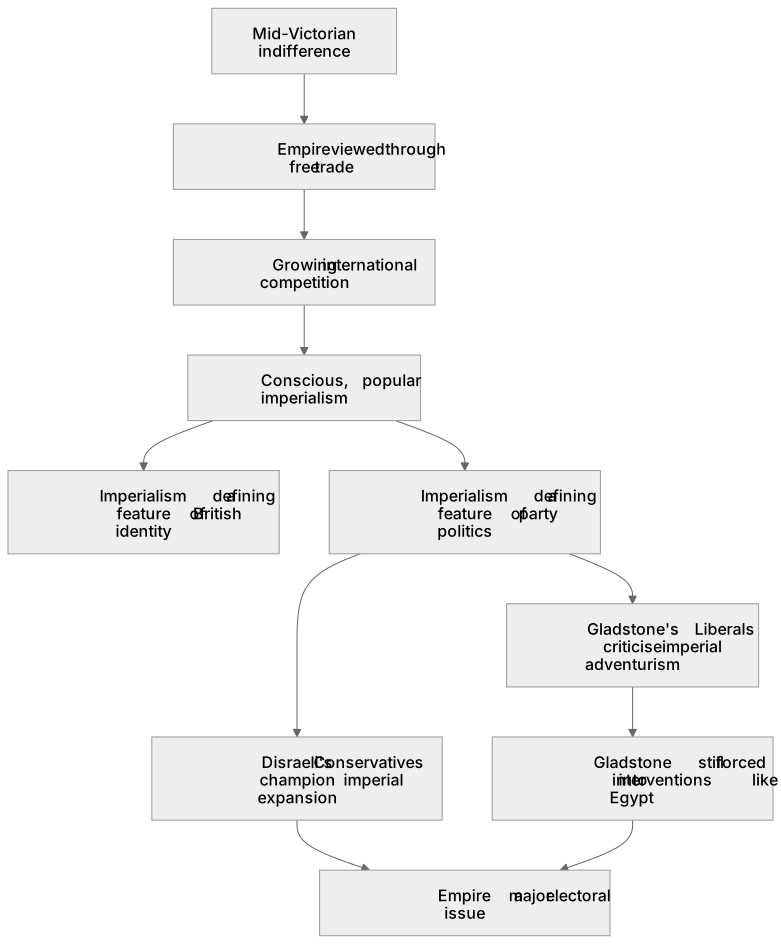
Put the events in order
Put these events in the order they happened, earliest first.
- 1. Disraeli's Crystal Palace speech
- 2. Occupation of Egypt
- 3. Royal Titles Act
Key words
Say what each word means before you turn the card.
Popular imperialism
Try answering aloud or in your head before turning the card.
Party political rivalry
Try answering aloud or in your head before turning the card.
Jingoism
Try answering aloud or in your head before turning the card.
Informal versus formal empire
Try answering aloud or in your head before turning the card.
See every definition
- Popular imperialism
- A conscious form of imperialism that became a defining feature of British identity and party politics as international competition grew.
- Party political rivalry
- Conflicts centred on the ideological divide between Benjamin Disraeli's Conservatives, who championed imperial expansion, and William Gladstone's Liberals.
- Jingoism
- Expansionist imperialism that Gladstone opposed, though he still authorised significant imperial actions like the occupation of Egypt in 1882.
- Informal versus formal empire
- Early Victorian imperialism focused on informal economic control and free trade rather than formal territorial acquisition, before the shift to late-Victorian New Imperialism.
Label the diagram
Some boxes have lost their names. Pick the right name for each number.
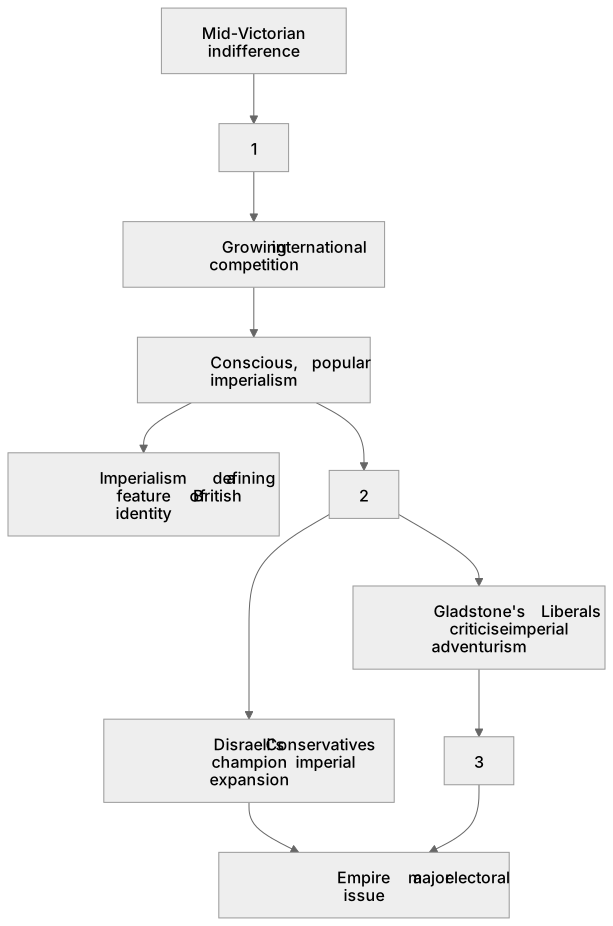
1Box 1
2Box 2
3Box 3
There is more to this lesson
The full lesson goes on to check your understanding and help you earn the marks. Create a free account to carry on, with your progress saved.
A week of Premium from your first lesson · Then the free plan continues · No card, no charge
Test your understanding of 1J The British Empire, c1857–1967 – The development of Imperialism, c1857–c1890: Attitudes towards imperialism in Britain; the development of party political conflicts
Active recall beats re-reading. Take an instant quiz now to test what you’ve learned and lock it into long-term memory.
A week of Premium from your first lesson · Then the free plan continues · No card, no charge