AQA · A-Level · History
Course version: 7042 · Version from Sept 2017
Trade and commerce; the chartered companies
Full specification wording
1J The British Empire, c1857–1967 – The development of Imperialism, c1857–c1890: Trade and commerce; the chartered companies
Trade and commerce were the primary engines of British imperial expansion between 1857 and 1890.
Checked against the AQA 7042 specification (opens in a new tab) on .
- Point 3 of 6
Study notes
From the checked teaching notes for this specification point.
The idea
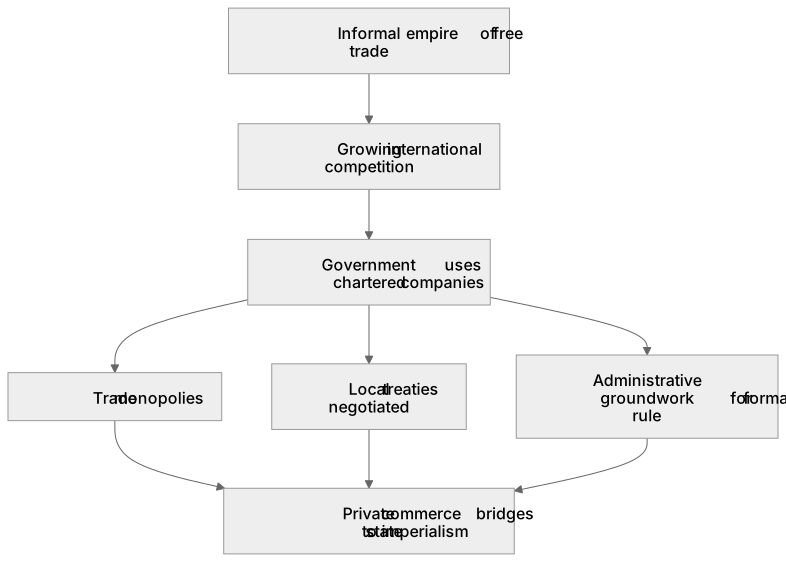
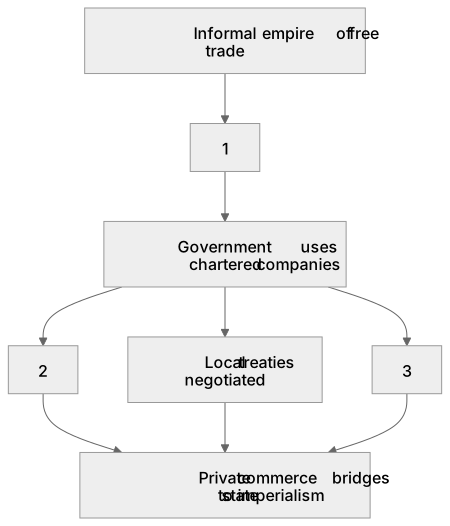
Trade and commerce were the primary engines of British imperial expansion between 1857 and 1890. Britain initially relied on an 'informal empire' of free trade, exporting manufactured goods and importing raw materials. As international competition grew, the government increasingly utilised chartered companies to secure commercial interests without the financial burden of formal colonisation. Examples include George Goldie's Royal Niger Company (1886) and Cecil Rhodes' British South Africa Company (1889). These companies established trade monopolies, negotiated local treaties, and laid the administrative groundwork for future formal British rule, effectively bridging the gap between private commerce and state imperialism across the globe.
What earns the marks
- Explain the shift from informal free trade to the revival of chartered companies in the 1880s as a response to foreign economic competition.
- Identify specific chartered companies, such as the Royal Niger Company, and explain their role in securing territory and resources for Britain.
- Analyse how chartered companies allowed the British government to expand its geopolitical influence on the cheap, avoiding direct administrative costs.
- Evaluate the limitations of chartered companies, including their frequent financial instability, exploitation of indigenous populations, and eventual replacement by formal government administration.
Common mistakes and how to put them right
Confusing the East India Company with the later African chartered companies.
Put it right: The EIC lost its administrative powers in 1858, whereas companies like the Royal Niger Company were chartered in the 1880s.
Assuming chartered companies were fully funded by the British government.
Put it right: They were actually private enterprises funded by private investors, though they held a royal charter granting monopoly rights.
Exam tips
- Use specific examples of chartered companies and their founders, such as Cecil Rhodes or George Goldie, to substantiate arguments about commercial expansion.
- Link the revival of chartered companies to the broader context of the 'Scramble for Africa' and increasing European economic competition during the Long Depression.
- When assessing the causes of expansion, explicitly weigh the importance of trade and commerce against strategic and diplomatic motivations to build a balanced argument.
Try the lesson
The start of the 1J The British Empire, c1857–1967 – The development of Imperialism, c1857–c1890: Trade and commerce; the chartered companies lesson, made from checked teaching notes for this specification point.
Have a go first
Which chartered company received a royal charter in 1889 to administer and develop trade in territory north of the Limpopo River?
Listen
Trade and commerce were the primary engines of British imperial expansion between 1857 and 1890. Britain initially relied on an 'informal empire' of free trade, exporting manufactured goods and importing raw materials. As international competition grew, the government increasingly utilised chartered companies to secure commercial interests without the financial burden of formal colonisation. Examples include George Goldie's Royal Niger Company (1886) and Cecil Rhodes' British South Africa Company (1889). These companies established trade monopolies, negotiated local treaties, and laid the administrative groundwork for future formal British rule, effectively bridging the gap between private commerce and state imperialism across the globe. A strong answer earns marks for these points. Explain the shift from informal free trade to the revival of chartered companies in the 1880s as a response to foreign economic competition. Identify specific chartered companies, such as the Royal Niger Company, and explain their role in securing territory and resources for Britain. Analyse how chartered companies allowed the British government to expand its geopolitical influence on the cheap, avoiding direct administrative costs. Evaluate the limitations of chartered companies, including their frequent financial instability, exploitation of indigenous populations, and eventual replacement by formal government administration. Exam tip: Use specific examples of chartered companies and their founders, such as Cecil Rhodes or George Goldie, to substantiate arguments about commercial expansion.
See it
Put the events in order
Put these events in the order they happened, earliest first.
- 1. East India Company lost its administrative powers
- 2. Cecil Rhodes' British South Africa Company was chartered
- 3. George Goldie's Royal Niger Company was chartered
Label the diagram
Some boxes have lost their names. Pick the right name for each number.
1Box 1
2Box 2
3Box 3
There is more to this lesson
The full lesson goes on to check your understanding and help you earn the marks. Create a free account to carry on, with your progress saved.
A week of Premium from your first lesson · Then the free plan continues · No card, no charge
Test your understanding of 1J The British Empire, c1857–1967 – The development of Imperialism, c1857–c1890: Trade and commerce; the chartered companies
Active recall beats re-reading. Take an instant quiz now to test what you’ve learned and lock it into long-term memory.
A week of Premium from your first lesson · Then the free plan continues · No card, no charge