AQA · A-Level · History
Course version: 7042 · Version from Sept 2017
The role and influence on attitudes to empire of explorers, missionaries,…
Full specification wording
1J The British Empire, c1857–1967 – The development of Imperialism, c1857–c1890: The role and influence on attitudes to empire of explorers, missionaries, traders, colonial administrators
Between 1857 and 1890, key individuals profoundly shaped British attitudes towards the empire.
Checked against the AQA 7042 specification (opens in a new tab) on .
- Point 4 of 6
- 2 key terms
Study notes
From the checked teaching notes for this specification point.
The idea
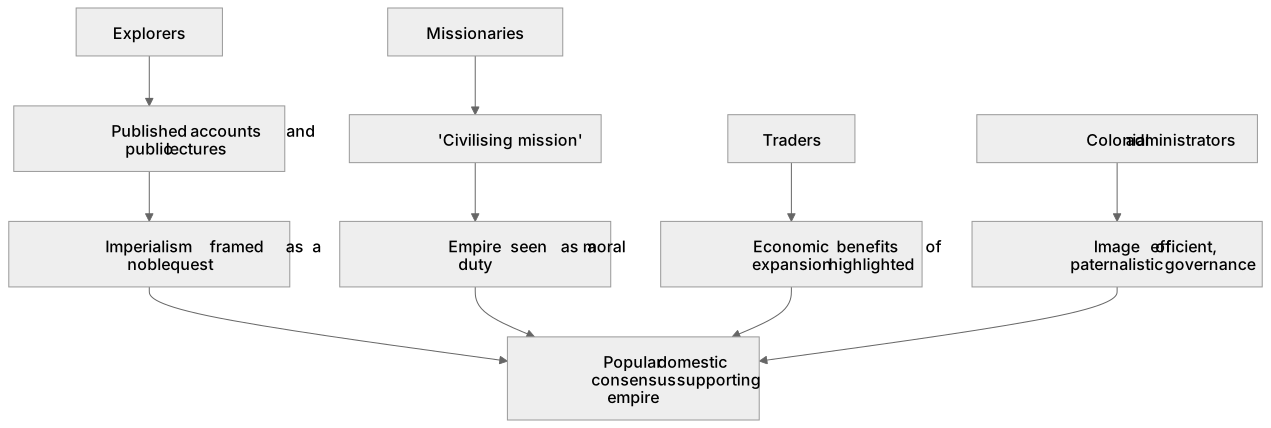
Between 1857 and 1890, key individuals profoundly shaped British attitudes towards the empire. Explorers like David Livingstone captured the public imagination through published accounts, framing imperialism as a noble quest. Missionaries promoted the 'civilising mission', influencing Britons to view empire as a moral duty to spread Christianity and end slavery. Traders, including Cecil Rhodes, highlighted the economic benefits of expansion. Meanwhile, colonial administrators like Evelyn Baring projected an image of efficient, paternalistic governance. Together, these groups fostered a popular domestic consensus that the British Empire was a necessary force for global progress, morality, and economic development.
What earns the marks
- Assess how explorers' publications and public lectures stimulated domestic fascination and support for imperial expansion.
- Evaluate the role of missionaries in promoting the concept of a 'civilising mission' and framing the empire as a moral and religious imperative.
- Analyse how traders and commercial figures influenced government policy and public opinion by emphasising economic opportunities and national prosperity.
- Examine the impact of colonial administrators in establishing a narrative of British racial and administrative superiority, fostering a sense of paternalistic duty.
Common mistakes and how to put them right
Treating these groups as entirely separate entities.
Put it right: In reality, their roles often overlapped, such as David Livingstone acting as both an explorer and a missionary.
Assuming the British public was universally enthusiastic about the empire.
Put it right: While these figures boosted support, there was still domestic apathy and anti-imperial sentiment that must be acknowledged.
Focusing solely on the actions of these figures abroad rather than explicitly linking them to their influence on domestic attitudes in Britain, which is the core requirement of the specification.
Exam tips
- Always link the actions of specific individuals, such as Livingstone, Rhodes, or Baring, back to how they shaped public or political attitudes within Britain.
- Consider how the popular press, literature, and public exhibitions amplified the influence of explorers and missionaries on the Victorian public.
- Compare the relative influence of different groups; for example, debate whether moral arguments presented by missionaries or economic arguments presented by traders were more persuasive to the public.
Try the lesson
The start of the 1J The British Empire, c1857–1967 – The development of Imperialism, c1857–c1890: The role and influence on attitudes to empire of explorers, missionaries, traders, colonial administrators lesson, made from checked teaching notes for this specification point.
Have a go first
Which famous missionary and explorer significantly influenced Victorian attitudes towards the Empire by promoting the 'Three Cs' (Commerce, Christianity, and Civilisation) in Africa?
Listen
Between 1857 and 1890, key individuals profoundly shaped British attitudes towards the empire. Explorers like David Livingstone captured the public imagination through published accounts, framing imperialism as a noble quest. Missionaries promoted the 'civilising mission', influencing Britons to view empire as a moral duty to spread Christianity and end slavery. Traders, including Cecil Rhodes, highlighted the economic benefits of expansion. Meanwhile, colonial administrators like Evelyn Baring projected an image of efficient, paternalistic governance. Together, these groups fostered a popular domestic consensus that the British Empire was a necessary force for global progress, morality, and economic development. A strong answer earns marks for these points. Assess how explorers' publications and public lectures stimulated domestic fascination and support for imperial expansion. Evaluate the role of missionaries in promoting the concept of a 'civilising mission' and framing the empire as a moral and religious imperative. Analyse how traders and commercial figures influenced government policy and public opinion by emphasising economic opportunities and national prosperity. Examine the impact of colonial administrators in establishing a narrative of British racial and administrative superiority, fostering a sense of paternalistic duty. Exam tip: Always link the actions of specific individuals, such as Livingstone, Rhodes, or Baring, back to how they shaped public or political attitudes within Britain.
See it
Key words
Say what each word means before you turn the card.
The Civilising Mission
Try answering aloud or in your head before turning the card.
Paternalism
Try answering aloud or in your head before turning the card.
See every definition
- The Civilising Mission
- The concept promoted by missionaries that framed the empire as a moral and religious imperative to spread Christianity and end slavery.
- Paternalism
- An image of efficient governance projected by colonial administrators, establishing a narrative of British racial and administrative superiority and a paternalistic duty.
Label the diagram
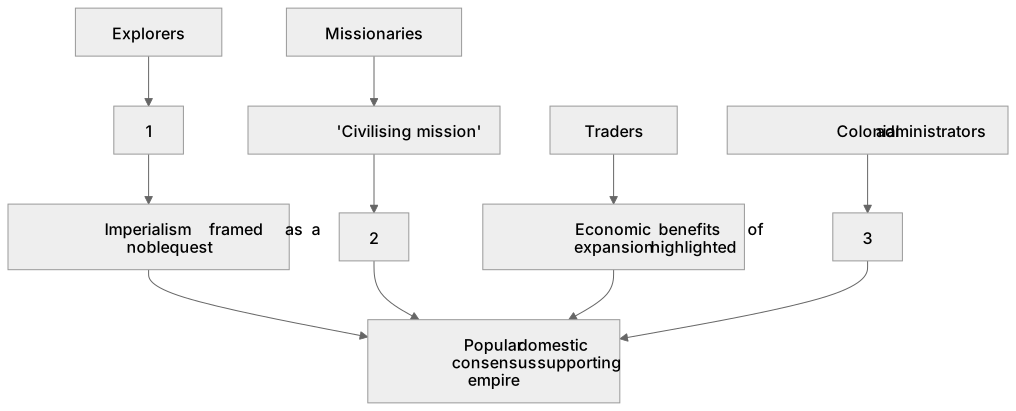
Some boxes have lost their names. Pick the right name for each number.
1Box 1
2Box 2
3Box 3
There is more to this lesson
The full lesson goes on to check your understanding and help you earn the marks. Create a free account to carry on, with your progress saved.
A week of Premium from your first lesson · Then the free plan continues · No card, no charge
Test your understanding of 1J The British Empire, c1857–1967 – The development of Imperialism, c1857–c1890: The role and influence on attitudes to empire of explorers, missionaries, traders, colonial administrators
Active recall beats re-reading. Take an instant quiz now to test what you’ve learned and lock it into long-term memory.
A week of Premium from your first lesson · Then the free plan continues · No card, no charge