AQA · A-Level · History
Course version: 7042 · Version from Sept 2017
Relations with indigenous peoples; challenges to colonial rule in Africa…
Full specification wording
1J The British Empire, c1857–1967 – The winds of change, 1947–1967 (A-level only): Relations with indigenous peoples; challenges to colonial rule in Africa and Asia; Mau Mau; the growth of nationalist movements and reactions to them; Rhodesia
Between 1947 and 1967, British relations with indigenous peoples deteriorated as challenges to colonial rule intensified across Africa and Asia.
Checked against the AQA 7042 specification (opens in a new tab) on .
- Point 6 of 6
- 4 key terms
Study notes
From the checked teaching notes for this specification point.
The idea
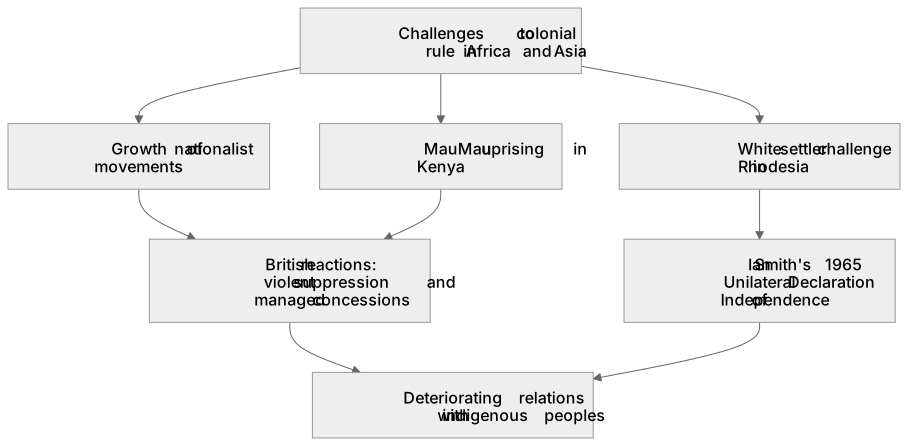
Between 1947 and 1967, British relations with indigenous peoples deteriorated as challenges to colonial rule intensified across Africa and Asia. The growth of nationalist movements, such as the Convention People's Party in the Gold Coast, forced Britain to react with a mix of violent suppression and managed concessions. The Mau Mau uprising in Kenya exemplifies this, where Britain's brutal military response and detention camps highlighted the violent reality of maintaining control. In Rhodesia, the challenge uniquely came from the white settler minority, culminating in Ian Smith's 1965 Unilateral Declaration of Independence, demonstrating Britain's inability to dictate terms and protect indigenous majority rights against settler nationalism.
What earns the marks
- Analyse the diverse nature of challenges to colonial rule in both Africa (e.g., Kenya, Gold Coast) and Asia (e.g., Malaya).
- Evaluate the severity and consequences of the Mau Mau uprising, including the British administration's use of detention camps and military force.
- Assess the growth of indigenous nationalist movements and the varying British reactions, ranging from violent suppression to negotiated independence.
- Examine the unique political situation in Rhodesia, focusing on the white settler population's resistance to majority rule and the 1965 UDI.
- Compare British relations with indigenous populations in colonies with significant white settler minorities versus those without.
Common mistakes and how to put them right
Treating all nationalist movements as identical.
Put it right: Distinguish between different types of challenges, such as communist insurgencies in Asia and anti-settler uprisings in Africa.
Assuming Britain always willingly granted independence.
Put it right: Highlight the violent reactions to nationalist movements, particularly the brutal suppression of the Mau Mau in Kenya.
Confusing the Rhodesian situation with indigenous nationalism.
Put it right: Clarify that the primary challenge in Rhodesia during this period was white settler nationalism resisting indigenous majority rule.
Exam tips
- Contrast the British government's handling of the Mau Mau uprising with its approach to nationalist movements in West Africa to demonstrate nuanced understanding.
- Use the Unilateral Declaration of Independence (UDI) in Rhodesia as a key example of the limitations of British imperial power in the 1960s.
- When discussing relations with indigenous peoples, explicitly mention the impact of white settler populations on British policy decisions.
Try the lesson
The start of the 1J The British Empire, c1857–1967 – The winds of change, 1947–1967 (A-level only): Relations with indigenous peoples; challenges to colonial rule in Africa and Asia; Mau Mau; the growth of nationalist movements and reactions to them; Rhodesia lesson, made from checked teaching notes for this specification point.
Have a go first
In which British colony did the Mau Mau uprising take place during the 1950s as a challenge to colonial rule and white settler dominance?
Listen
Between 1947 and 1967, British relations with indigenous peoples deteriorated as challenges to colonial rule intensified across Africa and Asia. The growth of nationalist movements, such as the Convention People's Party in the Gold Coast, forced Britain to react with a mix of violent suppression and managed concessions. The Mau Mau uprising in Kenya exemplifies this, where Britain's brutal military response and detention camps highlighted the violent reality of maintaining control. In Rhodesia, the challenge uniquely came from the white settler minority, culminating in Ian Smith's 1965 Unilateral Declaration of Independence, demonstrating Britain's inability to dictate terms and protect indigenous majority rights against settler nationalism. A strong answer earns marks for these points. Analyse the diverse nature of challenges to colonial rule in both Africa (e.g., Kenya, Gold Coast) and Asia (e.g., Malaya). Evaluate the severity and consequences of the Mau Mau uprising, including the British administration's use of detention camps and military force. Assess the growth of indigenous nationalist movements and the varying British reactions, ranging from violent suppression to negotiated independence. Examine the unique political situation in Rhodesia, focusing on the white settler population's resistance to majority rule and the 1965 UDI. A common slip: Treating all nationalist movements as identical. Instead, distinguish between different types of challenges, such as communist insurgencies in Asia and anti-settler uprisings in Africa. Exam tip: Contrast the British government's handling of the Mau Mau uprising with its approach to nationalist movements in West Africa to demonstrate nuanced understanding.
See it
Key words
Say what each word means before you turn the card.
Nationalism and independence
Try answering aloud or in your head before turning the card.
Colonial violence and counter-insurgency
Try answering aloud or in your head before turning the card.
Settler colonialism
Try answering aloud or in your head before turning the card.
The limits of imperial power
Try answering aloud or in your head before turning the card.
See every definition
- Nationalism and independence
- The growth of nationalist movements forced Britain to react with a mix of violent suppression and managed concessions, ranging from violent suppression to negotiated independence.
- Colonial violence and counter-insurgency
- Britain's brutal military response and detention camps in the Mau Mau uprising highlighted the violent reality of maintaining control.
- Settler colonialism
- In Rhodesia the challenge uniquely came from the white settler minority, whose resistance to majority rule culminated in the 1965 Unilateral Declaration of Independence.
- The limits of imperial power
- Britain's inability to dictate terms and protect indigenous majority rights against settler nationalism demonstrated the limitations of British imperial power in the 1960s.
Label the diagram
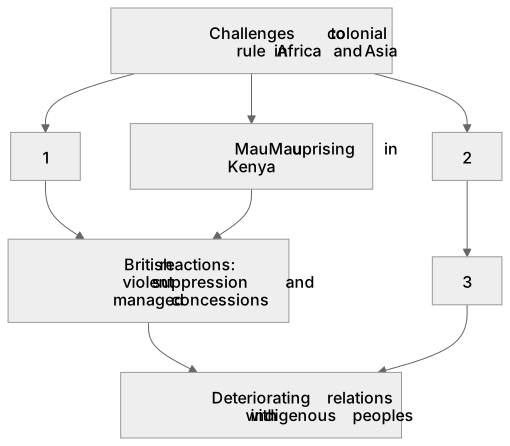
Some boxes have lost their names. Pick the right name for each number.
1Box 1
2Box 2
3Box 3
There is more to this lesson
The full lesson goes on to check your understanding and help you earn the marks. Create a free account to carry on, with your progress saved.
A week of Premium from your first lesson · Then the free plan continues · No card, no charge
Test your understanding of 1J The British Empire, c1857–1967 – The winds of change, 1947–1967 (A-level only): Relations with indigenous peoples; challenges to colonial rule in Africa and Asia; Mau Mau; the growth of nationalist movements and reactions to them; Rhodesia
Active recall beats re-reading. Take an instant quiz now to test what you’ve learned and lock it into long-term memory.
A week of Premium from your first lesson · Then the free plan continues · No card, no charge