AQA · A-Level · History
Course version: 7042 · Version from Sept 2017
Post-colonial political, economic and cultural ties; migration; the…
Full specification wording
1J The British Empire, c1857–1967 – The winds of change, 1947–1967 (A-level only): Post-colonial political, economic and cultural ties; migration; the residual impact of empire; popular culture
After decolonisation, Britain maintained post-colonial political and economic ties through the Commonwealth.
Checked against the AQA 7042 specification (opens in a new tab) on .
- Point 5 of 6
- 4 key terms
Study notes
From the checked teaching notes for this specification point.
The idea
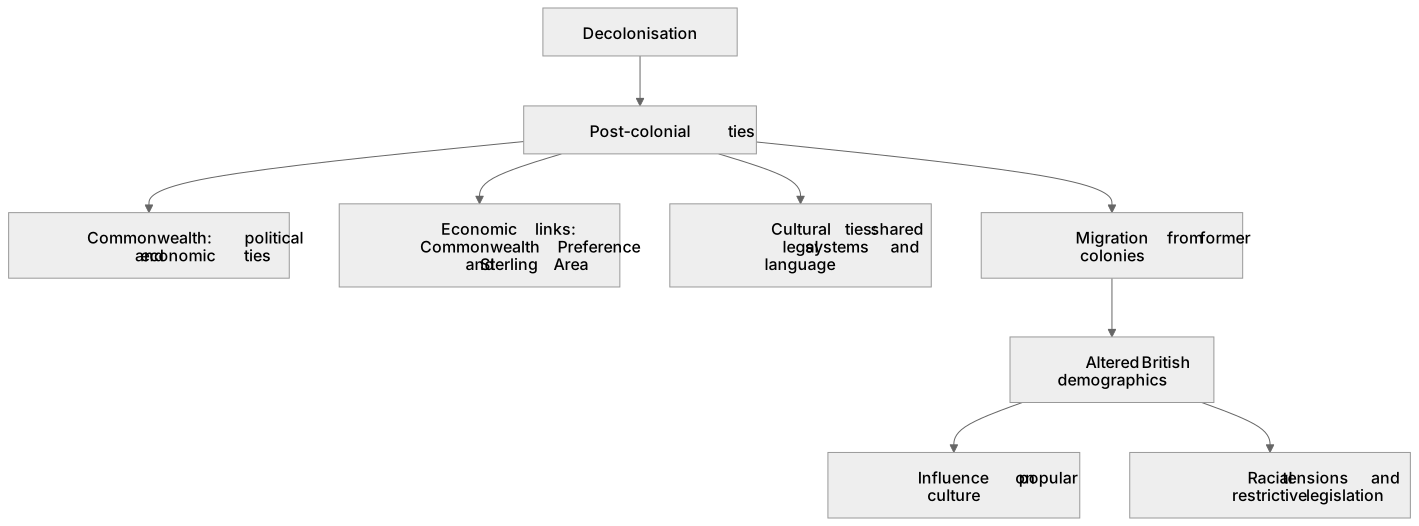
After decolonisation, Britain maintained post-colonial political and economic ties through the Commonwealth. Economic links persisted via Commonwealth Preference in trade and the Sterling Area, a currency arrangement pooling dollar reserves. Cultural ties endured through shared legal systems and language. Migration from former colonies, notably the Windrush generation and South Asian arrivals, altered British demographics, highlighting the residual impact of empire on the metropole. This shift heavily influenced popular culture, introducing music genres like ska and diverse culinary traditions, while also sparking racial tensions and restrictive legislation like the 1962 Commonwealth Immigrants Act.
What earns the marks
- Evaluate the effectiveness of the Commonwealth in maintaining British political and economic influence post-independence.
- Analyse the economic reliance of newly independent nations on British markets and the Sterling Area currency arrangements.
- Assess the social and demographic impact of Commonwealth migration to Britain, including the contributions and challenges faced by the Windrush generation.
- Examine how the residual impact of empire manifested in British popular culture, such as the integration of Caribbean music and South Asian cuisine.
- Discuss the political reactions to migration, including the shift from open borders to the restrictive 1962 Commonwealth Immigrants Act.
Common mistakes and how to put them right
Assuming decolonisation severed all ties.
Put it right: Emphasise the transition to the Commonwealth which preserved significant political, economic, and cultural links.
Confusing the Sterling Area with a trade agreement.
Put it right: Identify the Sterling Area as a currency and dollar-pooling arrangement, distinct from Commonwealth Preference trade tariffs.
Treating post-war migration as a universally welcomed process.
Put it right: Acknowledge both the economic necessity of migrant labour and the severe racial discrimination and legislative pushback they faced.
Viewing popular culture as unaffected by empire.
Put it right: Explicitly link the evolution of British music, food, and media in the 1950s and 1960s to the influx of Commonwealth migrants.
Exam tips
- Use specific examples of cultural integration, such as the Notting Hill Carnival or the popularity of ska music, to illustrate the residual impact of empire on popular culture.
- When discussing economic ties, distinguish clearly between trade systems like Commonwealth Preference and currency systems like the Sterling Area.
- Contrast the political rhetoric of a united Commonwealth with the domestic reality of racial tensions and immigration controls in 1960s Britain.
Try the lesson
The start of the 1J The British Empire, c1857–1967 – The winds of change, 1947–1967 (A-level only): Post-colonial political, economic and cultural ties; migration; the residual impact of empire; popular culture lesson, made from checked teaching notes for this specification point.
Have a go first
Which international organisation was primarily developed to maintain political and cultural ties between Britain and its former colonies after they gained independence?
Listen
After decolonisation, Britain maintained post-colonial political and economic ties through the Commonwealth. Economic links persisted via Commonwealth Preference in trade and the Sterling Area, a currency arrangement pooling dollar reserves. Cultural ties endured through shared legal systems and language. Migration from former colonies, notably the Windrush generation and South Asian arrivals, altered British demographics, highlighting the residual impact of empire on the metropole. This shift heavily influenced popular culture, introducing music genres like ska and diverse culinary traditions, while also sparking racial tensions and restrictive legislation like the 1962 Commonwealth Immigrants Act. A strong answer earns marks for these points. Evaluate the effectiveness of the Commonwealth in maintaining British political and economic influence post-independence. Analyse the economic reliance of newly independent nations on British markets and the Sterling Area currency arrangements. Assess the social and demographic impact of Commonwealth migration to Britain, including the contributions and challenges faced by the Windrush generation. Examine how the residual impact of empire manifested in British popular culture, such as the integration of Caribbean music and South Asian cuisine. A common slip: Assuming decolonisation severed all ties. Instead, emphasise the transition to the Commonwealth which preserved significant political, economic, and cultural links. Exam tip: Use specific examples of cultural integration, such as the Notting Hill Carnival or the popularity of ska music, to illustrate the residual impact of empire on popular culture.
See it
Key words
Say what each word means before you turn the card.
Commonwealth
Try answering aloud or in your head before turning the card.
Sterling Area
Try answering aloud or in your head before turning the card.
Commonwealth Preference
Try answering aloud or in your head before turning the card.
Windrush generation
Try answering aloud or in your head before turning the card.
See every definition
- Commonwealth
- The framework through which Britain maintained post-colonial political and economic ties after decolonisation.
- Sterling Area
- A currency arrangement pooling dollar reserves, through which economic links persisted.
- Commonwealth Preference
- A trade system through which economic links persisted after decolonisation.
- Windrush generation
- Migrants from former colonies whose arrival, alongside South Asian arrivals, altered British demographics.
Label the diagram
Some boxes have lost their names. Pick the right name for each number.
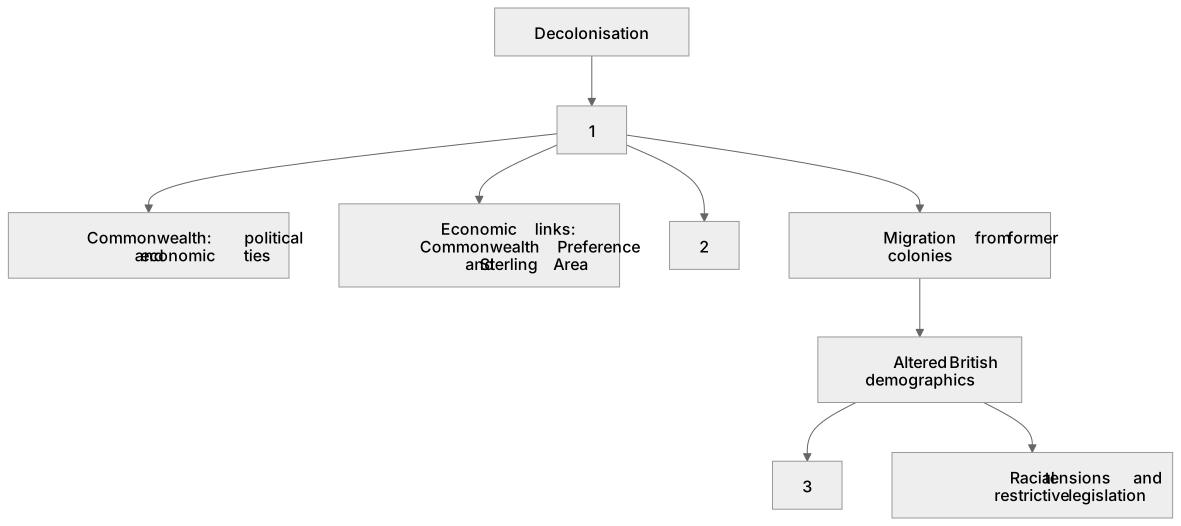
1Box 1
2Box 2
3Box 3
There is more to this lesson
The full lesson goes on to check your understanding and help you earn the marks. Create a free account to carry on, with your progress saved.
A week of Premium from your first lesson · Then the free plan continues · No card, no charge
Test your understanding of 1J The British Empire, c1857–1967 – The winds of change, 1947–1967 (A-level only): Post-colonial political, economic and cultural ties; migration; the residual impact of empire; popular culture
Active recall beats re-reading. Take an instant quiz now to test what you’ve learned and lock it into long-term memory.
A week of Premium from your first lesson · Then the free plan continues · No card, no charge