AQA · A-Level · History
Course version: 7042 · Version from Sept 2017
Trade and commerce; post-war reconstruction
Full specification wording
1J The British Empire, c1857–1967 – The winds of change, 1947–1967 (A-level only): Trade and commerce; post-war reconstruction
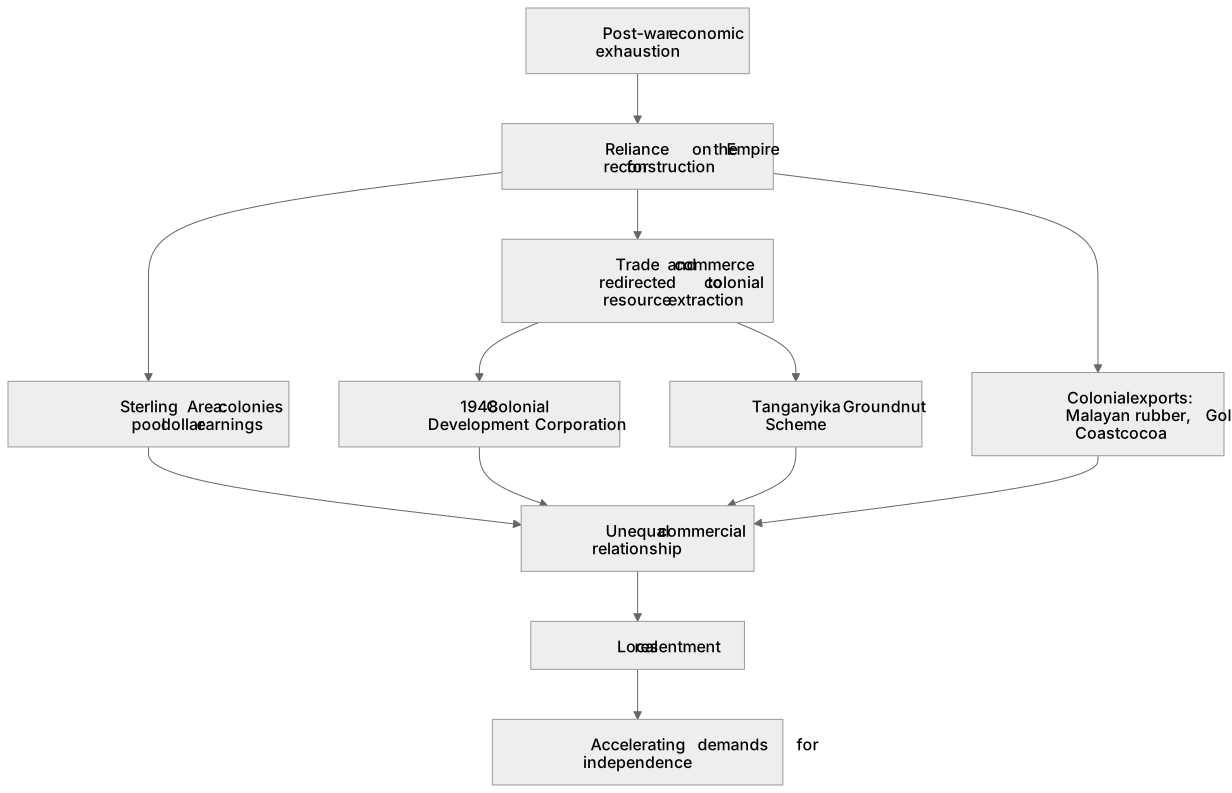
After the Second World War, Britain faced severe economic exhaustion and relied heavily on the Empire for post-war reconstruction.
Checked against the AQA 7042 specification (opens in a new tab) on .
- Point 3 of 6
- 4 key terms
Study notes
From the checked teaching notes for this specification point.
The idea
After the Second World War, Britain faced severe economic exhaustion and relied heavily on the Empire for post-war reconstruction. To rebuild its shattered economy and manage massive dollar shortages, Britain exploited the Sterling Area, ensuring colonies pooled their dollar earnings. Trade and commerce were redirected to maximise colonial resource extraction, exemplified by the 1948 Colonial Development Corporation and the infamous Tanganyika Groundnut Scheme, which aimed to supply Britain with cheap oils. While colonial exports like Malayan rubber and Gold Coast cocoa were vital for British recovery, this unequal commercial relationship often fuelled local resentment, accelerating demands for independence as colonies realised their economic subordination.
What earns the marks
- Explain the function of the Sterling Area in pooling colonial dollar earnings to support the British pound during post-war reconstruction.
- Analyse the impact of the Colonial Development and Welfare Acts and the Colonial Development Corporation on colonial economies.
- Evaluate specific commercial projects, such as the Tanganyika Groundnut Scheme, as examples of Britain prioritising its own economic recovery over genuine colonial development.
- Assess how the reliance on colonial exports, such as Malayan rubber and African cash crops, shaped British trade policies and influenced the pace of decolonisation.
Common mistakes and how to put them right
Assuming post-war colonial development schemes were purely altruistic.
Put it right: They were primarily designed to aid British post-war reconstruction and save dollar reserves.
Confusing the economic situation of the 1950s with the 1930s.
Put it right: Post-war trade was heavily defined by the dollar crisis and the need to rebuild a war-torn domestic economy.
Ignoring the agency of colonial producers; failing to recognise that local dissatisfaction with unequal trade terms directly contributed to nationalist movements.
Exam tips
- Use the Tanganyika Groundnut Scheme as a concrete example of a failed post-war commercial project driven by British domestic needs.
- Link economic policies directly to political outcomes, demonstrating how the extraction of colonial wealth for British reconstruction accelerated decolonisation.
- When evaluating trade, explicitly mention the dollar gap and how the Sterling Area functioned to protect British reserves.
Try the lesson
The start of the 1J The British Empire, c1857–1967 – The winds of change, 1947–1967 (A-level only): Trade and commerce; post-war reconstruction lesson, made from checked teaching notes for this specification point.
Have a go first
What was the primary economic role of the British Empire in relation to Britain's post-war reconstruction immediately after 1945?
Listen
After the Second World War, Britain faced severe economic exhaustion and relied heavily on the Empire for post-war reconstruction. To rebuild its shattered economy and manage massive dollar shortages, Britain exploited the Sterling Area, ensuring colonies pooled their dollar earnings. Trade and commerce were redirected to maximise colonial resource extraction, exemplified by the 1948 Colonial Development Corporation and the infamous Tanganyika Groundnut Scheme, which aimed to supply Britain with cheap oils. While colonial exports like Malayan rubber and Gold Coast cocoa were vital for British recovery, this unequal commercial relationship often fuelled local resentment, accelerating demands for independence as colonies realised their economic subordination. A strong answer earns marks for these points. Explain the function of the Sterling Area in pooling colonial dollar earnings to support the British pound during post-war reconstruction. Analyse the impact of the Colonial Development and Welfare Acts and the Colonial Development Corporation on colonial economies. Evaluate specific commercial projects, such as the Tanganyika Groundnut Scheme, as examples of Britain prioritising its own economic recovery over genuine colonial development. Assess how the reliance on colonial exports, such as Malayan rubber and African cash crops, shaped British trade policies and influenced the pace of decolonisation. Exam tip: Use the Tanganyika Groundnut Scheme as a concrete example of a failed post-war commercial project driven by British domestic needs.
See it
Key words
Say what each word means before you turn the card.
Sterling Area
Try answering aloud or in your head before turning the card.
Post-war reconstruction
Try answering aloud or in your head before turning the card.
Tanganyika Groundnut Scheme
Try answering aloud or in your head before turning the card.
Decolonisation
Try answering aloud or in your head before turning the card.
See every definition
- Sterling Area
- Arrangement through which Britain ensured colonies pooled their dollar earnings to support the British pound during post-war reconstruction.
- Post-war reconstruction
- Rebuilding of Britain's shattered economy after the Second World War, for which Britain relied heavily on the Empire.
- Tanganyika Groundnut Scheme
- Infamous commercial project that aimed to supply Britain with cheap oils, exemplifying the redirection of trade to maximise colonial resource extraction.
- Decolonisation
- Movement towards independence, accelerated as colonies realised their economic subordination and resented an unequal commercial relationship.
Label the diagram
Some boxes have lost their names. Pick the right name for each number.
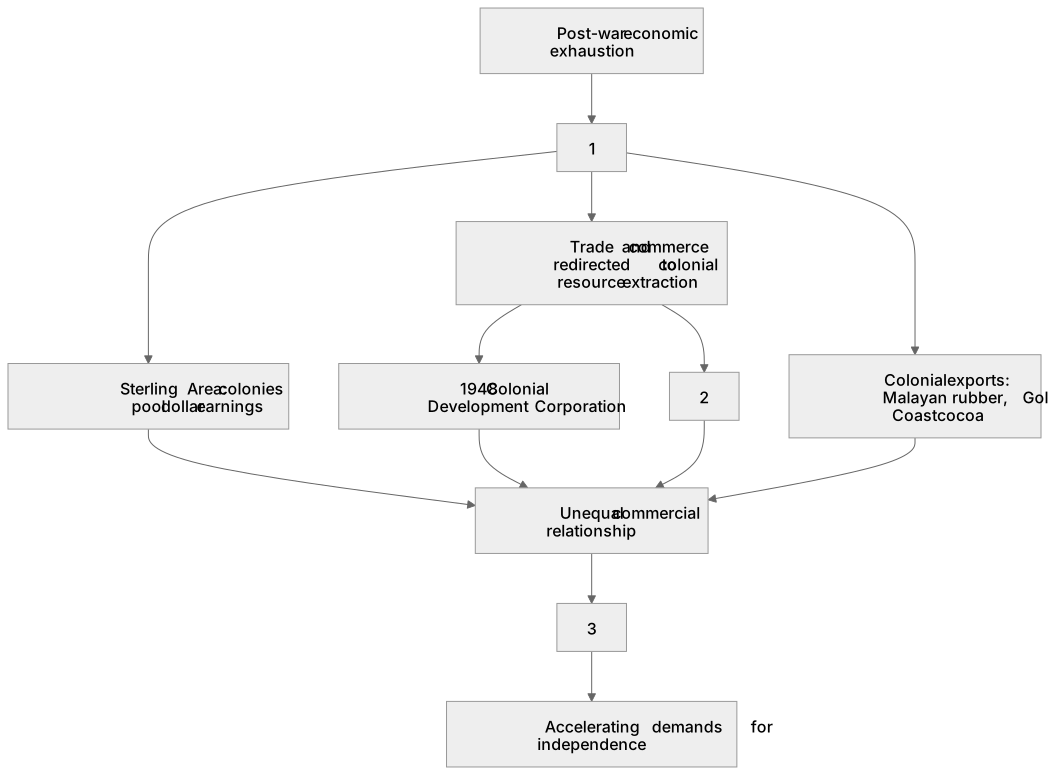
1Box 1
2Box 2
3Box 3
There is more to this lesson
The full lesson goes on to check your understanding and help you earn the marks. Create a free account to carry on, with your progress saved.
A week of Premium from your first lesson · Then the free plan continues · No card, no charge
Test your understanding of 1J The British Empire, c1857–1967 – The winds of change, 1947–1967 (A-level only): Trade and commerce; post-war reconstruction
Active recall beats re-reading. Take an instant quiz now to test what you’ve learned and lock it into long-term memory.
A week of Premium from your first lesson · Then the free plan continues · No card, no charge